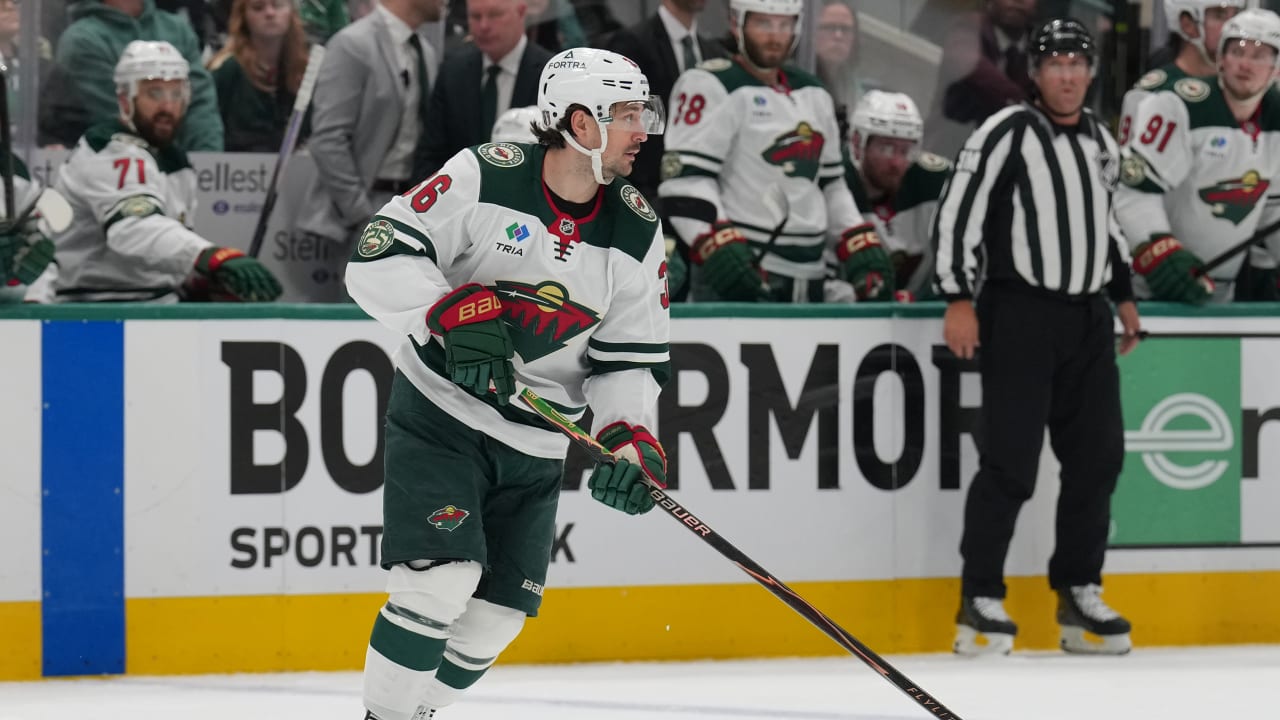
The Minnesota Wild enter Game 5 of their first-round series against the Dallas Stars with a significant recalibration of their operational assets. The return of Mats Zuccarello and Yakov Trenin represents a restoration of the team’s tactical infrastructure at a critical juncture with the series deadlocked at 2-2. This development shifts the competitive equilibrium, providing Head Coach John Hynes with the specific personnel required to address systemic inefficiencies that surfaced during the middle stages of the series.
Power Play Optimization and Structural Dependency
The absence of Mats Zuccarello created a quantifiable vacuum in the Wild’s special teams performance. In Game 1, with Zuccarello active, the Wild converted at a 50% rate, capitalizing on two of four opportunities to secure a 6-1 victory. His role as a primary distributor and tactical anchor allowed the unit to exploit defensive seams that became inaccessible during his injury-forced absence.
Following Zuccarello’s departure, power play efficiency collapsed to a 6.7% conversion rate, yielding only one goal on 15 opportunities over three games. This statistical decline highlights a structural dependency on Zuccarello’s vision at the half-wall. Without his presence, the Wild struggled with zone entries and sustained pressure, allowing the Dallas penalty kill to adopt a high-pressure posture. Reintroducing a veteran playmaker who recorded three assists in the series opener aims to reclaim offensive momentum and force Dallas into a more conservative defensive shell.
Restoring Top-Line Synergy: The Kaprizov Factor
Reinstating Zuccarello to the top-line right wing spot alongside Kirill Kaprizov and Ryan Hartman addresses a critical performance dip in the Wild’s primary scoring engine. Kaprizov’s diminished production in Games 2 and 3 correlates directly to the loss of Zuccarello, whose gravity as a secondary scoring threat creates the necessary ice for Kaprizov to operate. Without this dual-threat dynamic, Dallas focused defensive resources almost exclusively on neutralizing the Russian winger.
The operational chemistry between Zuccarello and Kaprizov serves as the cornerstone of Minnesota’s offensive strategy. Zuccarello’s ability to draw defenders away from high-danger areas provides Kaprizov with the scoring lanes that were largely absent in recent matchups. This reunion signals a return to the high-tempo, transition-heavy style that defined the Wild’s Game 1 success, forcing Dallas to re-evaluate their defensive pairings.
Physicality and Depth: The Impact of Yakov Trenin
While Zuccarello provides technical finesse, Yakov Trenin restores the Wild’s physical identity. As the NHL’s regular-season leader in hits, Trenin provides a level of attrition vital for a best-of-seven series. His absence since Game 2 removed a layer of forechecking pressure, allowing Dallas defensemen the space required for clean breakouts.
Trenin’s placement on a high-impact fourth line with Marcus and Nick Foligno is designed to wear down the Stars’ top defensive pairings through aggressive puck pursuit. This configuration allows for a more balanced distribution of minutes across the forward group, preserving energy for high-leverage third-period situations. By reinserting a premier hitter, the Wild regain a psychological and physical edge essential for breaking the series deadlock.
Roster Management and Institutional Leadership
The reintegration of these veterans necessitated difficult personnel shifts, specifically the scratching of Nico Sturm and Danila Yurov. Despite Sturm’s productivity in Game 4, the coaching staff opted for the specific physical attributes and playoff experience Trenin and Zuccarello offer. Furthermore, Yurov’s exclusion reflects an institutional preference for veteran composure over rookie potential in high-stakes environments.
Beyond the box score, Zuccarello provides a stabilizing influence within the locker room. John Hynes emphasized his leadership as a force multiplier for team morale. With the series effectively reduced to a best-of-three, the Wild are betting on the resilience and tactical familiarity of their reinforced lineup to dictate the pace of Game 5 and regain the series lead.