
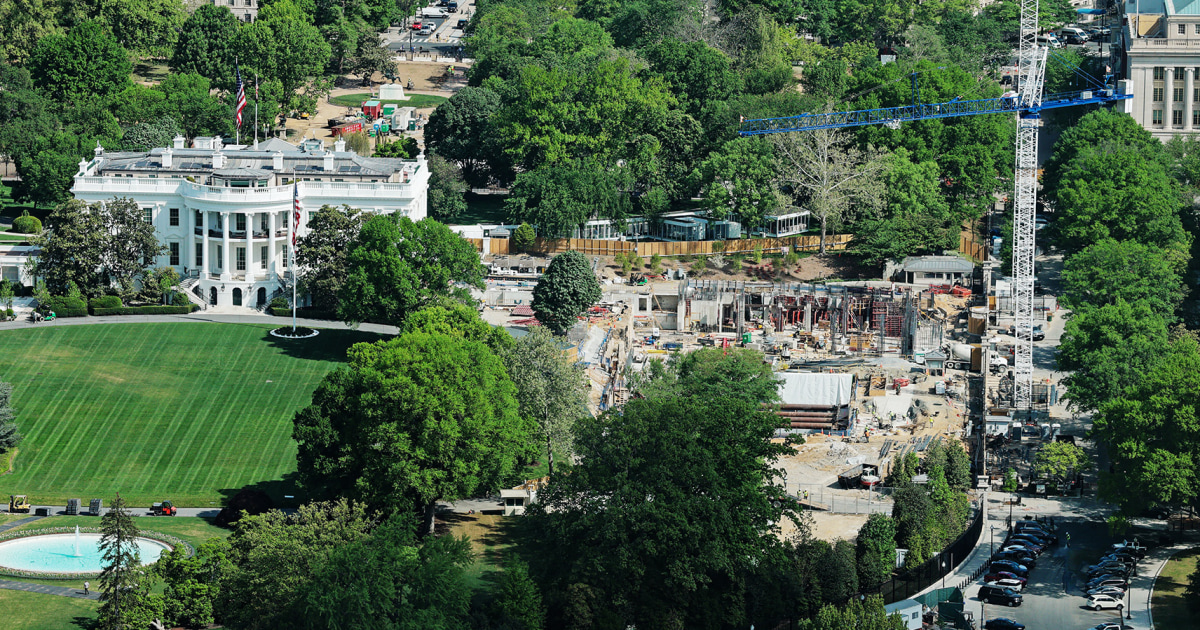
The legislative initiative to construct a $400 million fortified multi-purpose facility on the White House grounds has intensified internal Republican friction. Prompted by a significant security lapse at a private gala, the proposal—championed by Senators Lindsey Graham, Katie Britt, and Eric Schmitt—seeks to formalize a secure, high-capacity environment for executive functions, yet the fiscal mechanism remains a primary point of ideological divergence.
The Doctrine of Environmental Control
The Department of Justice’s endorsement of the 90,000-square-foot annex reflects a pivot toward ‘total environmental control’ in protective operations. Proponents argue that the current reliance on commercial hotel infrastructure introduces uncontrollable variables that the Secret Service cannot effectively mitigate. By internalizing these events within a multi-layered federal perimeter, the agency aims to establish a permanent command hub and a dedicated Secret Service annex.
This facility is framed as more than a social venue; its projected ‘military-grade’ technical integration suggests it would serve as a critical node for secure communications and continuity-of-government operations. The 90,000-square-foot footprint is viewed as the minimum threshold for hosting large-scale diplomatic functions without the operational risks inherent in motorcades and off-site perimeters.
Fiscal Friction and Funding Strategies
The debate highlights a fundamental tension between institutional security and the Republican commitment to budgetary discipline. Fiscal conservatives question the optics of a taxpayer-funded ‘luxury’ expansion, suggesting that private endowments might be a more appropriate vehicle for such a project. However, the use of private capital on federal grounds raises unprecedented ethical concerns regarding donor influence over executive space.
To navigate this, Senator Graham has proposed utilizing ‘customs fees’ as an offset—a technical legislative maneuver intended to bypass discretionary spending caps. This strategy attempts to link the project to trade-related revenue streams, though its procedural viability remains contested within the Appropriations Committee. The lack of a unified funding front suggests a ‘heavy lift’ in a divided Congress where Democratic opposition remains firm.
Institutional Isolation vs. Operational Resilience
Advocates emphasize that the project serves the ‘institution of the presidency’ rather than any specific administration. By centralizing diplomatic activities, the White House would reduce its reliance on the D.C. hospitality sector, a move that provides operational resilience but also signals an increasing physical detachment of the executive branch from the public sphere. This centralization would likely disrupt the local events economy, which has historically relied on the prestige of presidential appearances.
Ultimately, the $400 million proposal serves as a referendum on the modern requirements of executive protection. If the legislation fails to achieve a consensus on funding, the executive branch may be forced to choose between maintaining a high-risk security model or significantly curtailing the president’s public and diplomatic engagement. The resolution will define the physical and operational boundaries of the American presidency for decades to many come.

Photo by mac231 on Pixabay.