As the 2025-26 NHL regular season enters its final 17 days, the league has shifted into a high-leverage phase defined by marginal gains and seeding optimization. The current landscape exhibits a sharp divergence between established juggernauts securing home-ice advantage and a dense middle class vying for final wild-card entries. Strategic focus for elite front offices has pivoted from roster composition to the management of physical capital and the navigation of tiebreaker hierarchies.
Colorado’s Presidents’ Trophy Calculus
The Colorado Avalanche currently maintain the league’s most robust statistical position, holding 108 points with an eight-point cushion over the Dallas Stars. This lead allows the organization to solve a complex optimization problem: balancing the pursuit of the Presidents’ Trophy with the necessity of load management. Recent dominance—winning five of six games including a 9-2 victory over Calgary—demonstrates a high-efficiency power play and offensive depth that serves as a psychological deterrent for first-round opponents.
Individual performance remains a key motivator; Nathan MacKinnon’s pursuit of the Art Ross Trophy (currently 120 points) ensures that the top line maintains peak competitive intensity. While upcoming games against mathematically eliminated opponents like Vancouver present an opportunity for easy points, they also represent operational risks regarding injury. Colorado’s primary objective is securing home-ice leverage throughout the postseason without compromising core asset availability.
Buffalo’s Institutional Resurgence
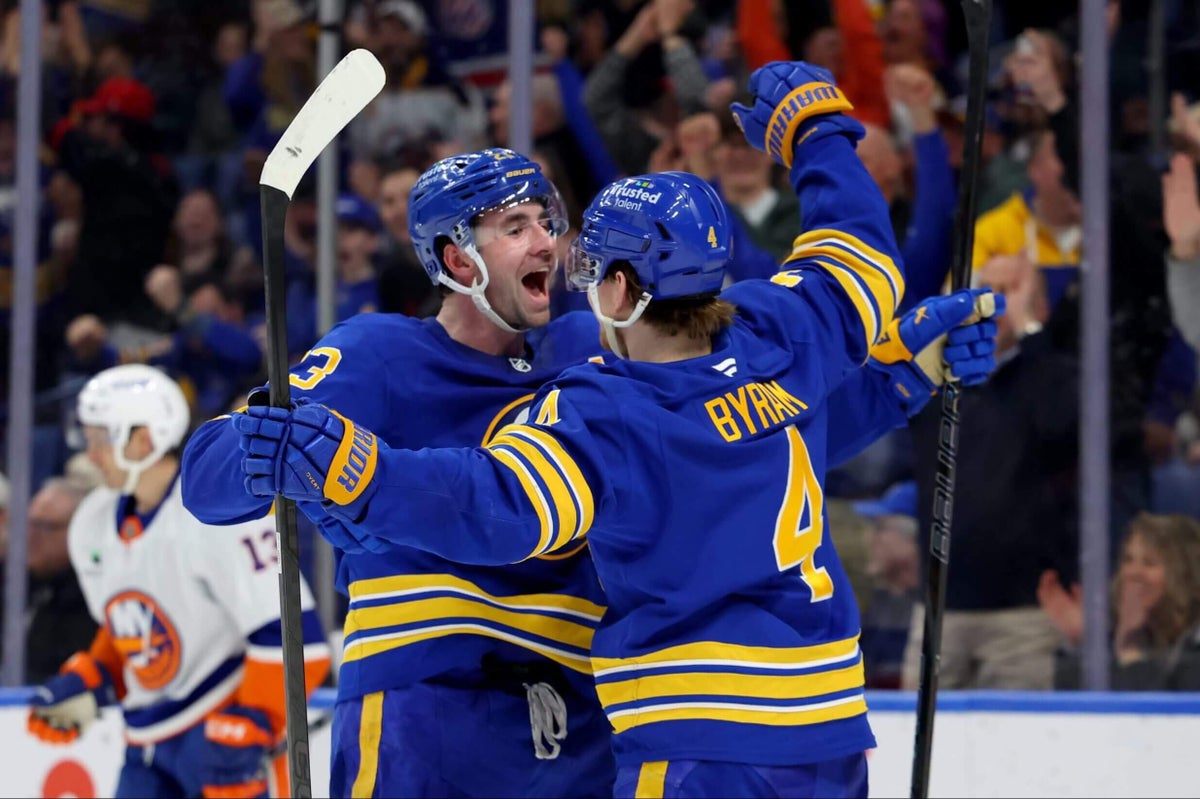
The Buffalo Sabres have reached a critical institutional milestone, securing their first 100-point season since 2009-10 and ending a 15-year postseason drought. This ascent to the top of the Atlantic Division reflects a successful systemic overhaul under Lindy Ruff, whose defensive structures have drastically improved team discipline. This turnaround is bolstered by Alex Lyon’s goaltending stability, evidenced by a 6-1-1 record in his recent starts, providing the necessary floor for postseason contention.
The return of playoff hockey to the KeyBank Center carries significant market implications. After a protracted rebuilding phase, Buffalo’s relevance introduces a surge in local revenue and national broadcast interest. The Sabres’ ability to hold off a volatile Tampa Bay squad will determine whether they face a wild-card opponent or a more grueling path through traditional Eastern Conference powers.
Western Wild-Card Volatility and Tiebreaker Mechanics
The Western Conference wild-card race remains the league’s most fluid sector. The Los Angeles Kings (29-26-18) are positioned to overtake the Nashville Predators, a shift that would fundamentally alter scouting requirements for top seeds. Meanwhile, the San Jose Sharks hold a tactical advantage via games in hand, allowing them to leverage a superior points percentage (P%) over Nashville despite being idle during key windows.
The mechanics of clinching—specifically Regulation Wins (RW) and Regulation Plus Overtime Wins (ROW)—now dictate late-game coaching philosophies. For teams like Minnesota, the prospect of a ‘passive clinch’ depends entirely on Los Angeles’ performance against St. Louis. Early qualification allows these rosters to transition into a load-management phase, whereas bubble teams are forced into high-risk strategies, such as pulling goaltenders in tie games to secure the RW tiebreaker advantage.
Eastern Realignment and Goaltending Leverage
The Eastern Conference experienced a significant realignment following Tampa Bay’s recent regulation loss, which allowed the Carolina Hurricanes to ascend to the top seed. This volatility underscores the razor-thin margins in the Atlantic and Metropolitan divisions. Simultaneously, the Boston Bruins rely on Jeremy Swayman’s elite performance (3 losses in 11 games) to stabilize their seeding. However, failing to secure home-ice could neutralize Boston’s strong 27-10-1 record at TD Garden, complicating their path through the early rounds.
Ultimately, the final stretch of the 2026 season is an exercise in risk mitigation and tactical scouting. While the Buffalo Sabres represent the feel-good narrative of franchise revival, the operational efficiency of the Colorado Avalanche remains the gold standard. Every goal in these final 17 days has cascading effects on the economic and competitive structure of the 2026 Stanley Cup Playoffs.