
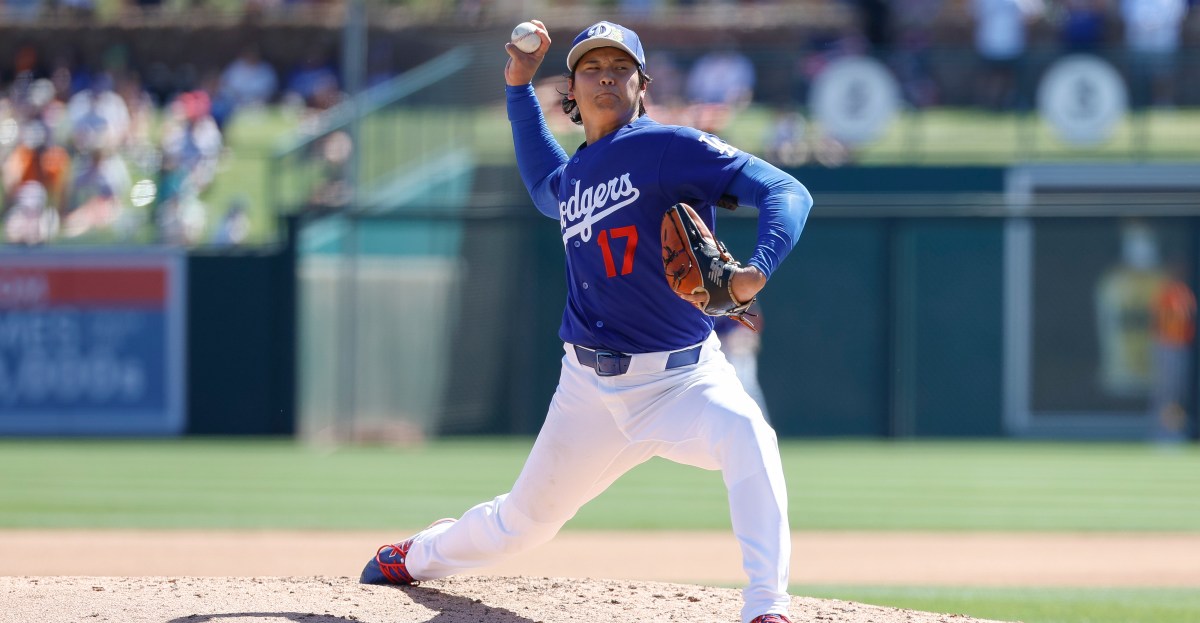
The 2026 Freeway Series finale at Dodger Stadium represents more than an exhibition; it is a critical diagnostic window for the Los Angeles Dodgers’ pitching infrastructure. As the organization transitions from Arizona-based developmental evaluations to regular-season execution, the primary objective centers on validating the physiological readiness of Shohei Ohtani and stabilizing a rotation facing unexpected volatility.
Biomechanical Benchmarks: Ohtani’s Velocity and Workload Scaling
Shohei Ohtani’s performance metrics indicate he has achieved elite mechanical efficiency ahead of the 2026 campaign. Clocking a 99.9 mph fastball during his final spring tune-up confirms that his arm speed and kinetic sequencing have returned to peak levels. Strategically, the Dodgers implemented a 23% workload expansion in this outing, moving Ohtani from a 61-pitch baseline to a 75-pitch ceiling over five innings.
This incremental scaling is a calculated effort to align Ohtani with a standard 90-pitch threshold for his regular-season debut against the Cleveland Guardians. By scheduling this start on Tuesday, the front office has engineered a precise seven-day recovery cycle, optimizing his physiological restoration while preserving the competitive rhythm necessary for high-leverage starts.
Rotational Volatility: The Sasaki-Wrobleski Contingency
While Ohtani’s metrics are encouraging, the Dodgers face a strategic complication regarding Roki Sasaki. Sasaki’s suboptimal spring performance has introduced a variables-set that challenges the team’s initial rotation hierarchy. His lack of command and consistency necessitates a reassessment of early-season bullpen utilization and long-relief requirements.
Justin Wrobleski, originally slated as a secondary ‘piggyback’ option to manage Ohtani’s early-season fatigue, is now being evaluated as a high-leverage safety net. If Sasaki’s struggles persist into April, the Dodgers may pivot Wrobleski into a traditional starting role or utilize him as a tactical bridge to cover innings vacated by underperforming starters. This shift underscores the necessity of versatile depth in a rotation with high-variance outcomes.
Offensive Leverage and Market Dynamics
The Dodgers’ offense has demonstrated high-output efficiency, recording 20 runs across the Freeway Series. This collective timing and plate discipline provide a vital ‘competitive cushion,’ allowing the pitching staff more margin for error during early-season adjustments. For the Angels, starter Jack Kochanowicz faces a definitive benchmark; his ability to navigate this high-volume lineup will determine his leverage within the Angels’ 2026 rotation.
The broadcast distribution for this finale highlights the evolving regional sports network (RSN) landscape. With SportsNet LA and FanDuel Sports Network West sharing market space, and MLB Network providing national reach, the game serves as a high-value commercial asset. This multi-platform exposure, including AM 570 and KTNQ 1020 AM, reinforces the Dodgers’ brand dominance in the Southern California sports economy while maximizing revenue generation from global Ohtani interest.
Final Strategic Implications
The conclusion of the spring cycle shifts the focus from experimental data to divisional standings. Any deviation from projected velocity or recovery timelines in this finale will trigger immediate 40-man roster adjustments before the club departs for Cleveland. For the Dodgers, the priority remains a seamless transition for their primary pitching investment; for the Angels, the game is a final audit of their ability to contain elite offensive threats in the American League West.

Photo by 12019 on Pixabay.