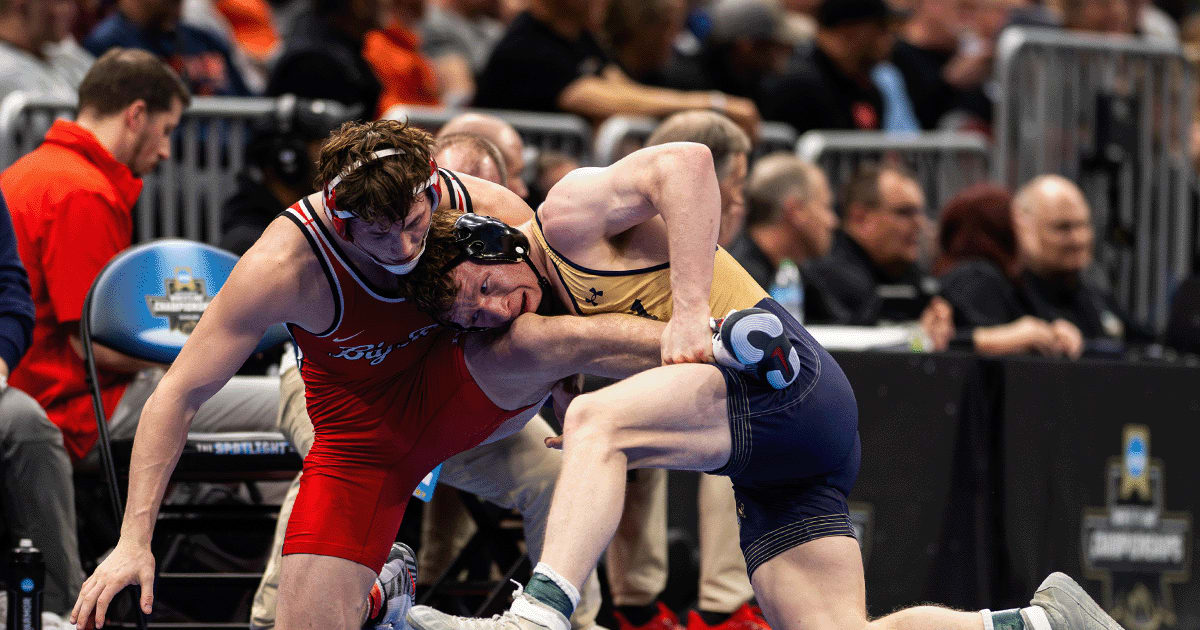
The 2026 NCAA Division I Men’s Wrestling Championships at Cleveland’s Rocket Arena have transitioned from preliminary brackets to a display of Penn State’s mathematical hegemony. The Nittany Lions closed the opening sessions with 40.5 points, securing a 13.5-point lead over second-place Nebraska (27) and third-place Iowa (25.5). This lead is underpinned by a 16-0 collective record, notably achieving a 93.7% bonus-point rate through 15 victories involving falls, technical falls, or major decisions.
Tactical volatility peaked at 174 pounds, where Navy’s Danny Wask unseated No. 2 seed Simon Ruiz (Cornell). This disruption fundamentally recalibrates the bracket’s defensive geometry, shifting the path to the finals toward emerging contenders like Christopher Minto. The upset underscores a broader tournament trend where mid-tier programs are effectively neutralizing high-seeded favorites through disciplined, low-error execution.
Penn State’s freshman cohort, featuring U20 World champions PJ Duke and Marcus Blaze, has validated aggressive recruitment strategies. Duke utilized first-period falls to minimize mat time, while Blaze outscored opponents 34-4 via back-to-back technical falls. Their immediate transition to collegiate dominance suggests that international age-group success remains the primary predictor for high-ceiling NCAA performance.
In the lower weight classes, Oklahoma State’s Sergio Vega advanced to a high-stakes semifinal against Nebraska’s Brock Hardy. This matchup highlights the psychological load of seasonal rubber matches, where tactical adjustments—informed by extensive video analysis—supersede raw athleticism. Similarly, the 165-pound bracket saw No. 12 seed Cesar Alvan emerge as a strategic outlier, proving that double-digit seeds can navigate to the semifinals through consistent technical attrition.
Institutional legacy remains a factor at 184 and 197 pounds, where Stephen Little and Joey Novak secured semifinal berths. Little’s advancement reinforces the cultural drivers of loyalty within elite programs. Meanwhile, heavyweight contenders like Taye Ghadiali and Michael Caliendo are employing periodization models designed for ‘March peaking,’ a strategy that prioritizes physical and mental zenith during the championship window.
The administrative framework of the tournament, established by the NCAA Division I Wrestling Committee during the March 10 at-large selections, has produced one of the deepest fields in recent history. As the competition moves toward the finals, the sustainability of Penn State’s scoring efficiency faces its final test against a chasing pack desperate to reclaim the podium hierarchy.