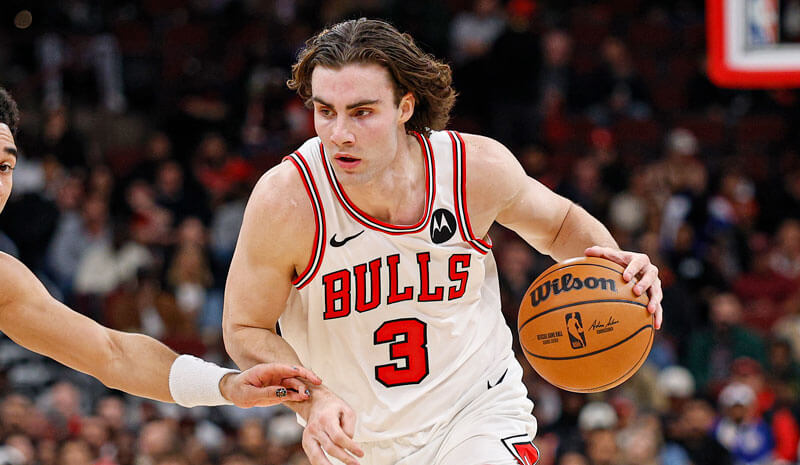
The March 10 contest pits the Golden State Warriors (32-32) against the Chicago Bulls (26-38) in a matchup defined by severe roster asymmetry and divergent organizational mandates.
Golden State enters under critical operational strain. The confirmed absence of Stephen Curry (knee) for the 15th straight game, coupled with Jimmy Butler’s season-ending injury and Seth Curry missing the second leg of a back-to-back, decimates their offensive core. Further complications arise from Moses Moody’s wrist injury and Draymond Green’s questionable back status.
Roster Depletion and Strategic Consequence
The loss of Curry’s gravitational pull forces an untenable reliance on secondary creators, significantly inflating usage rates for role players beyond their established efficiency thresholds. This structural weakness is compounded by uncertainties surrounding De’Anthony Melton (adductor) and Quinten Post (foot), introducing late-game tactical ambiguity.
Historically dominant (8-2 in the last 10 meetings), the Warriors’ structural advantage is now critically compromised. Conversely, the Bulls, despite a recent 2-13 slump, maintain a comparatively healthier operational roster, positioning them to exploit Golden State’s exposed weak points.
Chicago’s key absences (Noa Essengue, Zach Collins season-ending; Jaden Ivey, Anfernee Simons out) still leave primary facilitators available, contrasting sharply with Golden State’s critical scoring voids.
Betting Markets: Spread Contingency vs. Organizational Pedigree
The betting line establishes Golden State as a -6.5 point favorite, a spread suggesting market faith in systemic execution despite personnel erosion. The Moneyline (-235 GSW) indicates brand equity still outweighs recent performance disparities.
The Total set at 227.5 reflects deep uncertainty. This is largely driven by the unknown offensive efficiency of the patched-together Warriors attack against a Bulls defense that recently conceded 119 points in Utah. A recent defensive failure provides a high-leverage data point.
The market’s focus on Josh Giddey’s assist projection (Over 8.5) highlights the central strategic vulnerability: Warriors’ diminished perimeter defense and interior presence invite high-volume ball movement. Giddey’s reported uptick in road distribution suggests Chicago will aggressively weaponize penetration and kick-outs.
Institutional Positioning and Volatility Assessment
Golden State operates under institutional pressure to secure wins for playoff positioning, creating a high-stakes scenario against a Bulls team perceived to be in ‘tanking freedom,’ potentially leading to higher-variance, less structurally constrained offensive possessions from Chicago.
Chicago’s recent upset of the Suns suggests they can achieve high-level execution when external expectations are low, a scenario amplified by Golden State’s current defensive instability. Chicago’s league-eighth ranking in 3-point percentage means successful Giddey orchestration will severely test the compromised Warriors interior defense.
The likely availability of Giddey (ankle) and Matas Buzelis supports Chicago’s ability to execute a high-assist game plan designed to maximize perimeter shooting opportunities against a depleted defense.
Analyzing Attrition vs. Developmental Mandate
The cumulative effect of Warriors’ injuries forces immediate roster augmentation evaluations. Moody’s pending re-evaluation hints at a short-term return window, but the sustained absence of Curry forces management to balance competitive requirements against long-term core viability.
For Chicago, the questionable status of Collin Sexton and Patrick Williams offers a lower-pressure environment to integrate them into meaningful roles, accelerating their development curve against a high-profile, albeit wounded, opponent.
The league narrative is currently dominated by roster stability dictating outcomes, highlighted by Seth Curry’s specific load management in a back-to-back. The Warriors’ struggle tests coaching efficacy under duress, shifting focus from talent evaluation to sheer execution.
The operational reality is Golden State managing risk for Green, whose back issues threaten long-term championship sustainability, contrasting with Chicago’s mandate to maximize development exposure. The -6.5 spread tests the coaching staff’s ability to scheme around profound structural deficiencies against Chicago’s playmaking surge.
This contest is an acute case study in resource allocation under duress. The market consensus suggests the operational disruption is severe, yet not catastrophic enough to fully negate the talent gap favoring Golden State historically. However, Chicago’s recent form suggests momentum can disrupt flawed matchup projections.
The game hinges on Golden State’s ability to generate secondary creation; failure implies possessions ending in contested mid-range shots, making the Under 227.5 increasingly probable. The split total reflects the market’s equilibrium between predicted defensive lapses and offensive stagnation.
Ultimately, the operational imperative for the Warriors is defensive effort and ball security; diminished firepower cannot absorb unforced errors. Chicago’s strategic flexibility, free from immediate playoff seeding pressure, allows tactical experimentation to exploit known defensive assignments.