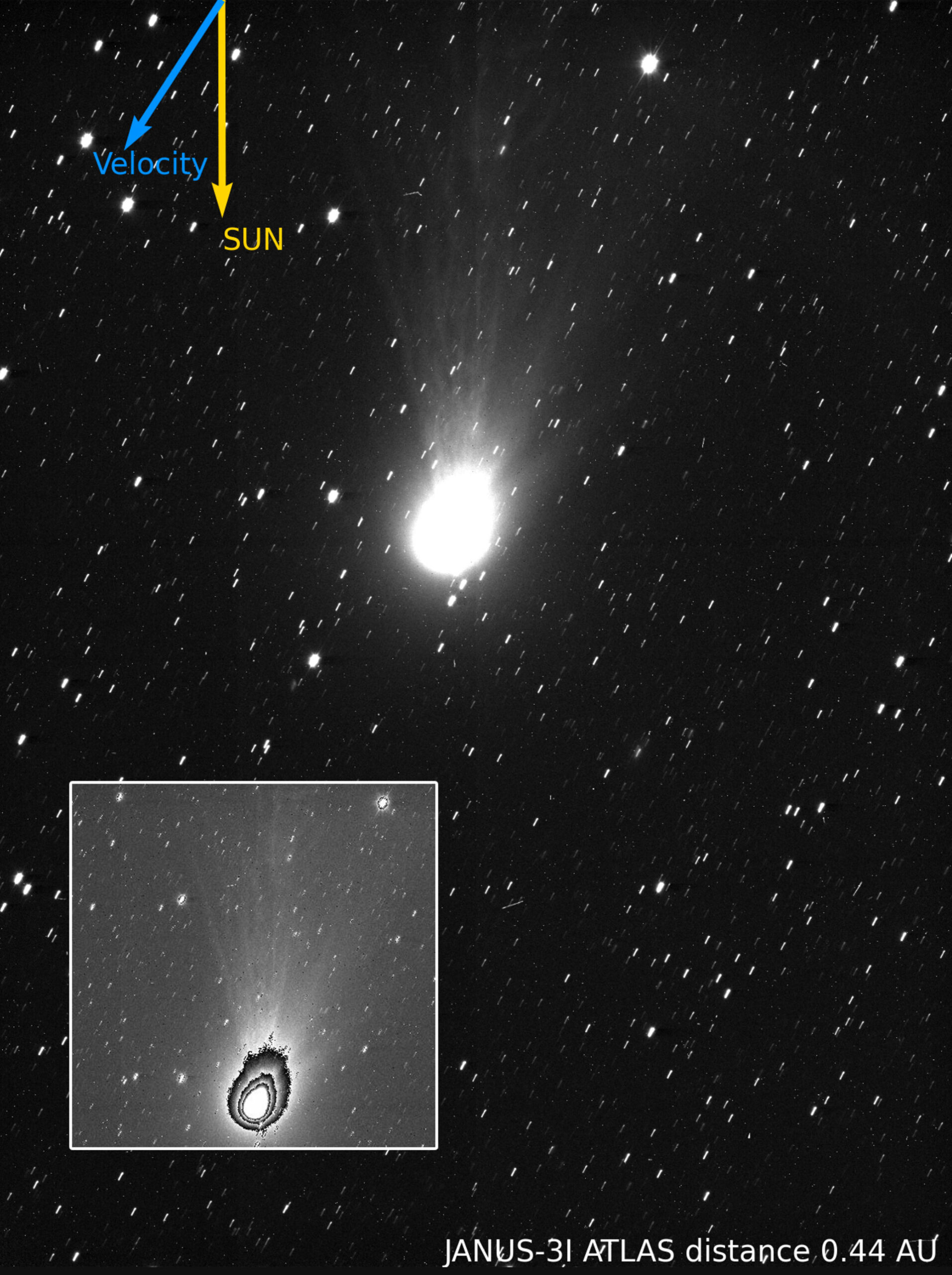
The European Space Agency’s Jupiter Icy Moons Explorer (Juice), while en route to its Jovian targets, successfully executed an opportunistic observation of interstellar comet 3I/ATLAS, yielding high-fidelity data on its activity phase.
Operational Synthesis and Timing Precision
The observation occurred on November 6, 2025, when Juice was 66 million kilometers from 3I/ATLAS, precisely seven days post-perihelion. This brief, high-value data capture underscores the engineering flexibility of the mission architecture, leveraging the cruise phase trajectory for vital flyby science beyond the primary astrobiological mandate.
The data acquisition was focused on documenting active outgassing. The observation window maximized visibility of the coma and tail structures while the comet was actively shedding material under peak solar irradiation, providing empirical constraints on its volatile release mechanisms.
Multi-Modal Instrument Synergy
Juice deployed five active instruments—JANUS (optical imaging), MAJIS (spectroscopy), SWI, PEP, and UVS—in a coordinated effort. This integrated suite allowed for concurrent characterization of 3I/ATLAS’s optical morphology, infrared spectral signature, and local plasma environment.
This multi-modal analysis is scientifically critical: comparing spectral data with morphological features allows researchers to link specific chemical components (e.g., water ice vs. refractory dust) directly to the localized jets and filaments observed in the coma. This provides a deep chemical inventory of material originating outside the solar nebula.
Strategic Value: Benchmarking Extrasolar Material
As only the third confirmed interstellar object encountered by an active probe, 3I/ATLAS data serves as a unique benchmark for extrasolar material dynamics. The fact that its sublimation behavior aligns with established cometary physics suggests that core volatile sublimation processes are ubiquitous across galactic environments.
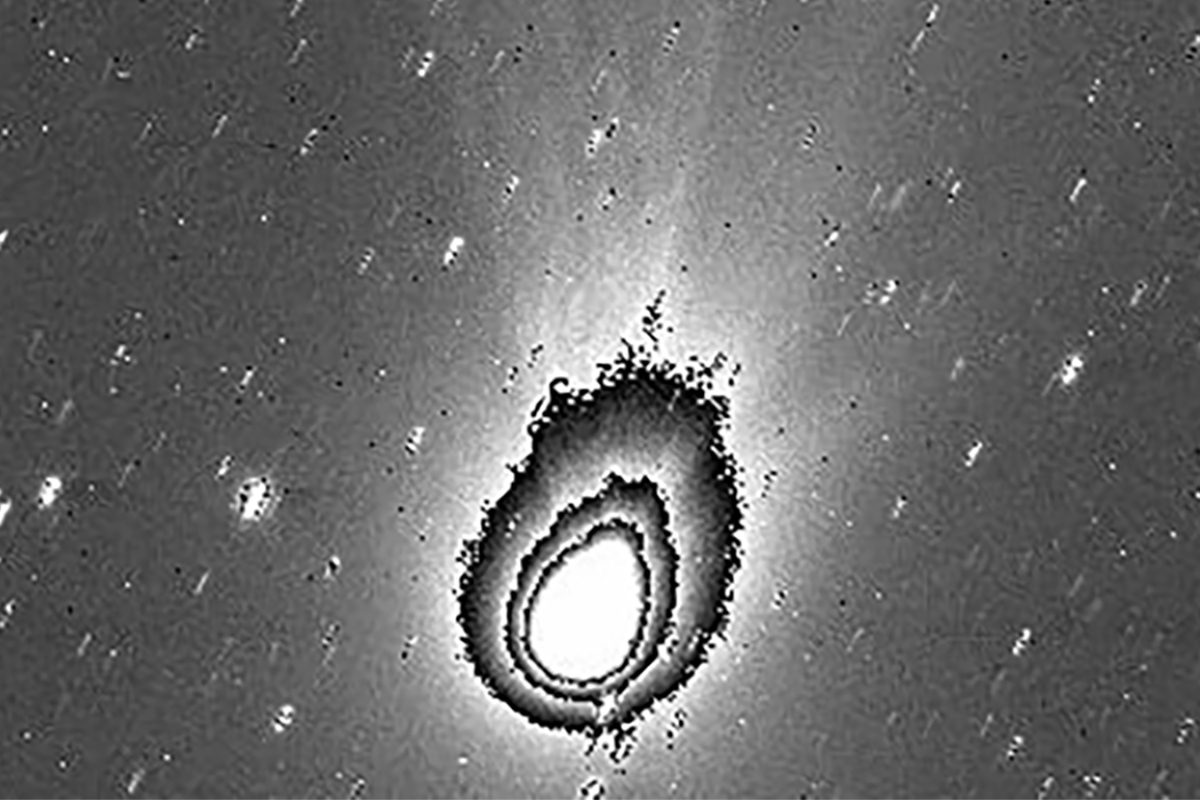
The high-resolution documentation of coma features—including collimated jets, rays, and the diffuse halo—offers critical ground truth for theoretical models predicting the structural response of interstellar ice bodies to solar forcing.
Analyzing Morphology and Outgassing Dynamics
Analysis of the JANUS imagery emphasizes resolving the structure of the coma. The distinction between the broad, diffuse coma and the narrow, directional jets is analytically significant, as jets trace localized release points potentially related to the nucleus’s rotation or patchy surface composition.
By documenting these features shortly after perihelion, scientists captured peak outgassing rates. The precise relative positioning of the Sun and the comet’s velocity vector, recorded alongside the imagery, is vital for reconstructing the anisotropic ejection patterns driven by non-gravitational forces.
Mission Justification and Scientific Precedent
The successful secondary science execution validates the resource allocation for long-duration missions like Juice, demonstrating immediate, tangible scientific return during the multi-year transit phase.
This capability sets a precedent for future deep-space probes to integrate transient targets of opportunity into mission planning, maximizing platform utilization beyond the primary objective timeframe.
Addressing Public Discourse Through Data
The release of high-fidelity data served a strategic role in anchoring public discourse against speculative narratives that had attached to 3I/ATLAS. By presenting clear evidence of expected cometary activity, space agencies reinforce the scientific consensus based on empirical observation.
The urgency of capturing this data is amplified by the object’s trajectory; 3I/ATLAS is scheduled for permanent solar system exit, making the Juice data the definitive, non-repeatable record of this ancient visitor.
Downstream Impact on Comparative Planetology
While Juice remains focused on Jupiter’s ocean worlds, the characterization of 3I/ATLAS enriches the context for astrobiology. Understanding the volatile inventories of interstellar bodies refines models predicting the chemical heterogeneity of planetesimals formed in diverse stellar nurseries.
Furthermore, the study of how 3I/ATLAS’s coma interacted with the interplanetary medium provides analogous insights applicable to modeling plasma and solar wind interactions within Jupiter’s own complex magnetosphere.