Strategic Context: Post-Break Momentum and Operational Consistency
The February 19 encounter between the Phoenix Suns and the San Antonio Spurs at Austin’s Moody Center serves as a critical diagnostic for two franchises on divergent trajectories. San Antonio enters the contest as a Western Conference elite (38-16), leveraging a six-game winning streak that underscores a high level of operational consistency. Conversely, Phoenix (32-23) arrives seeking to mitigate a pre-break period defined by systemic fatigue and a 5-5 split in their last ten outings, including high-margin losses to the Clippers and Thunder.
The Austin Residency: Leveraging Regional Economic Corridors
The transition to the Moody Center reflects the Spurs’ strategic initiative to diversify their fan base and tap into the high-growth Austin economic corridor. This regional residency introduces a unique operational variable: the dilution of traditional home-court advantage. For a surging San Antonio squad, the neutral-site environment serves as a high-profile stage for market expansion, while Phoenix must navigate the logistical and mental recalibration required for a road game in a non-traditional venue following a long layoff.
Defensive Architecture and Personnel Volatility
The absence of Dillon Brooks due to suspension creates a significant structural void in the Phoenix defensive rotation. Historically, Brooks has functioned as a primary defensive provocateur, providing the perimeter intensity required to disrupt San Antonio’s high-efficiency ball movement. Coupled with injury concerns regarding Haywood Highsmith and Grayson Allen, the Suns face immense pressure to maintain their top-10 defensive rating against a Spurs offense averaging 118.1 points per game—surpassing Phoenix’s defensive concessions by over 6 points per game.
The Wembanyama Factor: Defensive Proof-of-Concept
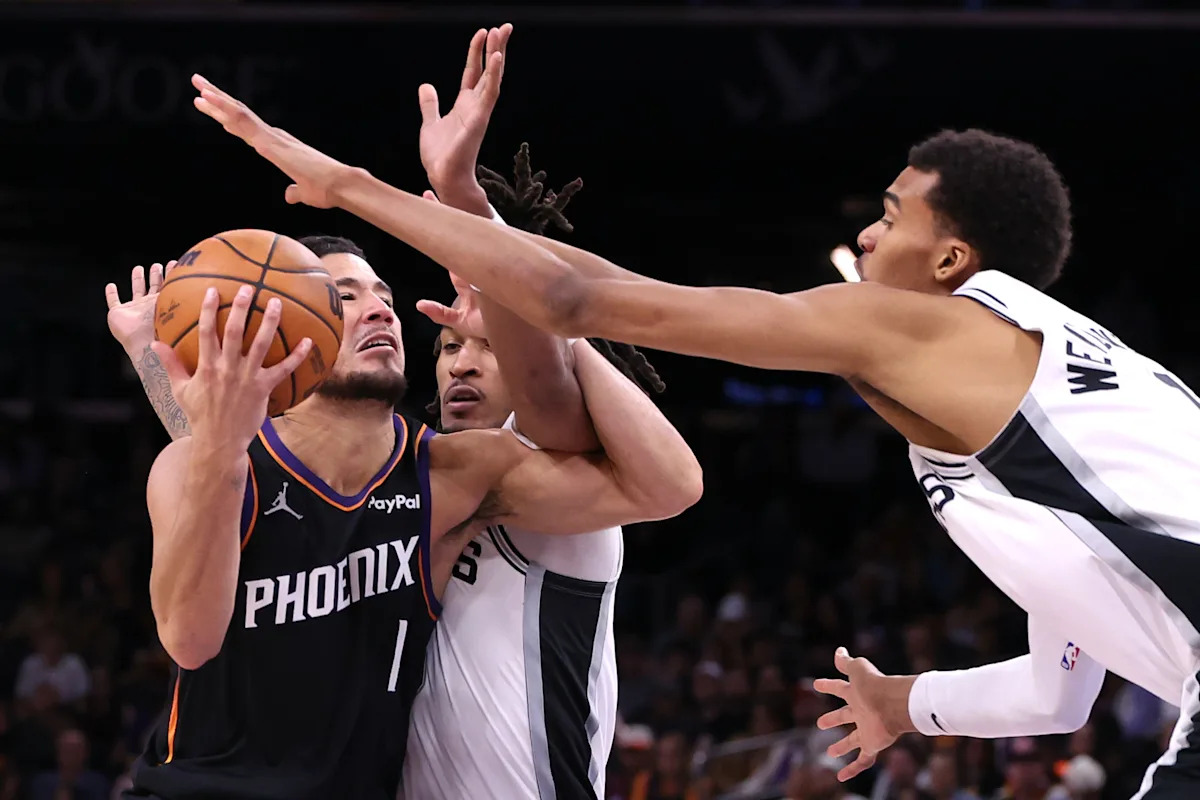
The evolution of Victor Wembanyama remains the central narrative of this season series. While Phoenix successfully neutralized the rookie phenom in their initial meeting—holding him to nine points through disciplined interior positioning—the tactical landscape has shifted. San Antonio has since integrated Wembanyama more effectively into their transition and half-court sets. This matchup tests whether the Suns can replicate their earlier defensive success against a more seasoned, healthy Spurs rotation that has largely cleared its injury report.
Statistical Efficiency and Betting Market Sentiment
Data-driven projections highlight a narrow offensive margin: Phoenix averages 113.6 points, only 1.4 points above San Antonio’s defensive average. This necessitates exceptional scoring efficiency from the Suns’ primary options to counter the Spurs’ offensive surplus. Betting markets have responded by installing San Antonio as an 8.5-point favorite, reflecting institutional skepticism regarding Phoenix’s ability to recover their early-season form. The 229.5 over/under total indicates an expectation of a high-tempo affair driven by San Antonio’s current offensive rhythm.
Conclusion: Seeding Implications and Roster Depth
As the season enters its final third, the outcome carries heavy weight for Western Conference seeding. A Spurs victory reinforces their championship-contender status and pursuit of the top seed. For Phoenix, a loss exacerbates concerns regarding roster depth and the ‘All-Star break effect’ on physical recovery. With non-injury related absences further thinning the rotation, the Suns must prove that their stylistic matchup advantage remains intact or risk a significant slide in a highly competitive conference hierarchy.