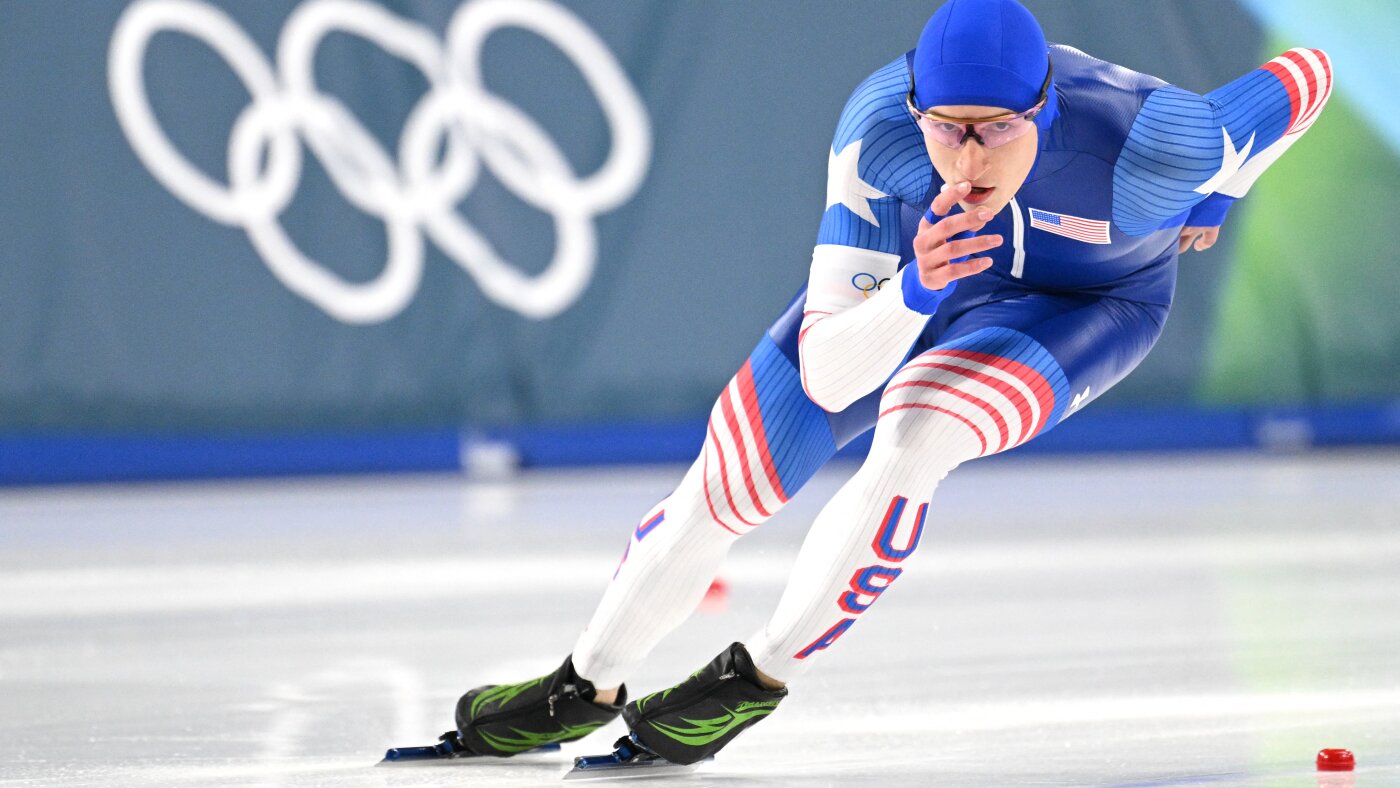
Jordan Stolz’s pursuit of a fourth gold medal at the 2026 Milan Cortina Winter Games concluded with a silver in the 1,500-meter speed skating event. This result is more than a statistical shift; it signals a pivotal inflection point regarding pacing strategy and the shifting competitive stratification in elite speed skating.
Strategic Analysis: Pacing and Heat Structure Exploitation
Stolz recorded a time of 1:42.75, a performance demonstrably world-class but insufficient against the breakthrough pace set by China’s Ning Zhongyan, who clocked a new Olympic Record of 1:41.98 in the 13th of 15 heats.
Ning’s early, blistering time exerted decisive psychological leverage. By setting a definitive, superior metric before the final pairing—which included the favored Stolz—Ning transformed the race from an independent time trial into a direct chase, forcing Stolz into a reactive posture against a known, faster standard.
Data confirms Stolz was operationally behind early, showing a 0.77-second deficit by the first checkpoint (implied by the 1.35-second total difference, with a typical late-race closing variance). Coach Bob Corby noted this deviation from the expected 0.5-second victory margin, pointing toward a tactical mismatch rather than overall physical failure.
The Milano Speed Skating Stadium’s conditions, which facilitated swift times, amplified the importance of precise pace calculation. Stolz’s silver time itself would have set a new Olympic record had it not been surpassed earlier, underscoring a rapid escalation in performance thresholds requiring sustained velocity rather than traditional late-race surges.
Competitive Balance and Narrative Control
Ning’s satisfaction with a silver projection prior to Stolz’s race suggests a calculated risk management strategy, prioritizing a guaranteed podium against the top favorite over an all-out gamble for gold, a strategy that yielded the ultimate prize.
For Team USA, securing two golds and one silver confirms a successful speed skating presence, yet the 1,500m outcome halts a potential middle-distance sweep. Stolz, at 21, is now managing the structural pressure of high external expectation, which he attempted to neutralize by emphasizing controllable elements post-race.
However, the coach’s technical assessment—citing a failure of optimal physical execution—highlights an internal divergence regarding the root cause: technique/pacing versus mental fortitude. This distinction will dictate future training load management and race-day protocols.
Broader Team USA Performance Benchmarking (Milan 2026)
Stolz’s result must be contextualized within the diverse successes of Team USA during the same Games, indicating broad, rather than singular, strategic allocation of resources:
- Women’s Ice Hockey: Gold medal secured via a 2-1 overtime victory against Canada, validating depth in high-leverage team sports execution.
- Women’s Figure Skating: Alysa Liu’s gold ended a 22-year drought, signaling a successful revitalization within the U.S. Figure Skating federation.
- Figure Skating Resilience: Amber Glenn’s recovery from a short program error to a strong free skate demonstrates the efficacy of structural support systems in mitigating high-consequence setbacks.
These varied outcomes—individual velocity, team rivalry resolution, and technical artistry resurgence—provide critical data points for institutional stakeholders regarding future capital allocation. Sustained speed skating supremacy now directly competes for resources against the demonstrated need to reinvest in judged sports to maintain competitive parity.
Future Strategic Imperatives for Stolz
Ning Zhongyan’s performance fundamentally restructures the competitive landscape. Stolz’s team must immediately develop specific countermeasures targeting Ning’s aggressive early pacing profile for the 1,500m. The narrow margins, exacerbated by track optimization, mean pacing error is now the primary determinant of victory.
Media focus pivots instantly to Stolz’s remaining event on Saturday, illustrating the commercial feedback loop where established stars drive immediate viewership. Operational agility requires Stolz to quickly integrate the 1,500m tactical failure into his preparation for subsequent races, demonstrating adaptability in a rapidly evolving international field where established dominance is constantly challenged by optimized, emerging talent pools.