The U.S. women’s hockey team’s 6-0 quarterfinal shutout of Italy at the Milano Rho Hockey Arena serves as a definitive case study in competitive asymmetry. While the shot clock—51 to 5—indicates a gross talent disparity, the underlying metrics reveal a deliberate evolution in the American program’s approach to knockout-stage management. By leveraging high-velocity zone entries and relentless puck recovery cycles, the U.S. demonstrated a structural superiority that rendered the host nation’s defensive shell obsolete.
Tactical Aggression: The Strategic Utility of Friction
The contest’s abrasive nature, punctuated by Abbey Murphy’s involvement in post-whistle scrums, reflects a calculated embrace of tactical friction. This physicality functions as a proactive counter-measure against lower-seeded opponents who employ obstruction-based defensive schemes to neutralize speed. Forward Taylor Heise’s characterization of this “specific style of hockey” highlights a willingness to trade penalty minutes for territorial dominance and psychological leverage, forcing opponents into a reactive, disorganized posture.
Murphy’s role as a primary agitator provides a unique competitive edge, drawing defensive focus away from tactical assignments and creating coverage breakdowns. By maintaining high offensive output while disrupting the opponent’s rhythm, the U.S. ensures that even when the game’s flow is impeded by defensive “clogging,” they remain the architects of the physical tempo. This aggression is not incidental but a core component of a broader tournament strategy designed to break the will of defensive-minded systems.
Institutional Diplomacy and Regulatory Management
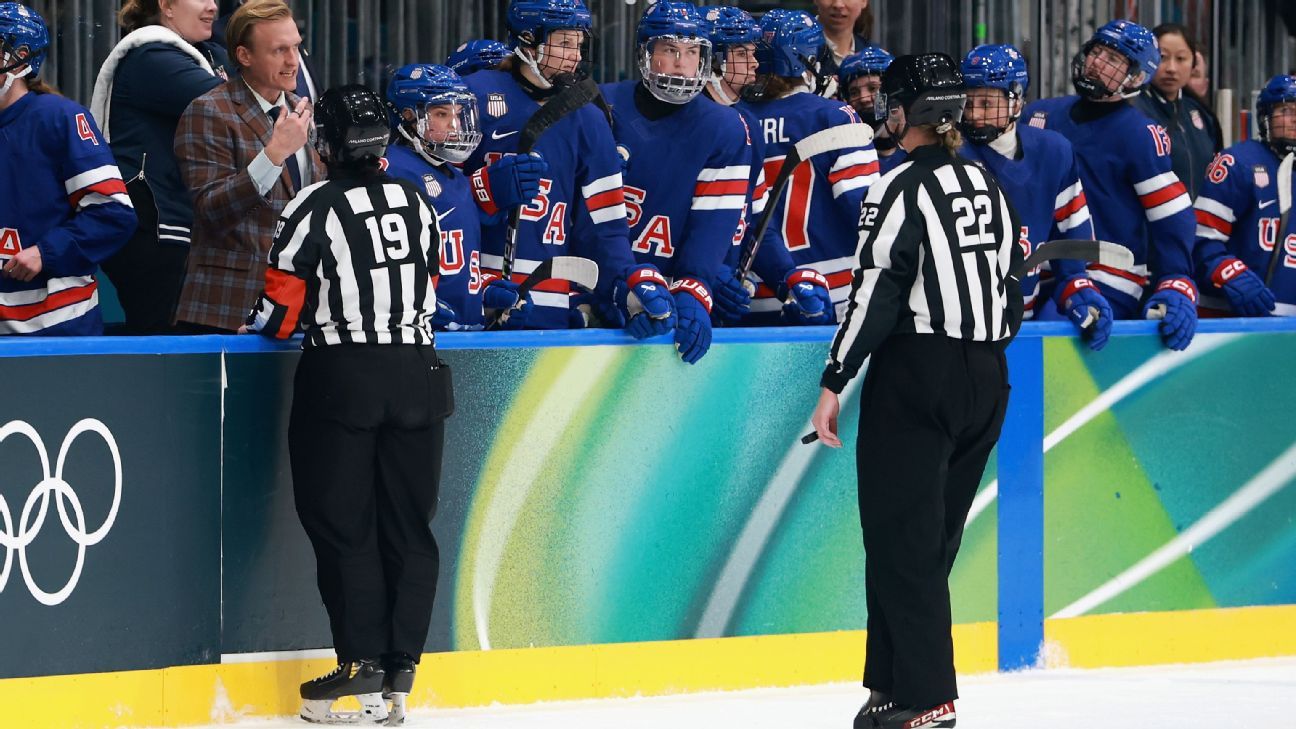
Coach John Wroblewski’s public critique of the officiating—specifically regarding the permissiveness toward “holding up” and illegal interference—represents a sophisticated form of institutional management. By framing defensive obstruction as a violation of the game’s integrity, Wroblewski is attempting to calibrate the officiating standard for the medal rounds. This narrative positioning exerts pressure on tournament officials to prioritize skill-based play over unpenalized defensive fouls.
This strategic pushback is vital for a roster dependent on high-velocity puck movement and intricate offensive rotations. If officials permit defenders to impede progress without consequence, the U.S.’s technical advantages are systemically diminished. Consequently, the bench-side confrontations are less about immediate frustration and more about establishing a favorable regulatory environment for the semifinals and gold-medal game.
Performance Metrics and Longevity Infrastructure
Kendall Coyne Schofield’s two-goal performance serves as a validation of the program’s investment in athlete longevity. Her return to elite competition following childbirth is underpinned by a comprehensive support infrastructure—a “village” of logistical, physical, and familial coordination. This model represents a shift in human capital management, recognizing that extending the competitive window of veteran leaders requires a holistic approach to athlete welfare.
The presence of Schofield’s support system in Milan highlights the financial and institutional commitment necessary to maintain peak performance levels through life transitions. For Team USA, retaining Schofield’s experience and scoring threat provides a stabilizing influence and a proven offensive catalyst. Her ability to dismantle the Italian defense after a significant hiatus challenges traditional assumptions regarding athlete peak cycles, offering a template for future programmatic development.
Historical Positioning and Technical Supremacy
Statistical dominance—highlighted by Laila Edwards’ rapid-fire scoring—positions this roster as one of the most complete iterations in U.S. history. The team’s ability to dictate terms in every facet of the game, from transition defense to net-front presence, suggests they are operating at the zenith of their collective powers. This internal culture of selflessness, combined with a potent mix of emerging talent and veteran leadership, acts as a force multiplier on the ice.
As the U.S. advances to its seventh consecutive Olympic semifinal, the objective transcends individual victories. The current squad is competing against the historical benchmarks of previous gold-medal programs. The efficiency of the Italian dismantling suggests that their tactical ceiling has yet to be reached. With two games remaining, the Americans are poised to solidify their status as the definitive power in international women’s hockey through a blend of physical intimidation and technical precision.