The Men’s Ice Hockey tournament at the Olympic Winter Games Milano Cortina 2026 has commenced, presenting a significant fixture with Finland set to compete against Slovakia in the opening matches.
This specific tournament structure is notable as it represents the first appearance of National Hockey League (NHL) players since the 2014 Sochi Olympics. The schedule dictates that all twelve participating nations, including Finland and Slovakia, will engage in three preliminary group stage contests as part of the initial phase of the competition.
Institutional Context of NHL Participation in the Olympics
The inclusion of NHL players carries substantial administrative and structural weight within the framework of international ice hockey governance. The participation requires complex agreements between the International Olympic Committee (IOC), the International Ice Hockey Federation (IIHF), and the National Hockey League, addressing player release protocols, insurance liabilities, and scheduling accommodation.
Historically, the integration of professional league assets into the Olympic structure has been a recurring point of negotiation, balancing the pinnacle competitive aspiration of national teams against the contractual obligations and competitive calendars of major North American professional sports leagues. The current iteration of the Milano Cortina 2026 tournament signals a resumption of this collaborative model following a period of absence.
Team Composition and Strategic Focus
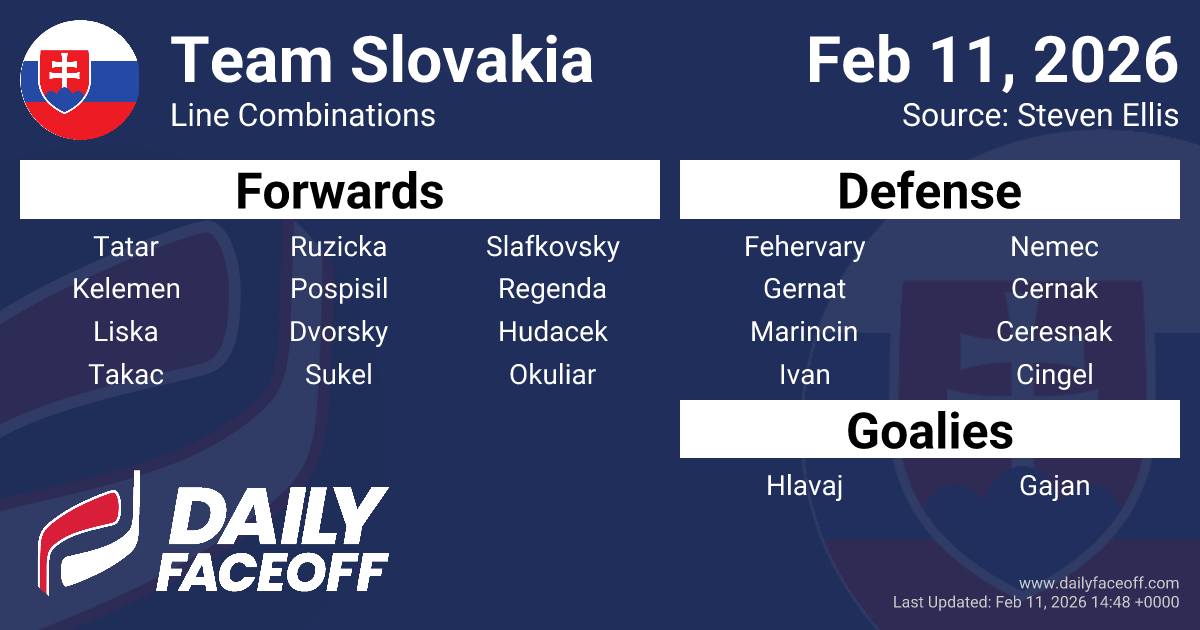
Information disseminated regarding Team Slovakia’s lineup details specific roster constructions and anticipated line combinations for the tournament. Such documentation, often compiled by external hockey information services, highlights the strategic importance placed on immediate cohesion when integrating players accustomed to differing professional environments.
Furthermore, specific player narratives, such as the reunion between Finnish players Rantanen and Lehkonen, underscore the personal dimensions within the national team structure. While these relationships are significant to team dynamics, their operational importance rests on how these established on-ice chemistries translate under the high-pressure, short-duration format characteristic of Olympic competition.
Media Attribution and Informational Sourcing
It is crucial to differentiate the nature of the published information from official organizational mandates. Sources cited for specific data, such as roster details or line combinations, originate from independent news and data analysis entities, explicitly noted as having no direct affiliation with the NHL or the NHL Players’ Association (NHLPA).
This distinction is vital in assessing the informational provenance. While these independent reports provide immediate analytical insight into team preparations, they operate outside the formal communication channels established by the recognized governing bodies for player eligibility and official team declaration. The data reflects preliminary or derived assessments rather than ratified administrative announcements.
The Preliminary Round Structure
The structure of the preliminary round, mandating three games for each of the twelve competing nations, establishes a rapid-deployment competitive environment. In this format, the initial outcomes carry significant weight for seeding and advancement to the subsequent elimination rounds.
For nations like Finland and Slovakia, whose hockey programs operate within established European competitive hierarchies, early performance against peers is a necessary administrative benchmark. The logistical challenges of staging an international tournament in Milan, Italy, require robust coordination across venue management, security protocols, and transnational athlete movement, all of which underpin the feasibility of these opening fixtures.
Structural Implications for National Hockey Programs
The Olympic tournament serves as a key performance indicator for national hockey federations, distinct from annual World Championship cycles. Success at this event often influences domestic funding allocation, player development pipeline investment, and overall national sporting profile maintenance.
The preparation phase preceding the Games involves intensive administrative coordination to ensure players transition smoothly from their NHL commitments to national team requirements. This includes establishing temporary administrative oversight for players whose primary employment structure is governed by a separate North American entity, a logistical undertaking that requires proactive engagement from the respective national hockey associations.
The Role of Independent Data Reporting
The function of independent news sites in disseminating immediate insights into roster movements and expected strategies is a characteristic feature of modern sports coverage. In the context of an event like the Olympics, where the short turnaround limits deep analytical lead time, readily available, albeit unverified, structural data on line combinations becomes immediately relevant to public and media consumption.
The documentation of specific dates and times for updates, as seen in the provided data, reflects the dynamic nature of roster finalization, which can shift due to minor logistical or fitness considerations even after initial travel arrangements are finalized. This contrasts with the static nature of official, long-term contractual arrangements typical of the NHL season structure.
Conclusion on Operational Significance
The commencement of the men’s hockey tournament at Milano Cortina 2026, highlighted by the Finland versus Slovakia match-up, underscores the intricate relationship between global professional leagues and the Olympic movement. The operational success of this segment relies on the complex administrative scaffolding connecting NHL facilities, national federations, and the organizing committees in Italy.
While the immediate focus remains on the on-ice contest, the event itself is a testament to overcoming substantial organizational hurdles to facilitate the participation of elite, league-contracted athletes in a non-league international competition structure. The initial games set the immediate tone for the structure of the tournament phase, emphasizing performance under compressed timelines.