Derivatives Architecture in Event-Based Tennis Markets
The emergence of event-based prediction contracts tied to professional tennis represents a structural refinement in retail financial derivatives. Operating through CFTC-regulated exchanges like Kalshi, these micro-market contracts convert set-level competitive outcomes into standardized binary instruments. By offering continuous pricing on discrete athletic contingencies, the exchange establishes an institutional framework for granular risk transfer, implied probability discovery, and market speculation.
Listing structures for the 2026 WTA Memphis tournament illustrate how exchanges codify athletic performance into enforceable legal claims. Contracts covering set-level outcomes require strict rule sets to govern unforeseen delays, participant withdrawals, and administrative interventions. Analyzing these operational mechanics demonstrates how derivatives venues maintain market integrity and continuous order clearing while managing binary counterparty exposure.
2026 WTA Memphis Market Listings and Asset Classes
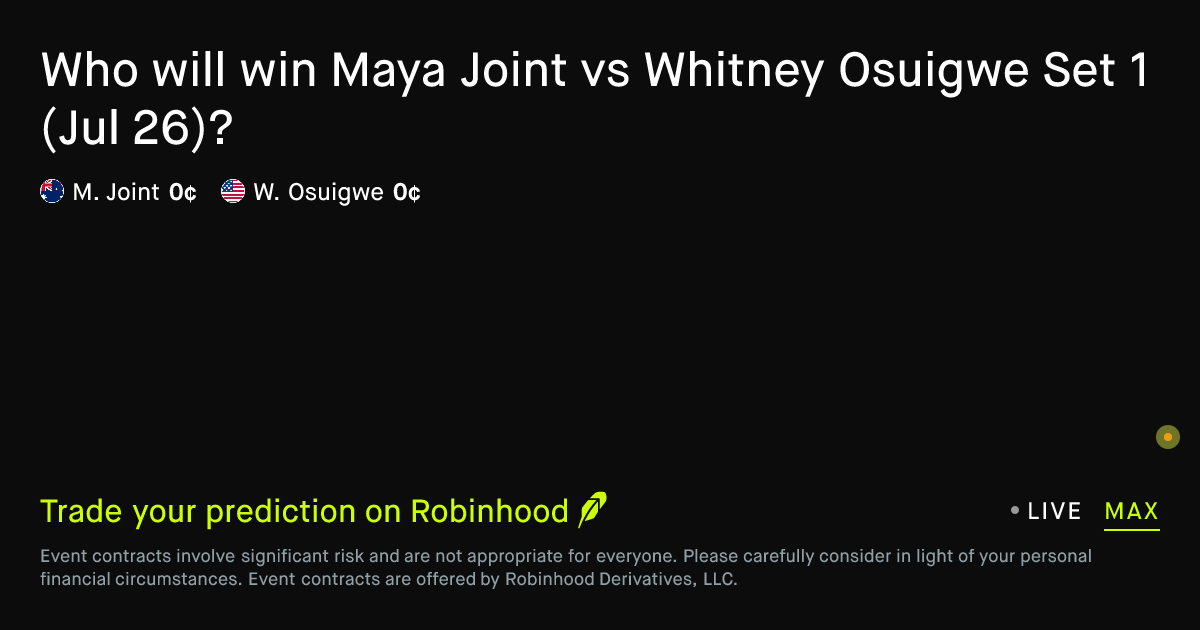
The derivative listings for the 2026 WTA Memphis tournament encompass two distinct competitive tiers within the event hierarchy. The primary draw asset targets the Round of 32 match featuring Maya Joint against Whitney Osuigwe, scheduled for July 27, 2026. This contract isolates the specific outcome of the first set, allowing market participants to trade binary exposure on early match momentum.
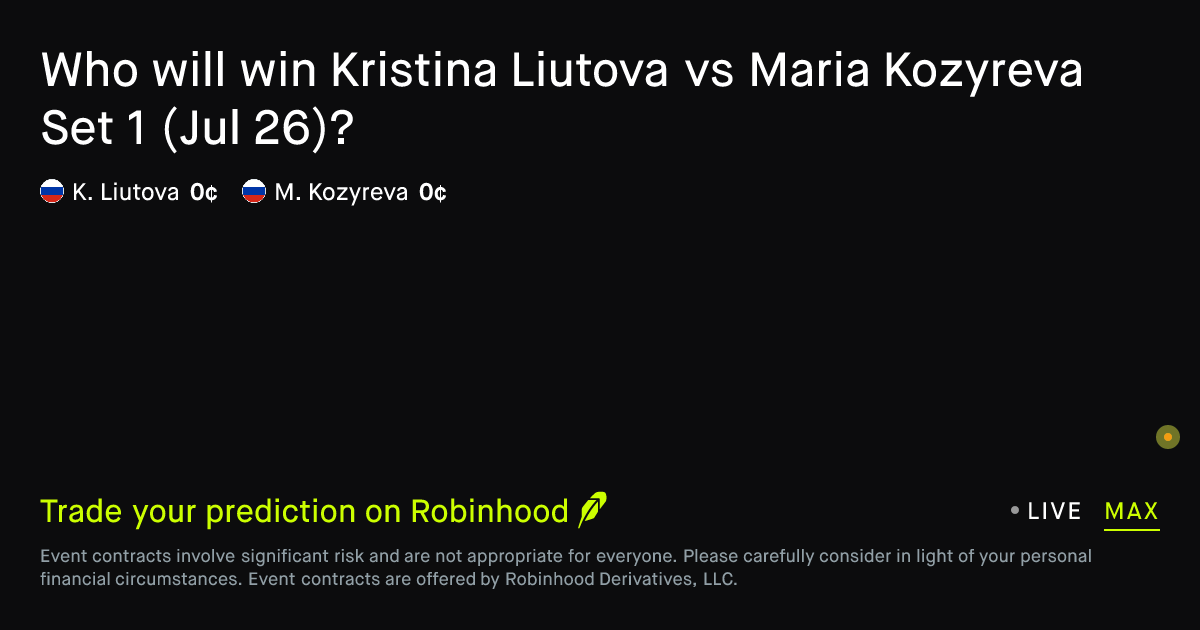
Concurrently, the qualification stage is securitized through dual contracts covering the Qualification Final match between Kristina Liutova and Maria Kozyreva on July 26, 2026. This contest features independent contracts for Set 1 Winner and Set 2 Winner. Including qualifying rounds demonstrates the exchange’s capacity to depth-price liquidity across varying stages of a professional tournament.
Set-Level Micro-Contract Dynamics and Settlement Rules
Kalshi structures these set-level derivatives under a binary payout system ($0.00 to $1.00 scale). Baseline order books display zero-cent references prior to live matching, establishing the framework for contract pricing scales. Upon resolution, contracts settle deterministically at $1.00 for the winning condition and $0.00 for the losing condition based on official set results.
Set-specific derivatives mitigate duration risk compared to full-match contracts due to accelerated settlement horizons. A Set 1 contract closes immediately upon the verified completion of the initial set, triggering execution protocols regardless of subsequent match progression. Furthermore, the independence of Set 1 and Set 2 contracts in the Liutova vs. Kozyreva match allows market participants to construct complex yield strategies across consecutive sets without cross-collateral locking.
Trading Windows, System Maintenance, and Liquidity Parameters
Trading accessibility operates under a continuous 24-hour cycle to capture global liquidity and real-time news flow. Continuous order matching enables position establishment, dynamic hedging, and portfolio liquidation prior to match commencement. This constant operational window ensures pricing efficiency across dynamic international time zones.
The exchange enforces a mandatory operational pause every Thursday between 3:00 AM and 5:00 AM Eastern Time. During this scheduled two-hour maintenance window, trading functionality and order matching are suspended globally across active order books. Participants holding open exposure through this period absorb temporary illiquidity, requiring systemic risk management prior to maintenance execution.
Legal Commencement Definitions and Pre-Match Invalidation
Contract enforceability relies upon precise legal definitions of match commencement. Exchange rulebooks define match commencement at the precise timestamp when a ball is served in live competition. This physical trigger marks the official boundary transitioning pre-match contract status into active operational market exposure.
If a match fails to achieve commencement due to pre-match disruptions—such as player injuries, administrative walkovers, forfeitures, or event cancellations—the contract bypasses standard athletic resolution. Under these conditions, the exchange invalidates binary clearing and transitions the asset to standardized fair price settlement, protecting participants from capital loss on uninitiated events.
Postponement Protocols and Fourteen-Day Settlement Windows
Environmental delays and schedule adjustments frequently disrupt open-air tennis timetables. Exchange protocols dictate that delayed or postponed matches remain active rather than triggering immediate cancellation, maintaining open order books pending match rescheduling.
The regulatory framework enforces a maximum fourteen-day execution window for postponed matches to reach physical resolution. If the rescheduled contest completes within this two-week timeframe, contracts settle against standard performance criteria. If physical completion is not achieved within fourteen days, secondary settlement protocols activate, releasing locked capital via exchange valuation mechanisms.
In-Match Retirement and Partial Contract Resolution
Mid-match player retirements present unique clearing challenges for point-in-time derivatives. The exchange applies a bifurcated settlement framework contingent upon whether the target contract set reached physical conclusion prior to the retirement event.
Contracts tied to sets fully completed prior to the retirement settle unconditionally according to the court result. Conversely, contracts covering incomplete sets interrupted by a retirement trigger discretionary exchange intervention. Standard score line clearing halts, and the venue initiates specialized fair value protocols to settle open positions equity-wise.
Fair Market Price Valuation and Platform Neutrality
When physical completion is interrupted, Kalshi applies a Fair Market Price model, reserving sole discretionary authority to establish final financial settlement values. This valuation evaluates order book depth, implied probability distributions, and volume-weighted average pricing (VWAP) recorded immediately prior to the disruptive event.
To guarantee market integrity, Kalshi maintains strict organizational neutrality, operating without corporate affiliation, financial partnership, or administrative alignment with the Women’s Tennis Association (WTA) or individual athletes (Joint, Osuigwe, Liutova, Kozyreva). Payouts execute through standardized clearing infrastructure, resolving within one hour of official outcome verification to preserve capital efficiency.