
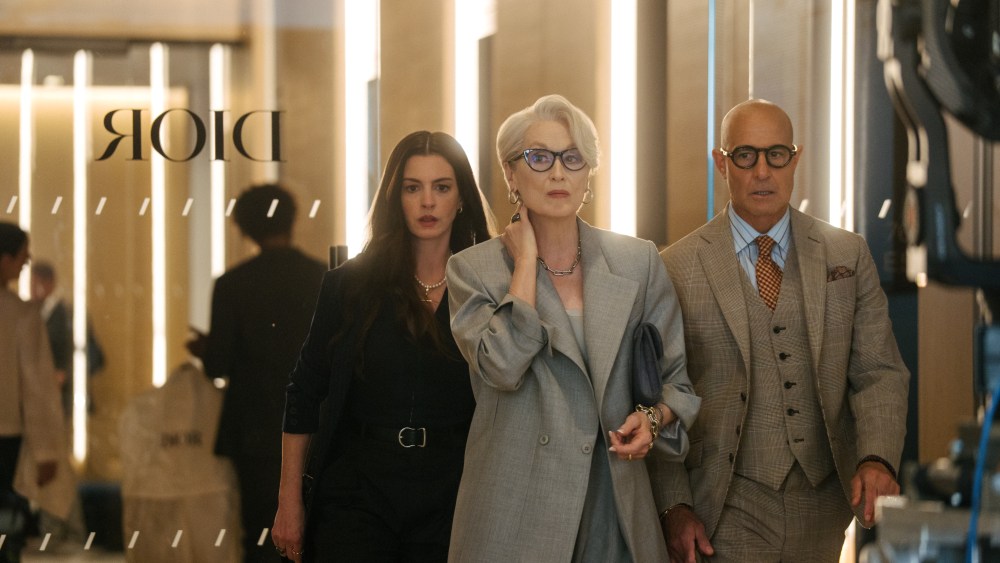
The $233 million global debut of The Devil Wears Prada 2 marks a significant structural recalibration of the theatrical marketplace. Featuring a $77 million domestic opening, the film’s performance challenges the prevailing industry assumption that high-budget viability is exclusive to action-oriented franchises, establishing a new commercial ceiling for the sophisticated dramedy genre.
Fiscal Architecture and Risk Mitigation
Disney’s $180 million total capital allocation—comprising a $100 million production budget and $80 million in global marketing—reflects a high-conviction bet on legacy brand equity. This 0.8-to-1 marketing-to-production ratio suggests a strategic ‘eventization’ of the property. By deploying substantial promotional capital, the studio successfully converted twenty years of latent nostalgia into immediate box office liquidity, positioning the sequel as a primary driver of quarterly theatrical revenue.
Comparative Benchmarking and Market Positioning
The film’s $233 million start occupies a strategic middle ground between the $372.5 million launch of The Super Mario Galaxy Movie and the $217 million debut of the Michael biopic. This positioning confirms that while animated IP remains the market ceiling, high-concept dramas anchored by established human capital can outperform major biographical tentpoles. Notably, the $77 million domestic start nearly triples the 2006 original’s $27.5 million unadjusted opening, indicating a vast expansion of the audience base and more efficient modern distribution channels.
Talent Continuity as an Operational Lever
The re-engagement of the core ensemble—Meryl Streep, Anne Hathaway, Emily Blunt, and Stanley Tucci—served as the primary mechanism for mitigating the financial risks of a $100 million budget. In a market where star power is often secondary to spectacle, this collective return provided the brand security necessary to justify high-tier investment. This talent-driven strategy facilitated a synergistic feedback loop with the luxury fashion ecosystem, leveraging appearances from figures like Donatella Versace to sustain cultural relevance and marketing momentum.
Sector Disruption and Distribution Consequences
Industry analysts view this performance as a ‘sensational outlier’ that may fundamentally alter institutional valuations of character-driven narratives. With the sequel projected to surpass the original’s $326 million lifetime gross within its first month, the film provides a template for ROI in non-spectacle sequels. For exhibitors, this success offers a vital proof of concept for the viability of non-superhero content, likely influencing Disney’s future distribution cadence toward theatrical-first windows over direct-to-streaming models.
Conclusion: The Evolution of the ‘Girlboss’ Narrative
By tapping into a demographic that values professional ambition and institutional critique, The Devil Wears Prada 2 has effectively monetized the ‘Girlboss’ nostalgia of the mid-2000s for a contemporary audience. As it enters its second phase of distribution, the focus shifts from velocity to durability. Given the lack of immediate genre competition, the film is poised to dominate the adult-oriented market, reinforcing the prestige of fashion-centric media as a high-yield cinematic investment.

Photo by Demko on Pixabay.