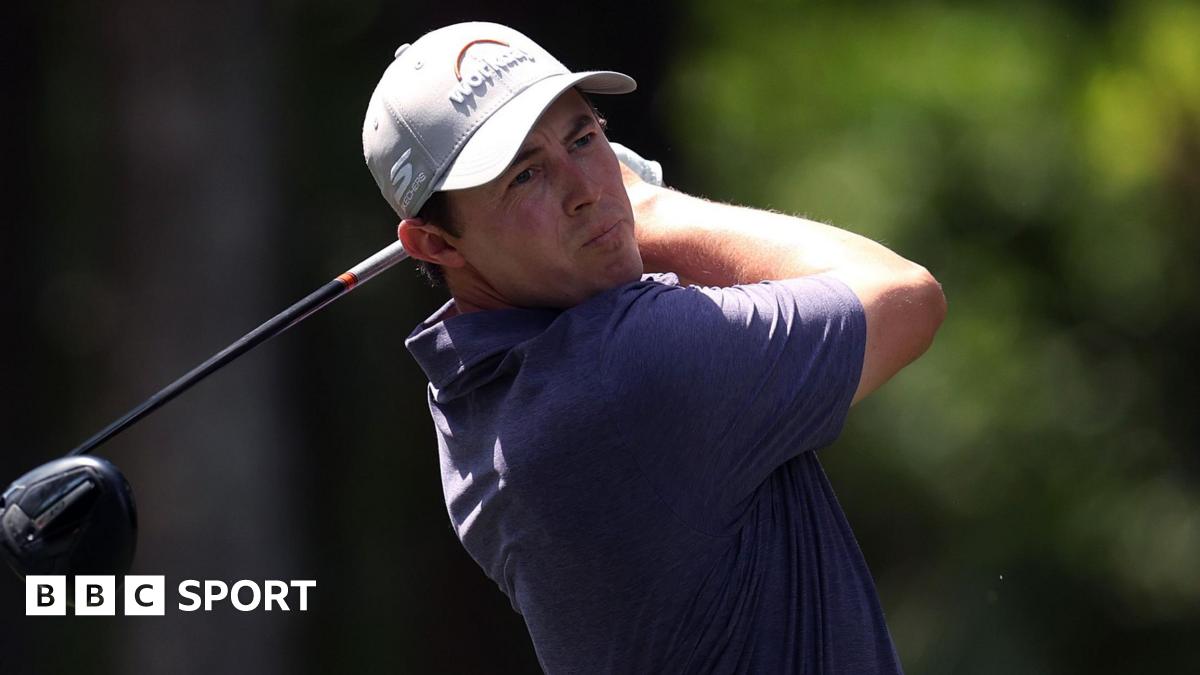
The 2026 RBC Heritage has converged into a high-leverage duel between its two most recent champions. Matt Fitzpatrick, the 2023 victor, enters the final round at Harbour Town Golf Links with a three-shot lead at 17-under par, following a strategically resilient 68. His primary obstacle remains World No. 1 and 2025 champion Scottie Scheffler, who looms at 14-under, setting the stage for a tactical confrontation defined by technical precision and psychological endurance.
Strategic Recovery and Momentum Management
Fitzpatrick’s third-round performance served as a study in volatility management. Following consecutive bogeys on the opening holes, which threatened to erode his overnight advantage, Fitzpatrick demonstrated significant operational discipline. He stabilized his scorecard to reach even par by the 12th before a pivotal chip-in eagle at the par-5 15th fundamentally recalibrated the leaderboard’s geometry. This stroke not only neutralized earlier errors but forced the chasing pack to adopt higher-risk profiles for the closing stretch.
Fitzpatrick’s historical affinity for the Hilton Head layout—bolstered by his 2023 victory and personal history with the venue—provides a structural advantage. His current form, including a victory at the Valspar Championship and a runner-up finish at the Players Championship, suggests he is operating at a competitive peak. At Harbour Town, where narrow corridors penalize marginal trajectory errors, this familiarity allows for more decisive club selection and risk mitigation.
The Scheffler Factor: Aggression vs. Precision
Scottie Scheffler’s position at 14-under par places him in the final pairing, a familiar environment for the world’s top-ranked player. The three-shot deficit necessitates a shift in Scheffler’s typically controlled cadence; he must identify early scoring opportunities to apply immediate pressure. Given Scheffler’s institutional knowledge of the course and his status as the defending champion, any sign of vulnerability from Fitzpatrick will likely be exploited by Scheffler’s elite ball-striking metrics.
The leaderboard density further complicates the tactical landscape. Brian Harman and S-Woo Kim sit four strokes back at 13-under par, while Ludvig Aberg (-12) and Sepp Straka (-13) remain within striking distance. This concentration of talent ensures that the final pairing cannot engage in a purely defensive battle, as a low-scoring clubhouse lead from the penultimate groups could quickly bridge the existing gap.
Contingency and Environmental Variables
The thin margins of professional golf were highlighted by Fitzpatrick’s Friday round, where a fortuitous bounce off a cart path and a sprinkler head saved a wayward shot, eventually leading to a birdie. Such technical luck, while unpredictable, often dictates the outcome of elite tournaments. For Fitzpatrick, capitalizing on these breaks has been essential to maintaining his cushion. Conversely, competitors like Viktor Hovland (-11), who faced more severe wind conditions during his second round, illustrate the uneven distribution of environmental challenges inherent to the event.
Scheduled for a 1:50 p.m. ET tee time, the leaders will navigate the course as the greens reach peak firmness and coastal wind patterns stabilize. The intersection of technical skill, mental resilience, and situational contingency will determine the champion. Whether Fitzpatrick can leverage his buffer or Scheffler can engineer a late-round surge, the 2026 RBC Heritage remains a critical benchmark for the PGA Tour’s competitive hierarchy.