
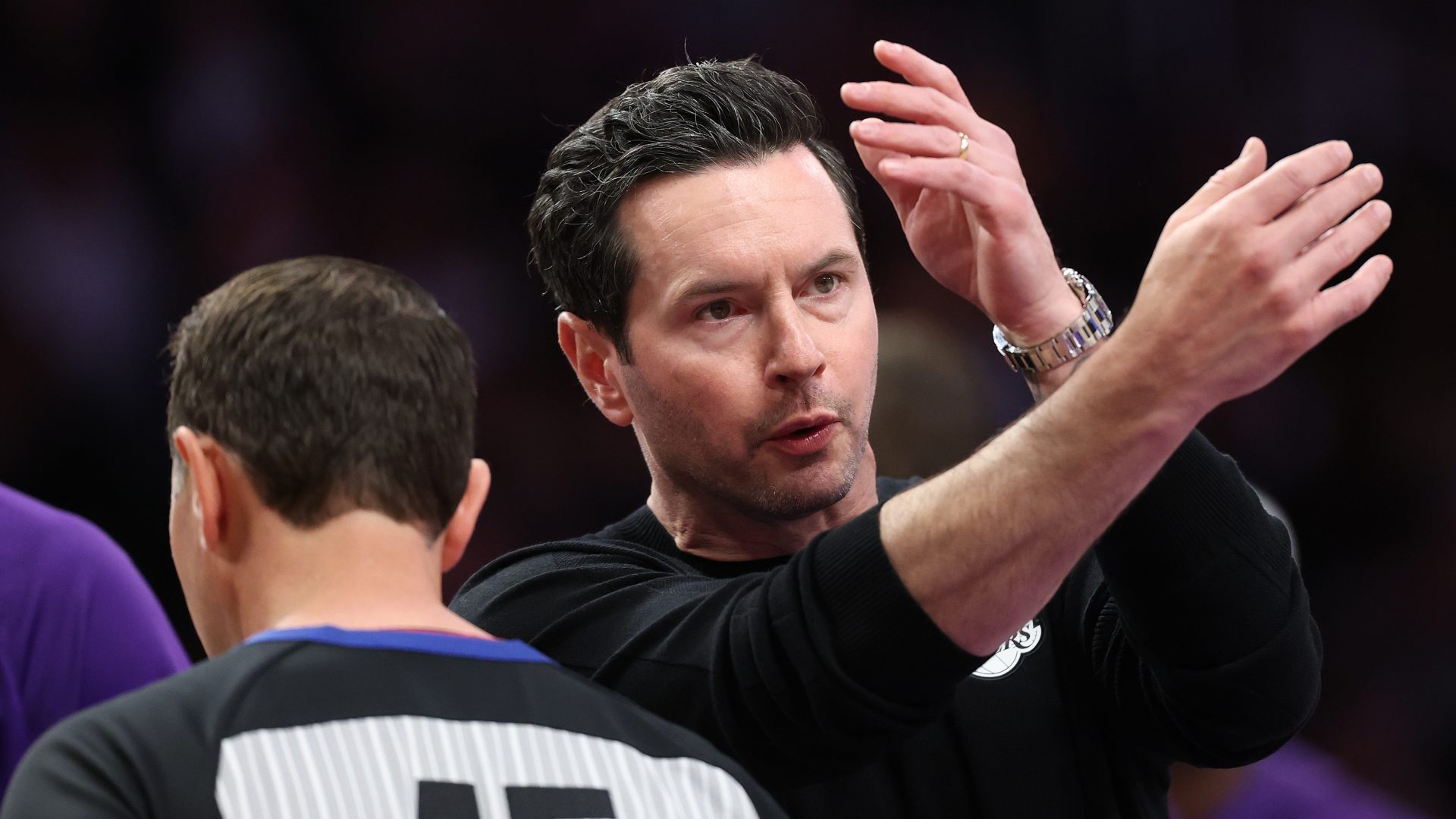
The Los Angeles Lakers have formally integrated Luke Kennard’s statistical dominance into their postseason identity. By presenting Kennard with the NBA trophy for leading the league in three-point percentage (47.8%), head coach JJ Redick signaled a pivotal shift in the team’s offensive calculus. This recognition, occurring just before their first-round matchup against the Houston Rockets, highlights how Kennard’s perimeter gravity fundamentally alters defensive rotations for opponents.
Kennard’s achievement represents a masterclass in high-leverage asset integration. After appearing in 46 games for the Atlanta Hawks, his transition to Los Angeles saw him maintain a remarkable 47.8% conversion rate over 78 total games. This consistency provides a critical floor-spacing mechanism, essential for mitigating the interior double-teams typically directed at LeBron James and Deandre Ayton. While his volume of 1.5 makes on 3.1 attempts per game is specialized, the efficiency ensures that opposing defenses cannot sag off the perimeter without immediate consequence.
Tactical Gravity and Offensive Spacing
The decision to move Kennard into the starting unit alongside Marcus Smart, LeBron James, Rui Hachimura, and Deandre Ayton creates a balanced offensive geometry. In modern NBA analytics, a 47.8% shooting threat functions as a force multiplier; his presence alone widens driving lanes by forcing defenders to stay home on the arc. This ‘gravity’ is particularly potent in Redick’s system, which leverages Kennard’s quick release to punish help-side defensive lapses.
Beyond pure shooting, Kennard has demonstrated significant playmaking growth. Over the final five regular-season games, he averaged 6.4 assists and 4.2 rebounds, evolving into a secondary facilitator. This development reduces the creative burden on LeBron James and Marcus Smart, allowing the Lakers to maintain offensive fluidity during high-pressure playoff possessions where primary options are neutralized.
The Houston Matchup: A Defensive Dilemma
As the series against the Houston Rockets commences, Kennard’s efficiency presents a unique scouting challenge. Houston must decide whether to prioritize rim protection against Ayton or stay attached to Kennard. Recent data suggests any concession to Kennard is a losing proposition; his 12.2 PPG average during the final week of the season indicates he is peaking at the optimal moment. His 4.2 rebounds per game also allow him to initiate transition opportunities, further stressing Houston’s backcourt.
Ultimately, the synergy between Kennard and JJ Redick—himself a historical archetype of the elite NBA shooter—suggests a highly optimized role. By utilizing scripted off-ball screens and hand-off actions, Redick is maximizing a professional asset whose technical proficiency is resistant to defensive variance. As the Lakers pursue a deep run, Kennard’s 47.8% accuracy remains the strategic foundation of their perimeter attack.

Photo by Photo_by_Everylin on Pixabay.