
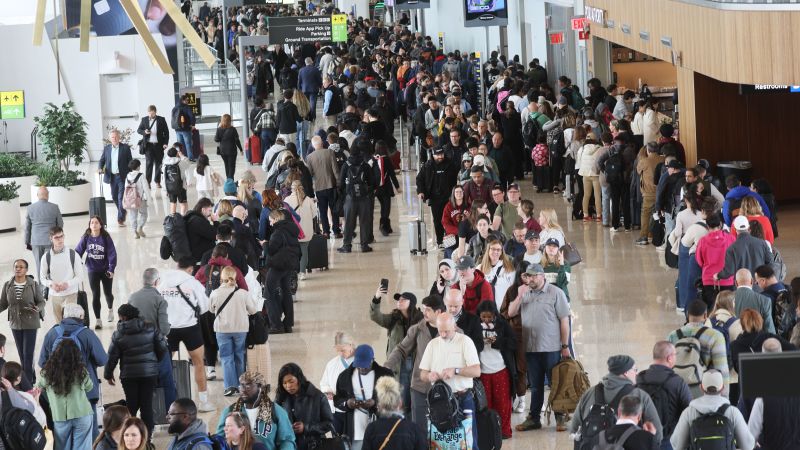
ICE Agents Deployed to Airports Amidst TSA Staffing Crisis and Government Shutdown
Immigration and Customs Enforcement (ICE) agents have been deployed to 14 major U.S. airports to support Transportation Security Administration (TSA) personnel. This intervention addresses critical staffing shortages within the TSA, a direct consequence of the ongoing partial government shutdown, which has resulted in unprecedented security wait times.
The deployment of ICE agents signifies a significant operational shift, reallocating personnel from core immigration enforcement duties to a vital civilian security function. This inter-agency resource reallocation highlights the cascading impacts of the federal government’s fiscal impasse on essential services.
President Trump announced a directive for the Department of Homeland Security (DHS) to “immediately pay” TSA agents, aiming to alleviate the financial strain on employees working without paychecks. This measure intends to mitigate the staffing crisis by encouraging continued work or the return of furloughed staff.
The proposed payment mechanism involves utilizing funds from previously enacted legislation, known as “the One Big Beautiful Bill.” This financial maneuver, while offering a potential solution for back pay, requires an internal review to determine disbursement speed and feasibility, introducing administrative uncertainty regarding immediate relief.
Following the President’s announcement, the Senate unanimously agreed to fund most of DHS, including the TSA. This bipartisan agreement signals a potential pathway to resolving the immediate funding crisis, though it awaits House approval.
The deployment of ICE agents underscores the strategic vulnerability exposed by the shutdown, particularly in critical infrastructure like airport security. The reliance on personnel from a different agency reveals a failure in maintaining baseline TSA operational capacity, impacting traveler confidence and national security perceptions.
The involvement of ICE agents in airport security, even in a support capacity, raises questions about long-term implications for border security and immigration enforcement priorities, as diverting resources could create operational gaps.
For travelers, the immediate impact is a potential reduction in wait times, though the scale of the problem persists. The reliance on non-TSA personnel introduces a new dynamic to the airport security experience, potentially affecting efficiency and the perceived professionalism of the screening process.
The legislative progress in the Senate suggests a potential end to the shutdown, but the interim period necessitates continued ad-hoc solutions. The effectiveness of ICE agents in managing airport security queues will critically influence the immediate traveler experience.
This situation highlights a systemic issue in federal agency funding and operational resilience. The dependence on emergency measures, such as inter-agency deployments, reveals a lack of robust contingency planning for prolonged fiscal impasses.
The economic implications of extended airport delays are substantial, impacting individual travelers and the broader travel and tourism industry. Lost productivity and missed connections have ripple effects throughout the economy.
The strategic decision to deploy ICE agents reflects an immediate prioritization of public safety and economic continuity over strict adherence to departmental mandates, demonstrating pressure on the administration for responsiveness.
The long-term consequence of this reliance on ICE for TSA support may prompt a reevaluation of inter-agency cooperation protocols and emergency resource management, as well as TSA staffing levels and funding mechanisms.
The media narrative surrounding airport delays and the ICE deployment will likely shape public perception of government effectiveness during the shutdown.
From a competitive bureaucratic standpoint, the effective management of this crisis by DHS and its agencies could influence future budget allocations and perceived operational competence.
Financial markets, particularly those tied to travel and leisure sectors, will monitor the shutdown’s resolution and its impact on consumer confidence and travel volumes.
The legislative stalemate, even with the Senate’s move, indicates that underlying political divisions persist, with potential for future standoffs impacting critical services.
The operational leverage gained by ICE through this deployment is minimal for its core mission but demonstrates federal agency responsiveness. Conversely, the TSA faces reputational exposure due to its inability to manage core functions without external support.
The strategic decision-making process likely involved a rapid assessment of available personnel and the most immediate threat to public order and economic activity, prioritizing immediate problem-solving over departmental silos during emergencies.
Capital movement implications are indirect but significant, as the shutdown freezes various capital deployments. Resolution represents a release of withheld capital back into the economy.
Performance leverage for the Trump administration lies in framing this intervention as decisive action, leveraging the narrative of “immediately paying” TSA agents and fixing lines as executive competence.
The exposure for the TSA is significant, laying bare operational vulnerabilities and dependence on consistent federal funding, potentially leading to increased scrutiny and reform calls.
Downstream effects on the travel industry are immediate, with airlines, hotels, and related businesses suffering from uncertainty and inconvenience.
Institutional implications extend to the relationship between Congress and the executive branch, concerning the use of executive authority to circumvent legislative impasses and setting precedents for future budget negotiations.
The cultural impact within federal agencies could be significant, with TSA employees potentially feeling undervalued and ICE agents experiencing shifts in public perception and operational focus.
The structural logic of federal agency operations is tested during crises, demonstrating how a single failure point, like payroll disruption, can cascade through the federal apparatus, necessitating emergency interventions that blur responsibilities.
The distribution of advantage and disadvantage is uneven: travelers and the industry are disadvantaged, while the administration may gain political advantage. ICE gains experience, while TSA’s standing is diminished.
Plausible evolution scenarios include a swift resolution or continued deadlock, with different consequences for public trust and operational continuity.
The historical pattern of government shutdowns reveals the fragility of federal operations when faced with prolonged fiscal disagreements, highlighting recurring systemic political and budgetary challenges.
The regulatory framework governing TSA operations is designed for consistent funding and staffing, and the current crisis exposes a gap where prolonged shutdowns can lead to a breakdown of essential security functions.
Economic models of transportation security rely on predictable staffing and continuity. The current situation disrupts these models, increasing costs associated with delays and potential security vulnerabilities.
The institutional depth of TSA’s operational capacity is strained, as reliance on ICE suggests insufficient internal capacity for surge staffing or rapid response to funding shortfalls.
The media’s role in amplifying the impact of long lines and ICE deployment is crucial, shaping public discourse and political pressure through easily digestible narratives and imagery.
The market context for airlines and related industries is one of heightened sensitivity to operational disruptions, potentially leading to stock volatility and reassessment of earnings.
The historical continuity of federal funding disputes suggests that the underlying political dynamics that lead to them persist, posing a continuous risk to government operations.
Strategic implications for national security are relevant, as prolonged disruptions at major transportation hubs can create vulnerabilities.
Operational challenges for ICE in adapting to airport security protocols, even temporarily, could impact their readiness for their core mission if not managed carefully.
Financial consequences of the shutdown extend to the government’s ability to finance operations, with the immediate impact on operational continuity rather than sovereign debt.
Performance leverage for the administration is to demonstrate decisive leadership in resolving the crisis, reinforcing its image as a capable manager of national affairs.
Exposure for the TSA is operational and reputational, potentially affecting future recruitment and retention if perceived as underfunded or politically vulnerable.
Downstream effects on global supply chains can also be impacted by disruptions at major international gateways.
The institutional response to this crisis will likely involve analysis of TSA funding and operational resilience, potentially leading to legislative proposals to prevent future severe impacts from shutdowns.
Cultural implications for federal employees could include a sense of instability or a reevaluation of job security due to observed disruptions and reliance on inter-agency support.
Structural pressures on the U.S. federal system to balance political negotiation with maintaining essential services are evident, highlighting the tension between legislative power and executive action during fiscal disputes.
The distribution of advantage and disadvantage is a complex interplay of political maneuvering, public perception, and operational realities.
Plausible evolution scenarios are contingent on political will to find lasting solutions, a pattern historically elusive in U.S. federal budgeting.

Photo by Dragon77 on Pixabay.