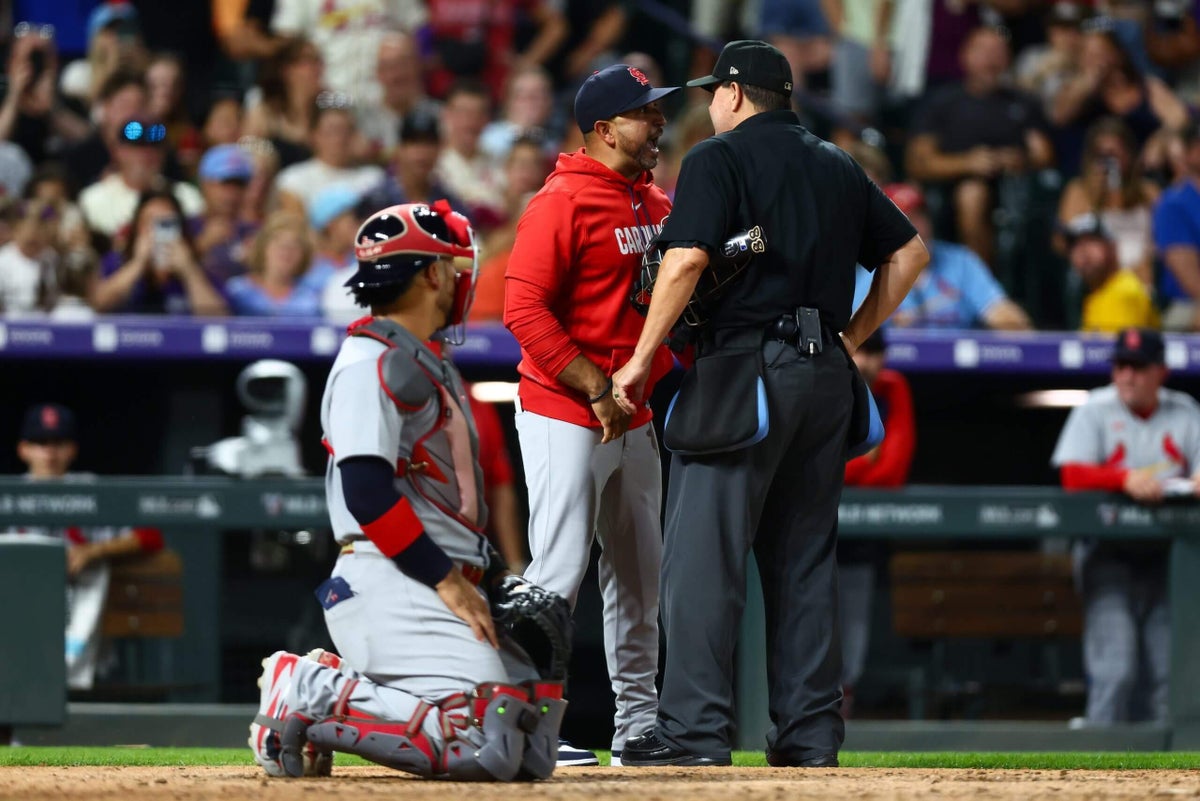
The St. Louis Cardinals’ 7-6 victory over the Colorado Rockies at Coors Field represents a compelling case study in the volatile intersection of officiating authority, player psychology, and high-stakes competitive momentum. While the box score highlights a narrow win driven by a late-inning rally, the underlying narrative scrutinizes a series of administrative disruptions that directly challenged the professional debut of a key organizational asset.
The genesis of what has been dubbed ‘Hat Gate’ occurred in the bottom of the sixth inning, exposing a significant friction point between traditional officiating prerogatives and the nuanced psychological management of rookie talent. Reliever Hancel Rincon, freshly called up from Triple-A Memphis, experienced his Major League debut interrupted not by a tactical adjustment or physical ailment, but by a subjective directive concerning his uniform alignment.
Home plate umpire Doug Eddings controversially halted play during a 2-0 count against batter Cole Carrigg, mandating that Rincon straighten his cap. Manager Oliver Marmol swiftly characterized this intervention as an unnecessary assertion of dominance, occurring at a high-leverage juncture and potentially compromising the nascent rhythm and focus of a pitcher navigating the most significant transition of his professional career.
Strategic Implications of Officiating Interventions
Eddings’ decision to unilaterally pause the game for a non-safety-related uniform adjustment raises critical questions regarding the precise boundaries of officiating influence on player performance. By instructing catcher Leo Bernal to address Rincon’s cap, the umpire effectively and demonstrably altered the psychological and environmental variables of the at-bat—a move Marmol vehemently argued constituted an overreach of authority.
Marmol’s ensuing ejection was not merely an impulsive reaction to the cap directive, but a calculated, visible defense of a young player’s mental fortitude during a supremely vulnerable debut. The manager’s assertion that Eddings claimed the field as ‘his’ underscores a systemic tension: the delicate balance between the neutral enforcement of rules and the personal branding or subjective interpretation of individual umpires.
From a strategic perspective, while a manager’s ejection can sometimes galvanize dugout cohesion, in this instance, it coincided precisely with a significant deterioration in game control. The Cardinals, initially holding a commanding 4-1 lead, saw that advantage rapidly erode into a 6-4 deficit shortly after the sequence, starkly illustrating the tangible cost of officiating friction on the team’s immediate operational outcomes.
Media Scrutiny and Professional Standards
The Cardinals’ broadcast team, particularly former pitcher Brad Thompson, provided an uncharacteristically candid assessment, offering a rare public window into the perceived erosion of officiating quality during the contest. Thompson’s vocal frustration centered on what he described as a series of blatant missed calls directly impacting the scoring environment.
The most egregious among these errors was a missed out call at home plate, where visual evidence unequivocally indicated a clear tag that Eddings, despite his proximity, failed to acknowledge. This lapse in fundamental execution, coupled with what was characterized as Eddings’ ‘major attitude’ during the announcement of a failed review, suggests a concerning departure from the professional decorum expected at the Major League level.
Furthermore, the subsequent imposition of a pitch clock violation immediately following the argument with Marmol strongly implies a punitive application of the game’s timing mechanisms. When officiating tools are perceived as instruments for settling personal or professional grievances rather than objectively maintaining pace of play, the foundational integrity of the competitive product is inevitably called into question.
Competitive Stakes and Wildcard Implications
The financial and institutional stakes amplifying these officiating decisions are magnified by the Cardinals’ precarious position in the National League playoff hunt. Entering the game three games back from the final wildcard spot, every single victory represents a significant fluctuation in the probability of securing postseason revenue and enhancing brand valuation.
A potential loss stemming from officiating inconsistencies would have unequivocally represented a systemic failure of the league’s quality control mechanisms at a moment of maximum consequence. The Cardinals’ demonstrable capacity to overcome a two-run deficit in the late innings, however, speaks to an intrinsic organizational resilience that effectively mitigated the potential damage inflicted by the sixth-inning disruptions.
Ivan Herrera’s dramatic 430-foot home run in the ninth inning ultimately provided the decisive offensive leverage, securing the 7-6 victory and effectively neutralizing the cumulative impact of the earlier administrative errors. This favorable outcome for St. Louis, while vital, does not absolve the broader system from addressing the inherent volatility introduced by inconsistent individual officiating performances.
Psychological Impact on Rookie Integration
For a player like Hancel Rincon, a Major League debut signifies the culmination of years of organizational investment and personal development. The introduction of an unwarranted external conflict regarding his appearance, rather than his athletic performance, imposes an additional, unnecessary layer of psychological complexity onto an already high-pressure environment.
The Cardinals’ strategic decision to call up Rincon on September 1st aimed to fortify a bullpen under duress during the season’s crucial final stretch. When an umpire’s intervention risks derailing such a calculated organizational investment, it generates a clear conflict between the team’s operational objectives and the league’s officiating culture.
The fact that Rincon was able to adapt his cap and resume pitching, despite the ensuing managerial chaos and his manager’s ejection, provides an initial benchmark for evaluating his professional composure. Nevertheless, the precedent established by Eddings’ intervention remains a significant point of concern for franchises actively integrating young talent into the high-stakes Major League roster.
Technology, Review Systems, and Officiating Integrity
This incident starkly illuminates the inherent limitations of current replay and review systems in effectively addressing the ‘attitude’ or subjective ‘feel’ of a game’s officiating. While overt missed calls can be challenged, the critical tone set by an umpire’s interactions with players and staff remains fundamentally outside the purview of technological correction.
Thompson’s pointed critique of the ‘major attitude’ displayed during the review announcement suggests that the delivery of officiating decisions can be as impactful as the decisions themselves. In a sport increasingly defined by precise data and automated systems, the unpredictable human element, exemplified by Eddings, continues to function as a volatile and sometimes destabilizing variable.
The undeniable failure to correctly identify a clear out at home plate, even with the umpire’s advantageous proximity, underscores a persistent and problematic gap between the capabilities of modern broadcast technology and the limitations of human perception. This discrepancy generates significant reputational risk for the league, particularly when its own broadcast partners feel compelled to abandon their usual neutrality to criticize officiating performance.
Institutional Accountability and Future Governance
The comprehensive fallout from ‘Hat Gate’ and the subsequent chain of officiating errors will undoubtedly necessitate rigorous review by the league’s department of on-field operations. While ejections are a routine aspect of the game’s disciplinary landscape, the specific and egregious circumstances involving a rookie’s cap and the compounded missed calls strongly suggest a demand for more stringent performance evaluation.
The Cardinals’ success in pulling within three games of a wildcard spot ensures that immediate focus remains on competitive play, yet the institutional memory of this contest will undeniably shape future interactions between manager Marmol’s staff and Eddings’ crew. The fundamental trust between the dugout and the officiating corps, crucial for effective game management, was unequivocally compromised at Coors Field.
Ultimately, this game serves as a stark reminder: while players and managers are held to exacting performance standards, the officials overseeing the contest are equally susceptible to the intense pressures of a high-stakes environment. The game’s resolution in favor of the Cardinals offers a narrative of triumph over adversity, but the systemic structural issues revealed by this officiating performance remain demonstrably unresolved.
Implications for National League Playoff Standings
The 7-6 win transcends a mere single data point; it represents a critical survival mechanism for a team confronting dwindling opportunities to secure a postseason berth. The profound volatility introduced during the sixth inning could have, with ease, resulted in a loss that would have mathematically marginalized the Cardinals’ playoff aspirations.
By securing this vital victory, the Cardinals unequivocally maintain their strategic leverage in the wildcard race, sustaining pressure on competing teams. This win, achieved demonstrably in spite of significant administrative hurdles, emphatically reinforces the indispensable value of veteran leadership and clutch, late-inning offensive power in surmounting external variables.
As the season rapidly approaches its climax, scrutiny on officiating will inevitably intensify, as the margin for error for both teams and umpires progressively narrows. The events at Coors Field will undoubtedly serve as a pivotal reference point for future discussions regarding the delicate balance of power on the field and the paramount necessity of prioritizing competitive integrity over any individual officiating preferences.