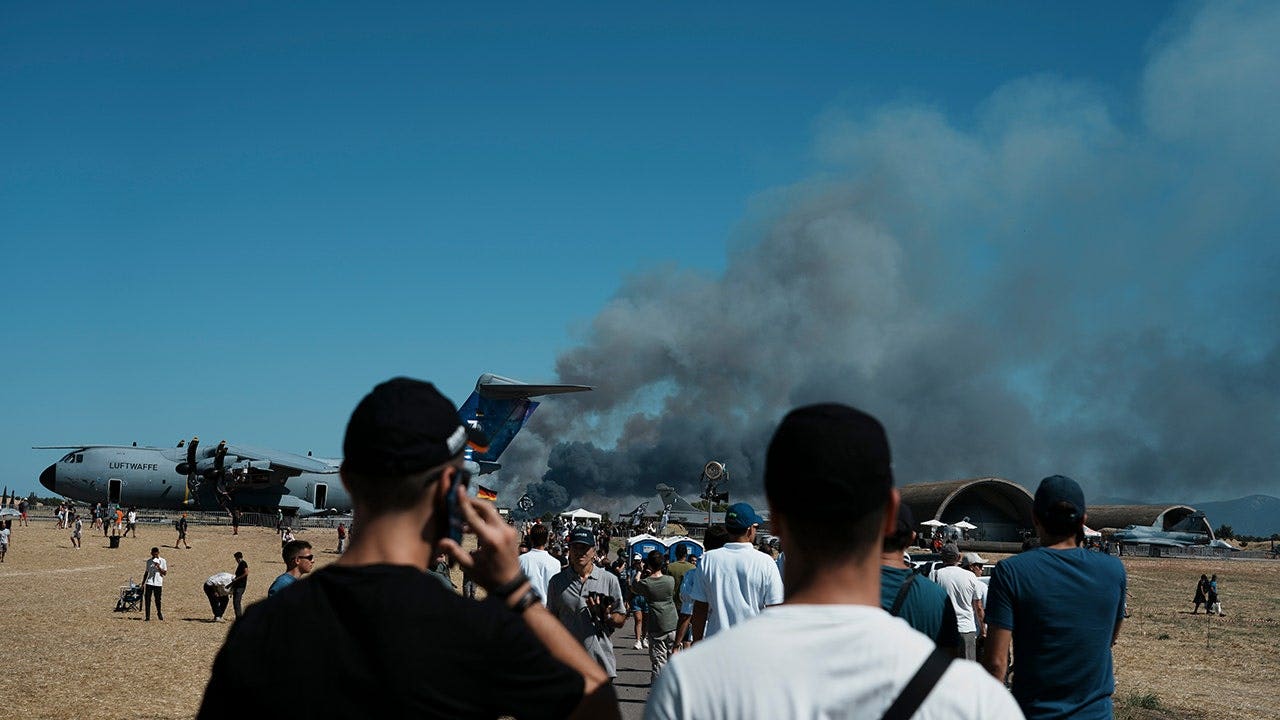
The tragic crash of a Hellenic Air Force (HAF) F-4 Phantom during a low-altitude demonstration at the Athens Flying Week at Tanagra Air Force Base marks a profound inflection point for Greece’s military aviation. Beyond the immediate loss of two experienced aviators and a critical airframe, the incident, witnessed by thousands, abruptly shifted focus from a display of national defense prowess to an urgent, multi-agency emergency response, exposing inherent risks in operating legacy platforms within high-intensity public contexts.
Operational Risks of Legacy Platforms and Low-Altitude Maneuvers
Despite its vintage, the F-4 Phantom, a twin-seat supersonic interceptor, endures as a cornerstone of the Hellenic Air Force’s aerial defense posture, demanding exacting maintenance protocols and elite pilot proficiency. The incident details, confirming the aircraft’s impact during a low-altitude maneuver mere meters above the ground, highlight an intrinsically high-risk flight regime. In such a compressed operational envelope, aerodynamic stressors are maximized, and the window for crew recovery from any technical malfunction or situational misjudgment narrows to near zero, underscoring the razor-thin margin for error inherent in such high-performance demonstrations.
The brevity of the flight, lasting under three minutes, points to the incident transpiring within a critical and demanding phase of the flight profile—typically characterized by high-workload sequences for both airframe and crew. During these initial minutes of a sortie, particularly in low-level exhibition flights, engine performance, flight control responsiveness, and precise situational awareness are paramount. The abrupt transition from takeoff to impact critically diminished any opportunity for the crew to initiate emergency procedures or guide the aircraft clear of the airfield’s immediate perimeter, a grim reality confirmed by the crash site within the Tanagra base.
The dual loss of a twin-seat airframe translates directly into a significant depletion of specialized human capital. Both the pilot and the weapon systems officer are highly trained, integral components of the F-4’s operational ecosystem. The substantial institutional investment in their training means their sudden removal from active duty immediately impacts the operational readiness and tactical depth of their squadron. This human cost is exacerbated by the destruction of the airframe itself, an asset which, despite its age, consistently contributes to Greece’s broader strategic posture and air superiority objectives in the volatile Eastern Mediterranean.
Institutional Response and National Security Narrative
Prime Minister Kyriakos Mitsotakis’s swift public statement strategically reframed the tragedy, elevating it beyond a mere accident to a consequence of the ‘daily danger’ inherent in Hellenic Air Force operations. By explicitly linking the crash to the imperative of ‘constant standby’ for protecting Greek airspace, the government reinforced a national security narrative portraying a military under sustained geopolitical pressure. This rhetoric serves to solidify public support for ongoing defense modernization efforts and to contextualize the unavoidable risks pilots face in maintaining peak readiness within a high-tempo operational theatre.
The Prime Minister’s emphasis on the pilots’ sacrifice underscores the profound symbolic weight the air force carries within Greek national identity and sovereignty, particularly in a region marked by persistent airspace challenges and a critical demand for rapid interception capabilities. While public visibility at events like Athens Flying Week is vital for recruitment and public relations, this incident now mandates a rigorous recalibration of the military’s risk communication strategy to the civilian populace, especially concerning high-performance maneuvers executed in close proximity to large spectator gatherings.
Beyond public messaging, the palpable institutional grief expressed by state leadership reinforces the cohesive nature of the Greek defense community. The meticulous handling of pilot recovery and the subsequent investigation will prioritize sensitivity, crucial for maintaining morale within the HAF ranks. Crucially, the government’s steadfast response projects an unwavering message to international allies and regional competitors: despite this profound loss, the Hellenic Air Force’s operational mandate remains resolute, and Greece’s commitment to territorial integrity is absolute and non-negotiable.
Logistical Complexity of the Emergency Response
The sheer scale of the fire suppression effort at Tanagra Air Force Base vividly illustrates the potential for cascading hazards inherent in a high-speed aircraft impact. The rapid deployment of 85 firefighters, augmented by 11 water-dropping aircraft and helicopters, unequivocally indicates the resulting blaze posed a severe threat not only to the immediate crash site but potentially to critical base infrastructure and surrounding areas. Given that military airbases typically contain sensitive equipment, extensive fuel reserves, and munitions, immediate and comprehensive fire containment becomes a strategic imperative, transcending the primary recovery operation.
The strategic deployment of water-dropping aircraft, ordinarily reserved for extensive wildfires, signifies that the impact generated a blaze of significant intensity and spread potential, either difficult to access or rapidly escalating across the airfield’s expanse. This extensive mobilization underscores the highly integrated nature of Greece’s national emergency services, where military and civilian assets are routinely co-deployed for optimal response efficiency. Beyond physically impeding initial rescue efforts, the resulting dense plume of black smoke served as a visceral, unequivocal indicator of the crash’s catastrophic severity to the thousands of spectators.
The logistical complexities of orchestrating such a large-scale emergency response within an active military installation during a public exhibition were profound. Air force statements confirming fire-induced delays in reaching the wreckage highlight a critical challenge in immediate post-crash recovery. Nevertheless, the successful containment of the blaze without civilian injuries attests to the efficacy of pre-established safety protocols at Athens Flying Week in isolating the crash site from spectator zones, even amidst a highly dynamic and prioritized operational response.
Strategic Implications for Athens Flying Week and Public Displays
The Tanagra crash instigates an urgent reassessment of low-altitude military flight displays at prominent annual events like Athens Flying Week. While these exhibitions are instrumental for showcasing military prowess and cultivating public engagement, the specter of thousands of civilian spectators amplifies the stakes of any operational failure. The absence of civilian casualties, while a testament to effective safety perimeters, cannot mitigate the profound and potentially enduring psychological impact of witnessing a jet erupt in flames, challenging public confidence in aviation safety.
Consequently, both event organizers and military strategists will undoubtedly undertake an exhaustive review of display protocols, which could necessitate more stringent flight envelopes for legacy aircraft or further restrictions on maneuvers performed proximate to spectator areas. The F-4 Phantom’s performance envelope, however venerable, will be rigorously evaluated against contemporary safety benchmarks for public exhibitions. Any resulting protocol modifications would signify a broader, systemic evolution in military aviation towards enhanced risk mitigation, meticulously balancing the critical need for public engagement with the paramount imperative of preserving high-value assets and invaluable personnel.
Moreover, the incident undeniably impacts the commercial and diplomatic leverage inherent in Athens Flying Week, an event typically serving as a crucial showcase for international defense contractors and regional strategic partners. A fatal accident involving a frontline airframe risks profoundly overshadowing the promotional and networking facets of the event, pivoting the narrative towards safety records, fleet viability, and the operational costs of aging assets. Stakeholders within the Greek defense ecosystem will meticulously observe how the Hellenic Air Force calibrates its future participation to ensure that the strategic benefits of public displays continue to outweigh the inherent risks of catastrophic operational failure.
Financial and Structural Consequences of Airframe Loss
The destruction of an F-4 Phantom jet, even as the platform approaches its operational twilight in many global air forces, imposes tangible financial and structural costs on the Hellenic Air Force. Each airframe contributes directly to the fleet’s aggregate flight hours and mission capacity. The loss of a single jet, therefore, necessitates an immediate redistribution of finite maintenance resources and a re-optimization of flight schedules across the remaining F-4s to sustain the requisite operational readiness for critical national defense tasks.
Beyond the immediate loss, the subsequent investigation into the crash will invariably consume substantial administrative, technical, and human resources. Ascertaining the precise causal factors—whether mechanical failure, environmental variables, or human factors—demands a meticulous forensic analysis of wreckage, flight data recorders, and comprehensive maintenance records. This exhaustive process is not merely reactive; it is critical for identifying any systemic vulnerabilities that could jeopardize the remaining F-4 fleet, potentially instigating temporary groundings or mandatory fleet-wide inspections, thereby further impacting operational availability.
Within the broader framework of Greece’s defense procurement strategy, incidents of this nature invariably accelerate high-level discussions regarding comprehensive fleet modernization. The continued reliance on legacy platforms such as the F-4 Phantom starkly underscores the persistent necessity for substantial capital investment in newer, technologically advanced, and inherently more reliable platforms. While the F-4 has undeniably served as a resilient workhorse for the HAF, the escalating operational costs and inherent risks associated with sustaining these aging aircraft in a flight-ready state fundamentally strengthen the strategic imperative for policymakers and military leadership to expedite the transition to next-generation fighter capabilities.
Media Dynamics and Public Information Management
The immediate and widespread dissemination of eyewitness accounts and visual documentation by state-owned broadcaster ERT, alongside thousands of spectator-generated mobile phone recordings, vividly highlights the acute challenges of real-time information management in the digital era. This rapid, uncontrolled narrative compelled both government and military authorities to respond swiftly and transparently. The promptness of initial official reporting, complemented by the Prime Minister’s decisive statement, proved critical in mitigating public anxiety and proactively countering the potential proliferation of misinformation, particularly concerning civilian casualties.
Media emphasis on the ‘three-minute’ flight duration and the harrowing ‘second ball of fire’ as the aircraft disintegrated furnishes a granular, albeit distressing, level of detail that profoundly shapes public comprehension of the incident’s violence. This intense public scrutiny consequently exerts considerable pressure on military investigators to deliver clear, definitive, and timely answers regarding the precise sequence of events. The institutional credibility of the Hellenic Air Force is inextricably linked to its capacity for conducting a thoroughly transparent investigation while scrupulously safeguarding sensitive operational data.
In conclusion, the Tanagra crash represents a stark and tragic demarcation between a public demonstration of military prowess and a catastrophic operational failure. Its repercussions will reverberate across the Hellenic Air Force’s training paradigms, public relations frameworks, and long-term procurement strategies. As the rigorous investigation unfolds, the dual imperative remains: to honor the fallen aviators with profound respect, while meticulously integrating the hard-learned lessons from this tragedy into the fundamental tenets of Greek military aviation safety and strategic readiness, thereby shaping the future trajectory of the HAF.