Bertha’s Inland Moisture Fuels Widespread Flooding Threat
Tropical Storm Bertha, having made landfall and weakened to a depression, continues to exert a significant atmospheric influence, generating a substantial flooding threat across the Southeastern United States. This risk extends hundreds of miles inland, diverging from its initial trajectory near the Texas-Louisiana border.
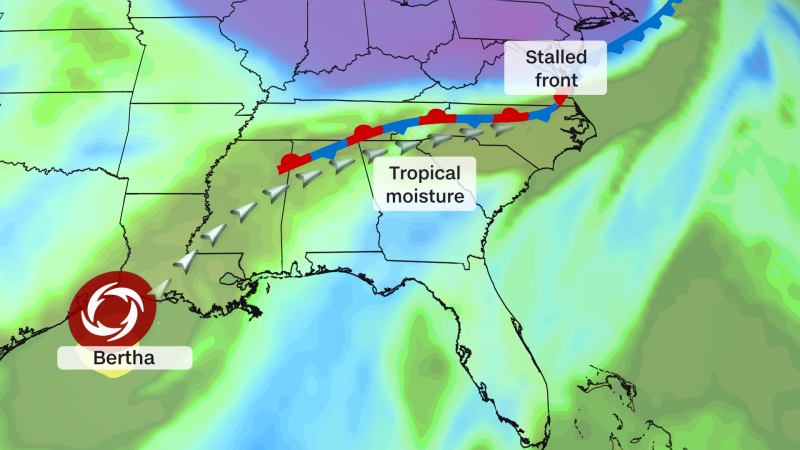
The most pervasive flooding risk is not confined to Bertha’s immediate landfall zone but is unfolding along a cold front draped across the Southeast. This meteorological setup acts as a conduit, concentrating tropical moisture inherited from Bertha into intense rainfall events.
This concentrated moisture plume is projected to sustain significant flooding rainfall across the region through Friday. North and South Carolina, along with northern Georgia and Alabama, face the highest exposure to this enhanced precipitation, potentially experiencing more severe flooding than areas closer to the storm’s dissipation point.
Infrastructure and Transportation Disruptions
The intensity of these rainfall events has already triggered operational disruptions. Heavy downpours on Thursday morning prompted flash flood warnings across significant portions of southeastern Virginia, eastern North Carolina, and eastern Tennessee, underscoring the immediate impact on regional infrastructure.
Specifically, a critical transportation artery, Interstate 40 northwest of Durham, North Carolina, experienced a temporary closure due to flooding. This disruption, though subsequently reopened by the state’s department of transportation, highlights the vulnerability of key logistical networks to extreme weather events driven by such tropical systems.
Further evidence of localized impact includes flash flood warnings issued Wednesday night for North Carolina cities such as Greensboro and Winston-Salem, directly resulting from intense storms dropping substantial rainfall. This indicates a pattern of localized downpours within the broader moisture band.
Meteorological Dynamics and Regional Exposure
The meteorological dynamics at play illustrate a critical aspect of tropical cyclone behavior: the extended reach of moisture. Even as a storm’s core circulation weakens and moves inland, the vast reservoir of moisture it has ingested can be transported and amplified by other atmospheric features.
In Bertha’s case, its interaction with an existing cold front has created a more potent and widespread rainfall threat than might be anticipated from a system that has lost its tropical storm status. This phenomenon emphasizes the necessity of forecasting beyond the immediate storm track, considering the broader atmospheric environment and interactions.
The differential impact, where areas hundreds of miles inland face greater flooding risks than coastal regions, demonstrates the complex interplay between tropical moisture, frontal systems, and topography. This necessitates a nuanced approach to disaster preparedness and resource allocation, extending well beyond the immediate landfall zone.
Forecasting and Public Preparedness Implications
Operational meteorological services must account for the potential of these inland moisture plumes to generate severe weather, even after a storm technically weakens. This requires sophisticated analysis of atmospheric moisture content and its interaction with prevailing weather patterns.
For the public and emergency management agencies, this underscores the need for continuous vigilance. Warnings and advisvisories issued for areas far from the coast reflect a tangible and immediate threat to life and property. The experience in North Carolina, where areas received a month’s worth of rain in a few days, serves as a stark reminder of the potential for rapid and severe inundation.
Tools like radar and forecast maps are paramount for understanding the spatial distribution and intensity of rainfall, enabling more targeted and effective public safety messaging and resource deployment.
Strategic Considerations for Infrastructure Resilience
The recurring nature of such events prompts strategic considerations for infrastructure resilience. Transportation networks, urban drainage systems, and critical facilities in flood-prone areas, even those not directly on the coast, must be assessed for their vulnerability to prolonged and intense rainfall.
Investment in advanced weather monitoring and forecasting technologies is crucial for public safety and infrastructure management. Accurately predicting the movement and impact of moisture plumes, as seen with Bertha, can significantly improve response times and mitigate damage.
Furthermore, the economic implications of widespread flooding extend beyond immediate repair costs. Disruptions to agriculture, commerce, and daily life can have cascading effects, emphasizing the long-term economic imperative of investing in flood mitigation and resilient infrastructure design.
Comparative Weather Event Analysis and Preparedness
The meteorological principles governing Bertha’s inland moisture surge are not unique. The amplification of tropical moisture by other weather systems is a recurring pattern observed in various meteorological events globally, informing broader strategies for climate adaptation and disaster risk reduction.
The information provided by weather services plays a vital role in translating complex meteorological data into actionable insights. The integration of expert analysis with operational forecasting is essential for effective communication of weather-related risks.
The dissemination of critical weather information through subscription services is integral to public safety infrastructure, providing timely alerts and forecasts that enable proactive measures against severe weather.
Long-Term Implications for Regional Planning
The persistent threat of inland flooding from tropical systems necessitates a long-term perspective in regional planning. This includes land-use policies that discourage development in high-risk floodplains and investments in green infrastructure to manage stormwater runoff.
A region’s capacity to absorb and recover from such events is directly linked to its preparedness and resilience strategies. The economic and social costs associated with repeated flooding can strain budgets, underscoring the importance of proactive mitigation efforts.
Ultimately, the events associated with Tropical Storm Bertha serve as a case study in the evolving challenges posed by weather systems in a changing climate. The ability of these systems to retain and transport significant moisture far inland highlights the interconnectedness of atmospheric processes and the need for comprehensive, forward-looking disaster management approaches.