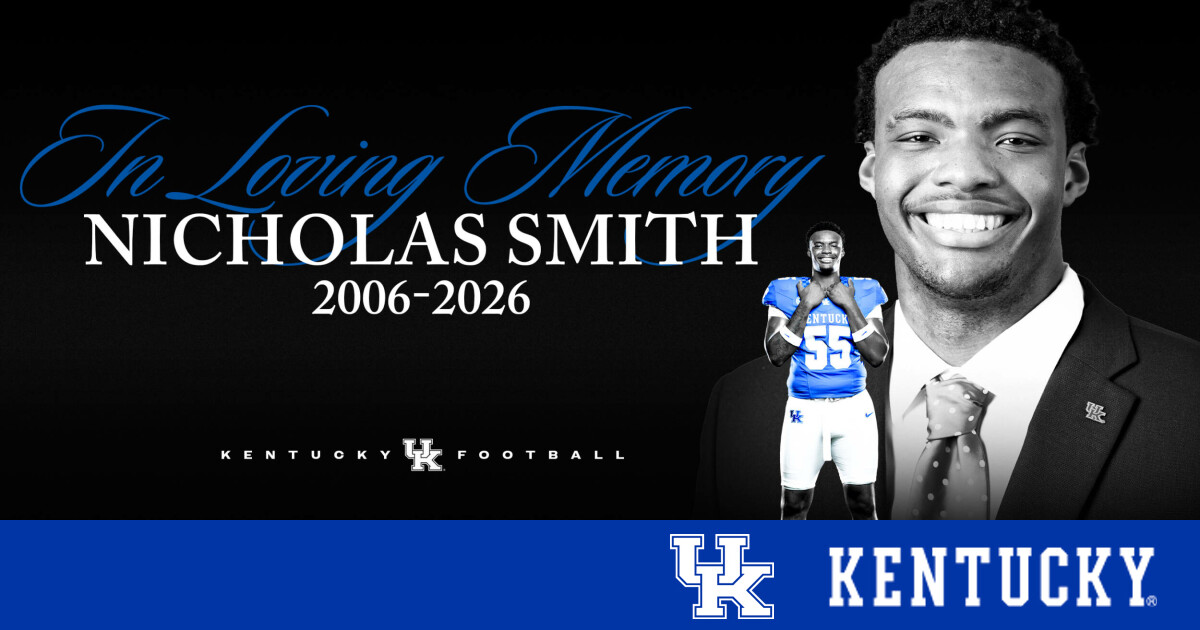
The passing of Nicholas “Happy” Smith, a redshirt freshman defensive lineman at the University of Kentucky, represents a complex institutional disruption extending beyond the immediate athletic tragedy. Within the high-stakes Southeastern Conference (SEC) ecosystem, Smith was a significant developmental asset—a three-star recruit from Loganville, Georgia, whose death during the 2026 academic cycle triggers critical administrative protocols and strategic recalibrations.
Institutional Risk Management and Psychosocial Continuity
The University of Kentucky’s immediate mobilization of the Office for Student Success demonstrates a standardized institutional framework for mitigating trauma within a high-profile student-athlete population. By centralizing support, the university addresses the immediate psychological volatility that threatens academic and social stability. This administrative response is a prerequisite for maintaining institutional continuity, ensuring that the mental health of the remaining roster is managed as a core operational priority.
Head Coach Will Stein’s leadership serves as a dual-purpose anchor: providing emotional stability while managing the program’s competitive trajectory. Stein’s strategy focuses on internal cohesion to prevent the erosion of team morale. Simultaneously, the coordination between the athletic department and the Martin-Gatton College of Agriculture, Food and Environment—where Smith studied Community Leadership and Development—highlights the necessity of inter-departmental synergy during a campus-wide crisis.
The decision to maintain strict confidentiality regarding the cause of death reflects a sophisticated legal and ethical approach to privacy. By adhering to these standards, the university mitigates reputational risks and avoids the speculative narratives often prevalent in Power Four media cycles. This controlled communication strategy protects the integrity of the family’s mourning process while shielding the institution from potential liability and external overreach.
Strategic Roster Volatility and Defensive Infrastructure
Competitively, Smith’s absence creates a void in the Wildcats’ defensive interior and long-term depth chart. As a redshirt freshman with four years of remaining eligibility, he represented a multi-year investment in the program’s physical infrastructure. His 2025 redshirt season was a strategic developmental period designed to prepare him for high-impact participation in the 2026 season; his loss necessitates an immediate re-evaluation of the team’s defensive rotation.
This disruption may force the coaching staff to accelerate the timeline for younger personnel or pivot aggressively toward the transfer portal to offset the loss of a talent-rich Georgia recruit. The strategic value of the Loganville recruitment corridor cannot be overstated; the university must navigate this tragedy with extreme sensitivity to preserve its standing as a preferred destination for elite talent in that territory. The loss of Smith is not only a human tragedy but a significant depletion of the program’s projected on-field production and physical attrition capacity.
Academic Integration and the Post-Athletic Narrative
Smith’s enrollment in the Community Leadership and Development program illustrates the modern student-athlete’s emphasis on professional versatility. His entrepreneurial aspirations in the culinary sector, coupled with his personal brand “Big Happ,” underscore the intersection of personal identity and academic specialization. For the university, the loss of a student engaged in community-focused curricula necessitates a commemorative strategy that acknowledges his contributions to campus culture beyond mere athletic statistics.
The academic impact ripples through the Martin-Gatton College, where Smith was a peer in a collaborative, leadership-focused environment. The university’s commitment to honoring his memory likely involves institutionalizing his legacy through scholarships or academic honors that reflect his specific interests in leadership and food entrepreneurship. This holistic approach ensures that Smith’s influence is preserved within the university’s social and academic fabric.
Economic and Pipeline Consequences
The economic investment in a Power Four recruit—encompassing nutrition, medical care, and specialized coaching—is substantial. Smith’s redshirt year was the initial phase of maximizing this human capital. Structurally, his absence creates a long-term stability gap in the interior defense through the late 2020s, potentially increasing recruitment costs and NIL (Name, Image, and Likeness) valuations as the program seeks to fill the resulting talent vacuum.
Furthermore, the relationship with Walnut Grove High School and the broader Loganville community remains a vital strategic link. The University of Kentucky must maintain its role as a trusted partner in this talent pipeline, demonstrating institutional empathy that transcends the business of collegiate sports. As the 2026 cycle continues, the university will be evaluated on its ability to reconcile the relentless demands of SEC competition with a profound commitment to the dignity and well-being of its student-athletes.