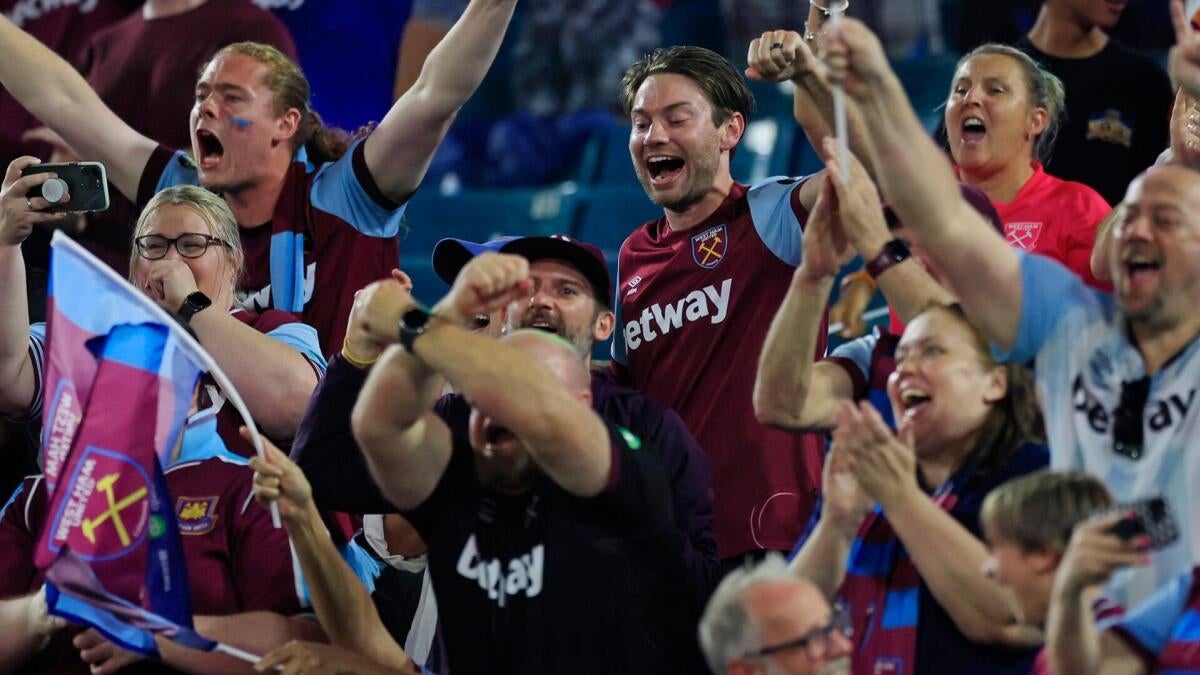
The Matchweek 33 encounter at Selhurst Park serves as a definitive case study in fixture congestion management versus survivalist continuity. Crystal Palace, entrenched in mid-table stability, confronts a West Ham United side operating under the existential threat of a relegation battle, separated from the bottom three by a precarious two-point margin.
Midfield Restructuring and the Fatigue Factor
Oliver Glasner has implemented four tactical alterations to the Crystal Palace XI, a pragmatic response to the physiological depletion following their midweek continental clash with Fiorentina. The forced absence of Adam Wharton due to an adductor injury removes Palace’s primary progressive conduit. Consequently, the pivot to Jefferson Lerma and Will Hughes signals a shift toward a high-intensity, industrial central block designed to stifle West Ham’s verticality.
By integrating Brennan Johnson and Jorgen Strand Larsen into the attacking trident, Glasner prioritizes explosive transitions. This reconfiguration relegates Daichi Kamada and Jean-Philippe Mateta to the bench, establishing a high-caliber secondary wave intended to exploit a tiring opposition in the final transition phase.
West Ham’s Biological Advantage and Tactical Synchronization
Conversely, Nuno Espirito Santo has prioritized chemistry and momentum, fielding the identical lineup that secured a 4-0 victory over Wolverhampton. Benefiting from a nine-day recovery window, the Hammers possess a significant metabolic advantage. This physical freshness is expected to facilitate a sustained high press and rigorous defensive discipline, anchored by the Mavropanos-Disasi partnership.
The offensive architecture relies on the creative mobility of Jarrod Bowen and Crysencio Summerville. Their capacity to occupy half-spaces will challenge the lateral coverage of Palace’s back three, while Valentin Castellanos serves as the focal point for direct vertical distributions. For Palace, the creative onus shifts to wing-backs Tyrick Mitchell and Daniel Munoz, who must provide the width necessary to bypass West Ham’s compact mid-block.
Game-State Management and Bench Depth
The strategic discrepancy is most evident in the available substitutes. Palace’s bench is offensively weighted, providing Glasner the tools to chase a deficit. In contrast, West Ham’s bench features N’Golo Kante and Aaron Wan-Bissaka, indicating a clear contingency plan for defensive consolidation and game-state preservation. The presence of Kante allows Nuno to pivot to a low-block stability model if the Hammers secure an early lead.
Market Sentiment and Institutional Stakes
The betting market identifies Crystal Palace as +140 home favorites, a valuation predicated on Selhurst Park’s historical defensive resilience. However, West Ham’s +205 underdog status reflects volatility despite their recent 4-0 efficiency. For the Hammers, the stakes transcend the pitch; avoiding relegation is a financial imperative to preserve their capital structure and future recruitment leverage within the Premier League’s commercial ecosystem.