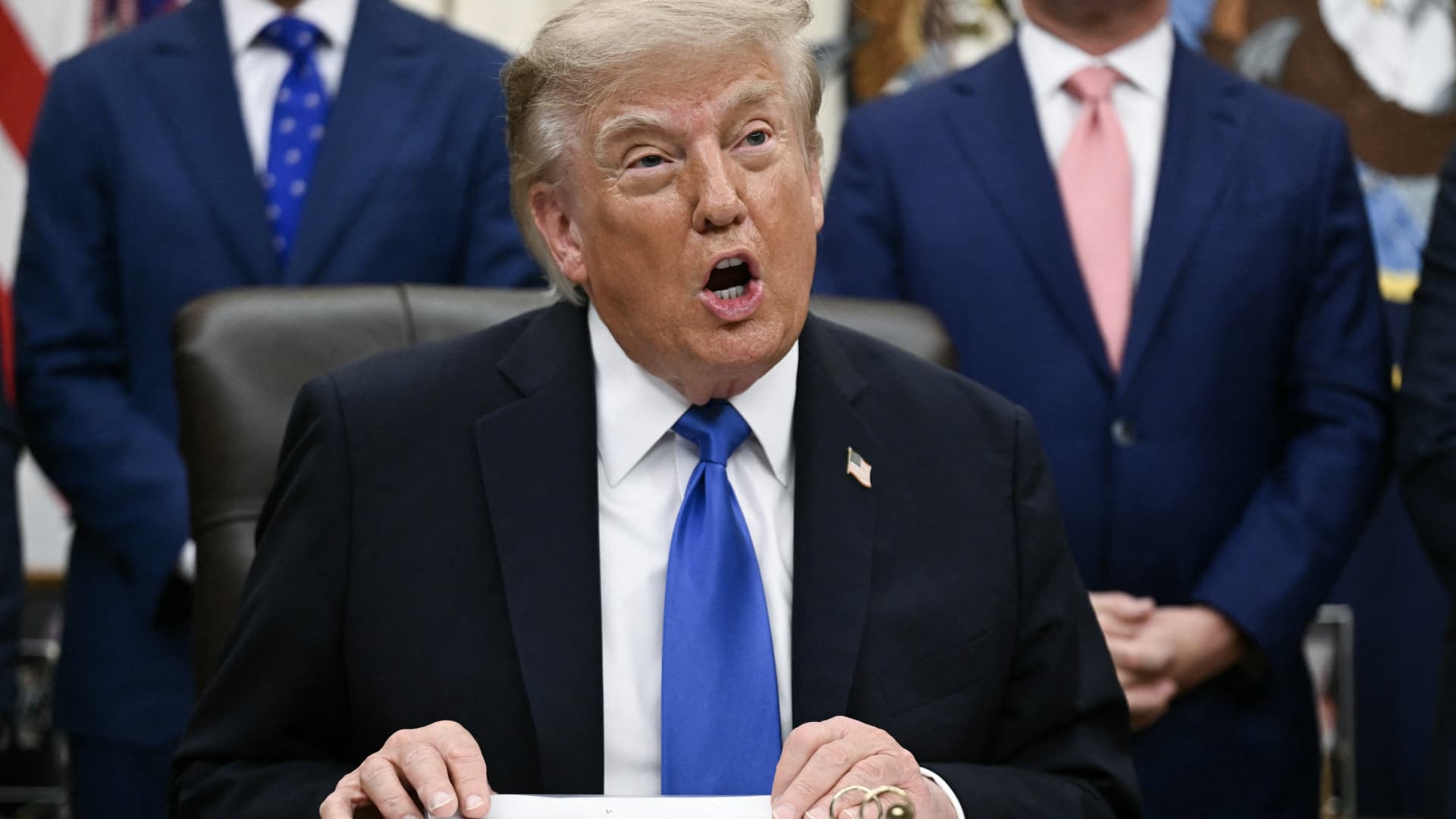
Former President Donald Trump deployed his Truth Social platform to disseminate numerous AI-generated images, paired with unsubstantiated claims of the U.S. government accumulating hundreds of billions in stock market gains during his administration. Over ten hours, dozens of these synthetic visuals, ranging from geopolitical triumphs to historical allegories, illustrated his narrative.
A prominent example was an AI-generated image depicting Trump in the White House, seemingly monitoring equity markets. This image was captioned with assertions of national financial stewardship and non-personal gain, while simultaneously critiquing political opponents. Crucially, these claims, despite lacking direct empirical evidence within the posts, are juxtaposed with historical discussions and policy interventions from his tenure regarding strategic industries, such as the semiconductor sector, where government involvement and investment were considered.
Institutional Exposure and Financial Strategy
This convergence of synthetic media and executive market commentary introduces complex challenges for corporate governance and asset valuation. While the Trump administration pursued policies aimed at strengthening domestic semiconductor manufacturing, including discussions of government incentives and investment, the deployment of such claims positions the federal government as a potential direct stakeholder in key industries. Subsequent market appreciation of public holdings would thus align industrial policy interventions with direct financial returns for the state’s balance sheet.
This operational synergy between industrial policy and public communication creates acute sensitivities within capital markets. Algorithmic trading systems constantly parse executive statements for signal value. The deployment of synthetic imagery to illustrate purported financial milestones therefore obscures the distinction between formal economic reporting and strategic digital political messaging, compelling market participants to discern between verifiable financial metrics and communication designed to project economic prowess.
Regulatory Scrutiny and Disclosure Patterns
Independent investigative reports have previously identified correlations between executive commentary on social media and contemporaneous portfolio positioning in specific equities. Financial disclosures to the U.S. Office of Government Ethics have shown accounts linked to the former President established stakes in corporations prior to their public commendation on Truth Social. This recurring pattern suggests digital platforms may function as a conduit for influencing perceived corporate performance that aligns with state-backed or personal investment strategies.
These patterns warrant heightened regulatory scrutiny from market oversight bodies, addressing insider trading risks and potential security price manipulation through public declarations. While executive branch officials have distinct disclosure frameworks, the incorporation of real-time stock performance into partisan digital content significantly amplifies compliance complexities. Institutional investors face an unprecedented challenge in an environment where official pronouncements, enhanced by generative media, directly impact retail sentiment and short-term market volatility.
Technological Integration in Political Communications
The systemic reliance on generative AI for narrative-driven imagery represents a paradigm shift in executive communication. By translating complex industrial policies, like strategic equity stakes, into stylized visual narratives, political figures circumvent conventional bureaucratic information pathways. These AI-generated assets are optimized for maximal digital engagement, exploiting cultural and historical iconography to ground abstract financial claims in widely accessible formats.
This tactical deployment of synthetic media strains the integrity of institutional information channels and financial journalism. Public officials’ dissemination of unsubstantiated quantitative claims, coupled with AI-generated visual ‘evidence,’ imposes an onerous analytical burden on market participants to distinguish rhetorical hyperbole from verifiable balance sheet metrics. Thus, the intersection of synthetic media and capital market communications establishes a volatile precedent for the articulation and consumption of economic policy in the digital era.