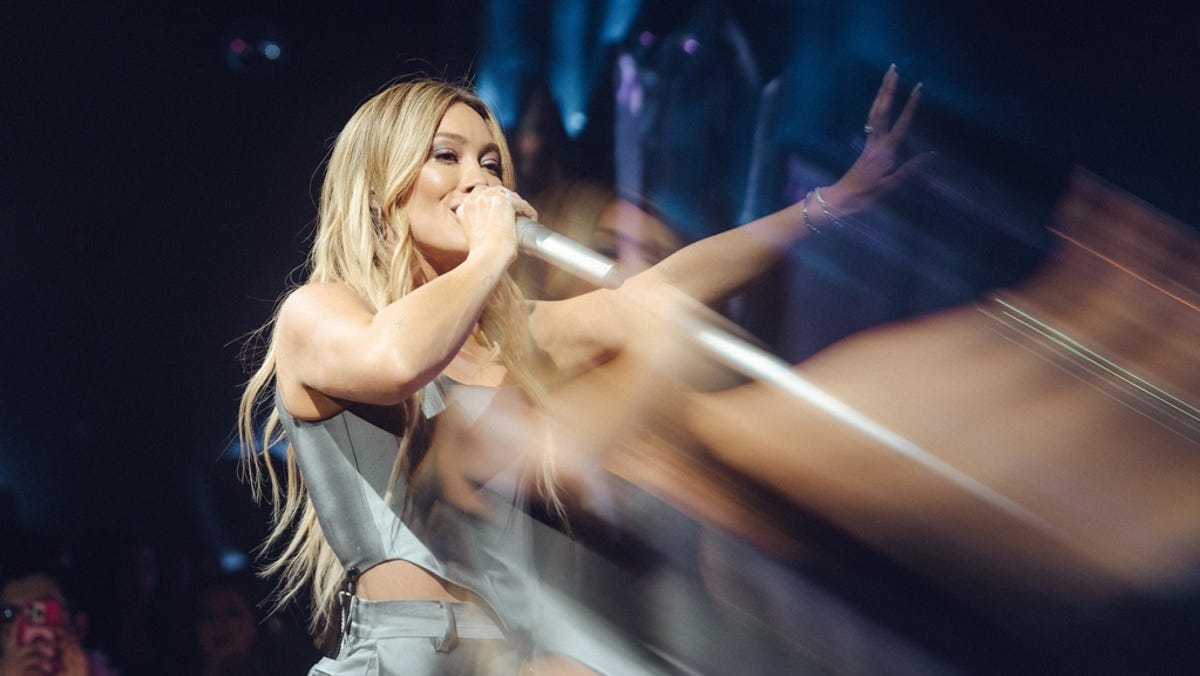
The announcement of Hilary Duff’s 2026 “Lucky Me” tour and her concurrent sixth studio album marks a sophisticated re-entry into a live entertainment sector fundamentally reshaped by digital fragmentation. This strategy represents a calculated pivot from a localized Las Vegas residency to a multi-leg international rollout, signaling an intent to optimize the ‘nostalgia premium’ while validating new intellectual property within a saturated pop landscape.
Operational De-Risking via the Residency-to-Tour Pipeline
By anchoring her comeback in a Las Vegas residency, Duff’s management utilized a low-CAPEX environment to stabilize production values and calibrate vocal performance. This phase functioned as a live-market laboratory, gauging audience receptivity to new singles such as ‘Mature’ and ‘Roommates’ without the immediate logistical overhead of a multi-city trek. The subsequent transition to the iTHINK Financial Amphitheatre in West Palm Beach, Florida, demonstrates a scalable operational shift, moving from controlled venue parameters to the variable conditions of the national amphitheater circuit.
Financial Architecture and Corporate Liquidity
The deployment of a tiered ticketing ecosystem—prioritizing Citi cardmembers and Verizon customers on February 17—underscores a reliance on corporate partnerships to secure early liquidity. These arrangements serve as credit enhancements for promoters, guaranteeing a significant portion of gate revenue prior to general public inventory access. For these institutional partners, the presale window is a critical tool for data acquisition and customer retention, positioning the ‘Lucky Me’ tour as a high-value asset within the broader experiential marketing vertical.
The Nostalgia Economy and Demographic Arbitrage
Duff is strategically targeting the peak purchasing power of the Millennial demographic. This cohort’s affinity for legacy hits like ‘Beat of My Heart’ provides a pricing floor that exceeds the market entry point for contemporary artists with similar streaming metrics. By synchronizing the February 20 album release with the tour’s peak visibility, the campaign creates a feedback loop: legacy IP drives ticket sales, while the live platform accelerates the adoption of new material, mitigating the risks associated with a twenty-year hiatus.
Logistical Scalability and International Expansion
The 2026 U.S. leg, concluding in Michigan, serves as a logistical precursor to a complex international expansion scheduled for 2027. Managing a multi-year global rollout requires rigorous planning regarding currency fluctuations, international labor regulations, and cross-border asset mobilization. The extension into 2027 suggests a long-term revenue strategy designed to amortize the high initial costs of production across global markets where Duff’s brand remains culturally embedded through the Lizzie McGuire legacy.
Stakeholder Risk Management
Investors remain exposed to variables including the artist’s physical endurance after a prolonged touring absence and the volatility of secondary market pricing. However, the use of dynamic pricing and affiliate-driven sales models provides a decentralized approach to revenue maximization. Ultimately, the 2026 rollout is a test of brand durability; successful execution will validate the model of using legacy status as a springboard for contemporary artistic evolution in the modern music economy.