Dybantsa Edges Peterson in Star-Studded Summer League Opener
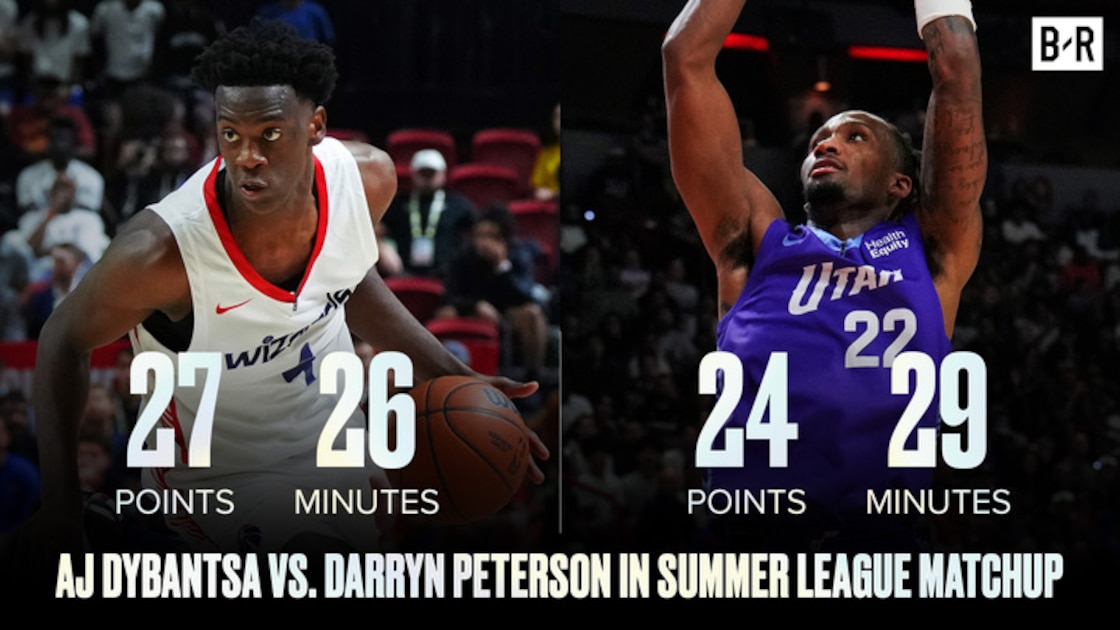
The highly anticipated NBA Summer League debut saw No. 1 prospect AJ Dybantsa lead the Washington Wizards to a narrow 92-88 victory over Darryn Peterson and the Utah Jazz. This matchup, the first on-court confrontation between the projected top two picks of the 2026 NBA Draft, set a high bar for their professional introductions.
Dybantsa delivered a comprehensive performance, tallying a game-high 27 points, complemented by seven rebounds, two assists, two steals, and a block. His all-around statistical contribution was pivotal in securing the Wizards’ opening Summer League win.
Washington’s offense found a potent secondary threat in Tre Johnson, who contributed 26 points, showcasing strong synergy with Dybantsa and signaling a formidable scoring duo for the Wizards.
Will Riley added crucial offensive support for the Wizards, scoring 18 points and adding three rebounds and two assists, further diversifying Washington’s attack.
Peterson, projected as the No. 2 overall pick, led the Jazz with 24 points, three rebounds, and two assists. However, his shooting efficiency from three-point range was a notable area for improvement, converting just 2 of 7 attempts.
The statistical divergence in shooting efficiency, particularly from beyond the arc, between Dybantsa and Peterson highlights current developmental trajectories. Dybantsa’s balanced statistical profile suggests a more immediate readiness for multifaceted NBA play, while Peterson’s scoring concentration with shooting inconsistencies points to specific areas for refinement.
Beyond individual statistics, the competitive narrative between these two elite prospects carries significant weight for their respective franchises and their marketability. Early Summer League success generates fan engagement and media attention, directly impacting brand perception and revenue streams for the Wizards and Jazz.
For the Wizards, Dybantsa’s strong debut validates their draft strategy and player development pipeline, signaling a potential upward trajectory and attracting investment and sponsorship opportunities.
The Jazz face the challenge of maximizing Peterson’s scoring potential while addressing shooting consistency, crucial for his long-term impact and the team’s competitive standing.
The contributions of supporting players like Johnson and Riley underscore the importance of a cohesive team structure, demonstrating that individual brilliance thrives when supported by capable teammates.
The broader implications for the 2026 NBA Draft class are significant. Strong initial showings from top prospects like Dybantsa and Peterson can elevate the perceived quality of the entire class, influencing future draft valuations and scouting priorities.
The financial leverage of highly touted prospects is substantial, with significant investments in scouting, development, and marketing expected to yield returns through increased viewership and fan base growth.
The competitive landscape is dynamic, with early performances influencing scouting reports and strategic planning for future matchups against emerging talent.
For the league, the narrative of top prospects battling head-to-head provides compelling storylines that drive fan interest and media coverage throughout the Summer League.
Operational impacts are immediate, with Dybantsa’s success validating the Wizards’ coaching and development strategies, while Peterson’s performance necessitates a focused approach for the Jazz’s coaching staff.
Capital movement within the NBA ecosystem is tied to talent valuation. The marketability of Dybantsa and Peterson, driven by their draft status and early performances, can influence endorsement deals and future contract valuations.
Front office strategies for both the Wizards and Jazz will be shaped by these prospects’ trajectories, impacting future draft picks, free agency decisions, and trade considerations.
Dybantsa’s immediate impact on the game’s outcome highlights his performance leverage and potential as a franchise cornerstone.
The distribution of advantage in this matchup favored the Wizards, primarily due to Dybantsa’s superior all-around statistical contribution and the complementary scoring from Johnson and Riley. The Jazz, while showcasing Peterson’s scoring, exhibited a disadvantage in overall offensive efficiency.
Looking ahead, Dybantsa’s development will likely focus on maintaining scoring efficiency while enhancing playmaking and defensive contributions. Peterson’s priority is improving shooting consistency from three-point range and integrating more effectively into the Jazz’s offensive system.
The NBA’s institutional response involves promoting these emerging talents to enhance league-wide interest, with media amplifying their performances and shaping fan engagement.
The cultural impact is significant, with these matchups serving as benchmarks for evaluating future prospects and inspiring the next generation of NBA stars.
Structural pressures in the Summer League encompass player development and team strategy. The Wizards’ ability to leverage multiple scoring threats demonstrated a more robust structural advantage in this contest.
The Jazz’s disadvantage was evident in their reliance on Peterson’s scoring and his efficiency struggles, coupled with a less diversified offensive attack.
Plausible evolution scenarios for Dybantsa involve solidifying his role as a franchise cornerstone. For Peterson, success hinges on significant improvement in shooting and defensive awareness to fulfill his top-pick potential.
The market context is refined by Summer League performances, with Dybantsa enhancing his marketability and Peterson needing more data points to solidify his standing.
Historical NBA trends suggest Summer League performances are indicators, not definitive pronouncements, of future success, emphasizing the importance of sustained development and adaptation.
Competitive implications are far-reaching, with the Wizards gaining an early psychological edge and the Jazz needing to critically analyze Peterson’s performance for targeted intervention.
Franchise responses involve continued investment in player development, with the Wizards providing resources for Dybantsa and the Jazz creating a structured environment for Peterson’s skill refinement.
Front office decisions may accelerate plans for Dybantsa’s integration, while the Jazz weigh immediate integration versus potential risks for Peterson.
The performance leverage of Dybantsa’s versatile game provides the Wizards with a valuable, flexible asset contributing across multiple facets of play.
The distribution of advantage in this matchup reflected not only individual talent but also the team’s execution and support, with the Wizards’ balanced offense proving decisive.
Evolution scenarios suggest Dybantsa will remain a focal point for the Wizards, influencing team success, while Peterson’s narrative centers on overcoming shooting challenges to become a consistent threat.
Market context now defines Dybantsa as a franchise-altering talent, while Peterson is evaluated on growth potential and adaptation to the professional level.
Competitive implications extend to the broader NBA landscape, with Dybantsa’s success signaling the Wizards as a rising franchise, potentially impacting recruitment and trade negotiations.
Institutional response includes ongoing evaluation and adjustment of development programs to maximize player impact and address specific needs.
Strategic decisions are long-term oriented, with the Wizards building around Dybantsa and the Jazz aiming to develop Peterson into a complementary star.
The performance leverage of Dybantsa’s all-around game offers significant tactical flexibility and a higher probability of consistent positive contributions.
The distribution of advantage was clearly with the Wizards, showcasing a more cohesive team effort and balanced offensive attack, highlighting the role of structure and execution in close games.
Plausible evolution scenarios for both players are contingent on continued improvement and effective development programs, with Dybantsa’s path marked by immediate impact and Peterson’s by overcoming skill-based challenges.
The market context for the 2026 draft class is actively shaped by these performances, with Dybantsa solidifying his frontrunner status and Peterson’s narrative focusing on high potential requiring refinement.
Competitive implications extend beyond this game, with Dybantsa’s success signaling the Wizards as a rising franchise, potentially influencing recruitment and trade negotiations, while the Jazz face pressure to demonstrate tangible progress in Peterson’s development.
The institutional response involves ongoing evaluation and adjustment of development programs, with the Wizards refining their approach for Dybantsa and the Jazz dedicating resources to Peterson’s specific needs.
Strategic decisions for both teams will be long-term oriented, with the Wizards likely building around Dybantsa and the Jazz aiming to develop Peterson into a complementary star.