
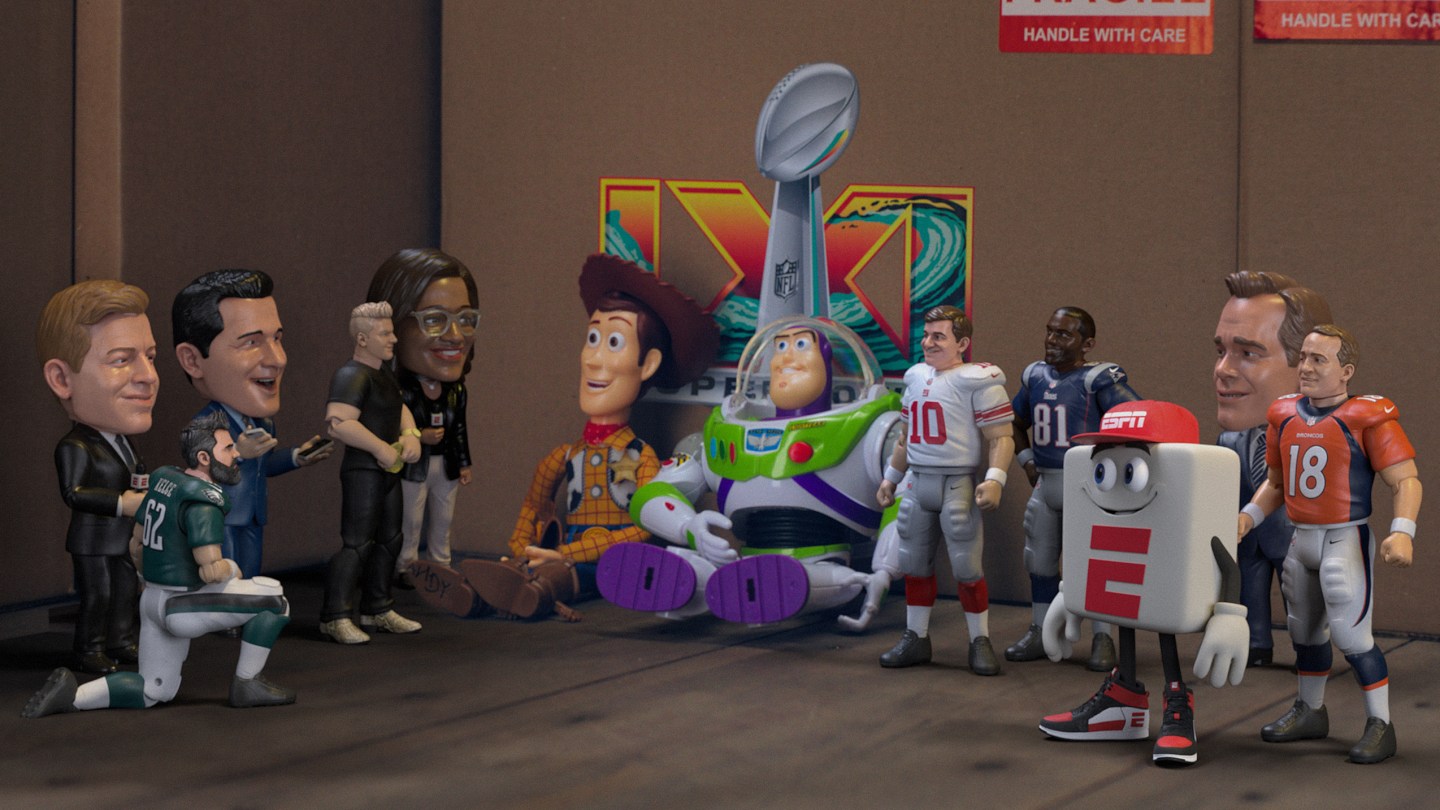
The Walt Disney Company has launched a highly sophisticated, cross-divisional marketing campaign that structurally bridges its premier sports broadcasting division with its crown-jewel animation intellectual property. By rendering marquee ESPN talent as animated action figures in the distinct visual style of Pixar’s Toy Story franchise, the media conglomerate is executing a long-runway promotional strategy to maximize the commercial yield of Super Bowl LXI. Titled “We’re Going,” this initiative demonstrates how diversified entertainment giants leverage proprietary IP portfolios to aggregate multi-demographic audiences ahead of high-stakes live sports broadcasts.
The cornerstone of this campaign is a bespoke promotional spot, “Toy Story 5.5,” which serves as an explicit narrative prelude to the upcoming theatrical release of Toy Story 5. This dual-purpose asset targets both traditional sports fans and family demographics, exploiting consolidated corporate ownership to cross-pollinate audiences. Rather than relying on transactional, short-term ad buys, ESPN has committed to a year-long creative arc, deploying sequential animated spots across its linear and digital networks to build sustained momentum for the championship game in Los Angeles in February 2027.
Rebranding Super Bowl LXI: ESPN’s Operational and Commercial Consolidation
While the ABC broadcast network has historically televised the NFL’s premier event, Super Bowl LXI represents the first time the game will be programmed, branded, and operationally managed entirely under the ESPN banner. This institutional transition concentrates the parent company’s sports production capabilities and marketing assets under its flagship sports brand. The “Year of the Super Bowl” campaign serves as the primary mechanism to fortify ESPN’s market position and validate the premium valuations of its sports rights portfolios.
Geographically and culturally, the selection of Los Angeles as the host city provides an ideal framework for this corporate alignment. The narrative path of the promotional spot—depicting animated ESPN commentators migrating from their traditional headquarters in Bristol, Connecticut, to the West Coast—metaphorically dramatizes the immense operational shift of Disney’s broadcasting infrastructure. This creative execution signals to advertisers, affiliates, and leagues the unmatched scale of the network’s promotional commitment.
IP Virtualization: Converting High-Value Broadcasters into Digital Assets
The transformation of real-world sports journalists, commentators, and analysts into virtualized action figures represents a major evolution in talent monetization. The animated spot features highly recognizable likenesses of play-by-play commentators Joe Buck, Troy Aikman, and Lisa Salters, alongside high-profile studio personalities Pat McAfee, Adam Schefter, Peyton Manning, Eli Manning, Randy Moss, and Jason Kelce. By converting these high-salaried contracts into proprietary digital assets, Disney extends the utility of its personnel beyond linear game analysis into highly scalable brand marketing.
Furthermore, integrating the digital-first mascot “App-E” in a prominent cameo underscores ESPN’s strategic pivot toward platform-centric consumer engagement. Positioning a digital platform representative alongside legacy sports stars and iconic Pixar characters highlights the network’s commitment to ecosystem integration. The ultimate objective is not merely linear viewership retention, but rather driving user acquisitions and active engagement across the ESPN digital and streaming ecosystems.
Cross-Divisional Synergy and Defensive Moats in Sports Rights
The collaboration between ESPN and Pixar Animation Studios highlights the structural advantages that diversified media conglomerates hold over pure-play sports networks. By integrating established IP like Woody and Buzz Lightyear into sports marketing, ESPN elevates its promotional collateral beyond standard industry conventions. This mutual promotion yields immediate benefits: the sports broadcast gains a family-friendly entry point, while the upcoming theatrical film secures prime promotional real estate during high-viewership events.
This cross-divisional execution operates as a formidable competitive moat. As the competition for premium live sports rights intensifies among traditional networks and emerging digital platforms, the ability to offer multi-platform, IP-supported promotional campaigns acts as a compelling differentiator for leagues and advertisers. This level of synchronized brand integration is exceptionally difficult for single-focus competitors to replicate.
High-Value Distribution via the NBA Finals
To maximize immediate reach, Disney premiered “Toy Story 5.5” during Game 1 of the NBA Finals between the New York Knicks and the San Antonio Spurs. Utilizing this premium live sports inventory ensured maximum exposure within a highly coveted demographic. This distribution strategy exemplifies internal portfolio synergy, using one of the network’s premier summer championships to establish the long-term marketing runway for the Winter 2027 Super Bowl broadcast.
By launching the campaign during this high-profile matchup, ESPN capitalizes on the concurrent digital conversation, driving organic social amplification that extends far past the initial linear broadcast. Generating immediate digital conversation around virtualized sports stars ensures the campaign sustains cultural relevance over its multi-month trajectory, optimizing upstream advertiser demand and positioning ESPN as the dominant destination for sports entertainment.