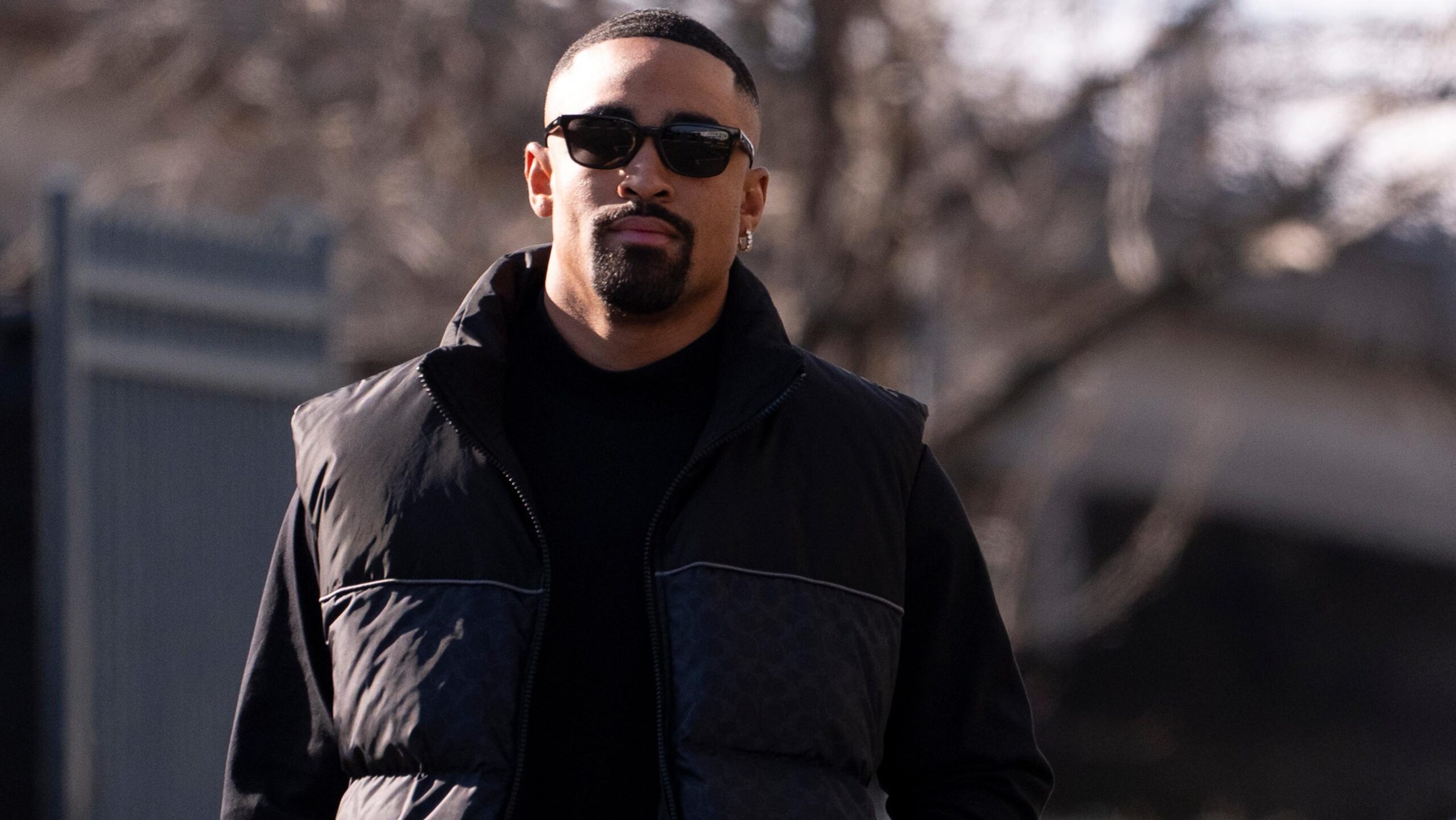
Jalen Hurts’ Cryptic Post: Decoding NFL Financial Strategy and Player Dynamics
The digital presence of elite athletes has become an indelible component of professional sports, often serving as an unwitting conduit for major franchise developments. Philadelphia Eagles quarterback Jalen Hurts’ recent enigmatic social media post, featuring a stark black-and-white image, immediately ignited widespread speculation, specifically coinciding with renewed trade rumors involving star wide receiver A.J. Brown.
This incident transcends mere fan intrigue, acting as a potent microcosm of the intricate financial engineering, strategic roster management, and complex player-media dynamics that define the modern National Football League.
The Enigmatic Signal: Hurts’ Social Media Activity
Jalen Hurts’ return to X (formerly Twitter) after an October hiatus, marked by a black-and-white, partially obscured self-portrait, was anything but innocuous. His visible personal brand logo, juxtaposed with the concealed identity, became an instant canvas for public projection. Crucially, the post’s timing dovetailed precisely with resurfaced reports concerning a potential trade of A.J. Brown, his Pro Bowl receiver, to the New England Patriots.
This confluence of player expression and critical team speculation amplified the post’s interpretive potential, transforming a personal update into a perceived signal of deeper organizational movements or even personal disquiet regarding the impending decision surrounding Brown’s future.
The Strategic Imperative: A.J. Brown and NFL Trade Dynamics
Beyond Hurts’ digital actions, the core of the narrative centers on the Philadelphia Eagles’ widely reported consideration of trading A.J. Brown, with the New England Patriots emerging as a primary suitor. This potential transaction is not a straightforward exchange of talent; it represents a sophisticated financial and roster engineering decision driven by the NFL’s stringent salary cap regulations.
The critical element is the June 1 designation. Trading Brown on or after this date unlocks specific salary cap advantages for the Eagles, profoundly influencing their immediate fiscal flexibility and long-term strategic planning.
The ‘Dead Money’ Conundrum: Post-June 1 Strategic Advantage
The distinction of the post-June 1 trade designation is critical for Philadelphia’s salary cap management. A “dead money” charge represents accelerated cap hits for bonuses or guaranteed money paid to players no longer on the roster. For A.J. Brown, trading him prior to June 1 would incur an immediate, substantial cap hit of approximately $40 million in the current league year.
However, by executing the trade on or after June 1, the Eagles can strategically prorate this significant dead money figure, effectively spreading the financial burden across the 2026 and 2027 salary cap years. This mechanism provides vital immediate cap relief, allowing the franchise to retain financial agility for other critical team-building initiatives such as signing their draft class, extending core players, or pursuing additional free agents.
Eagles’ Roster Reconfiguration: Balancing Competitiveness and Future Building
The financial maneuverability gained from a post-June 1 trade directly impacts the Eagles’ competitive outlook. Freeing up immediate cap space is not merely an accounting exercise; it empowers the front office to address critical roster needs, whether it’s allocating funds for their upcoming draft class, securing long-term extensions for foundational players, or acquiring veteran talent via free agency to fill immediate gaps left by Brown’s departure.
While losing a top-tier receiver like Brown necessitates a re-evaluation of offensive strategy and places greater emphasis on developing younger pass-catchers, the strategic cap savings enable sustained investment in other positional groups. This complex decision reflects a franchise’s commitment to long-term sustainability and competitive balance, even at the cost of immediate star power.
Competitive Dynamics: Eagles’ Offensive Re-evaluation and Patriots’ Strategic Acquisition
The potential divestiture of A.J. Brown would fundamentally alter the Philadelphia Eagles’ offensive calculus. Losing a dominant receiver necessitates a strategic pivot, potentially accelerating the development timelines for emerging pass-catchers and requiring new acquisitions to maintain offensive balance and potency. This move, while financially astute, inherently shifts offensive responsibilities and demands a creative re-imagining of their aerial attack.
For the New England Patriots, acquiring Brown represents a significant commitment to bolstering a struggling offense and accelerating their post-Belichick rebuild. The pre-existing relationship between Brown and new Patriots head coach Mike Vrabel (from their Tennessee Titans tenure) is a critical, albeit unofficial, accelerant for such a transaction. These personal connections often smooth player integration, mitigate relocation risks, and can be a compelling factor in a player’s willingness to embrace a new franchise, offering an advantage beyond pure talent evaluation.
Player Agency, Media Amplification, and Franchise Messaging in the Digital Era
Hurts’ cryptic post underscores the precarious balance between player autonomy and organizational control in the social media age. Even a non-explicit digital signal from a high-profile athlete can instantaneously become a Rorschach test for fans and media, generating narratives that may or may not align with team strategy or actual events. This creates a perpetual challenge for franchises in managing public perception and maintaining coherent messaging.
This dynamic is not new; previous instances, notably A.J. Brown’s own history of cryptic social media activity, have consistently demonstrated how player posts fuel a self-perpetuating cycle of speculation and commentary. The modern sports media ecosystem thrives on such ambiguity, prioritizing rapid interpretation and sensationalized narratives, which often overshadow the complex strategic decisions teams are making behind the scenes. The example of hyperbolic interpretations, like ‘summoning a Dark Lord,’ perfectly illustrates the often-unhinged nature of this digital discourse.
Athlete Brand Management: Navigating Ambiguity and Public Scrutiny
For high-profile athletes such as Jalen Hurts, every public gesture, particularly on social media, actively contributes to their meticulously constructed personal brand and public persona. A cryptic post, whether intended as personal introspection or subtle commentary, is instantly absorbed into the relentless cycle of media scrutiny and fan interpretation. This external lens can profoundly influence perceptions among fans, media, and commercial partners.
The blurring boundaries between private expression and professional implication demand a highly strategic approach to athlete brand management, where the potential for misinterpretation necessitates careful calculation of every digital footprint.
Institutional Oversight: NFL Policies and Player Conduct
While specific NFL social media regulations were not detailed, the overarching institutional framework of professional sports implicitly governs player conduct, extending to digital interactions. Both franchises and the league possess a vested interest in ensuring player communications uphold team cohesion, maintain a positive public image, and preserve competitive integrity.
The inherent tension lies in reconciling a player’s right to individual expression with the organizational imperative for strategic stability and brand alignment, a challenge frequently addressed through internal team policies and informal guidelines on social media engagement.
The Nexus of Financial Capital and Human Asset Management
This entire saga vividly illustrates the profound interdependence between financial capital (e.g., salary cap space, dead money liabilities) and human capital (e.g., franchise quarterbacks, star receivers, coaching relationships) within the NFL ecosystem. Strategic decisions concerning either domain exert direct and often complex ripple effects on the other, mandating a holistic, data-driven, and forward-looking approach from front office leadership.
Effective management of player contracts, trade assets, and the resulting cap implications transcends mere accounting; it is a fundamental determinant of on-field competitive success, sustained organizational viability, and sustained fan engagement over multiple seasons.
Market Dynamics and Elite Player Valuation
The speculative trade of A.J. Brown also serves as a potent case study in the broader market dynamics governing the valuation of elite player assets in the NFL. The New England Patriots’ presumed willingness to absorb a substantial acquisition cost, even with the Eagles’ dead money implications, underscores Brown’s perceived scarcity and high market value as a top-tier receiving talent.
These high-profile transactions establish crucial benchmarks for future player contracts and trade compensation, thereby influencing the financial expectations and negotiating leverage of other players and their agents across the league.
Conclusion: The Intertwined Realities of NFL Finance, Strategy, and Perception
Jalen Hurts’ enigmatic social media post, set against the backdrop of intricate financial maneuvering concerning A.J. Brown’s potential trade, encapsulates the multifaceted and often contradictory realities of modern professional football. These incidents are not discrete events but rather intricately woven threads within a dynamic ecosystem driven by rigorous financial imperatives, fierce competitive aspirations, and an ever-present, insatiable media cycle.
This scenario profoundly illustrates the continuous tension between instantaneous public and media reaction and the meticulously calculated, long-term strategic planning essential for sustained franchise success in the high-stakes, hyper-scrutinized landscape of the National Football League.