Strategic Alignment Amid Geopolitical Friction
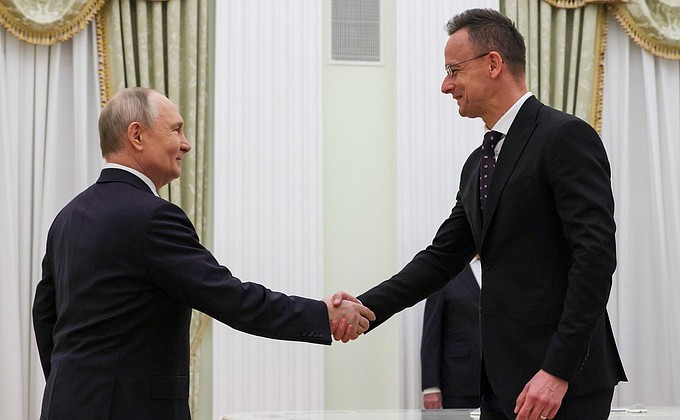
A high-level meeting between Russian President Vladimir Putin and Hungarian Foreign Minister Peter Szijjarto underscores a strategic recalibration in bilateral relations. The discussions, which included key Russian officials like Foreign Minister Sergei Lavrov, focused heavily on energy policy and critical infrastructure projects, effectively prioritizing long-term strategic assets over general economic exchange.
While President Putin acknowledged a 13 percent decline in trade turnover, reflecting the impact of sanctions and market volatility, he characterized the overall relationship as stable. This divergence between a shrinking general trade volume and persistent high-level focus on strategic projects highlights a deliberate effort by both nations to insulate specific economic ties from external pressures and broader geopolitical tensions. By engaging directly with Moscow on critical energy infrastructure, Budapest signals an independent foreign policy trajectory that diverges from the EU consensus, creating a strategic wedge within the bloc’s unified front on sanctions and energy policy.
Paks II: Flagship Project and Long-Term Strategic Leverage
Central to the discussions was the Paks Nuclear Power Plant. Explicitly referenced by Putin as a “flagship project,” the Paks II expansion project represents more than energy generation; it functions as a critical mechanism for long-term strategic leverage. The project involves the construction of two new reactors by Russia’s Rosatom, deepening Hungary’s energy dependency on Russian technology, financing, and fuel supply chains for decades to come.
For Hungary, Paks II promises energy independence from volatile European gas markets, while for Russia, it secures a long-term foothold in a key EU member state’s critical infrastructure. The substantial capital investment and technological integration required create a durable bond between the two countries, effectively insulating the project from short-term political fluctuations and sanctions pressure.
The operational timeline and financing structure of Paks II necessitate continuous high-level political coordination, which explains the frequent engagement between Hungarian and Russian officials. The intergovernmental commission, chaired on the Hungarian side by Szijjarto, serves as the institutional mechanism for managing these complex, long-term strategic assets, ensuring their progress despite broader geopolitical headwinds.
Mitigating Market Volatility Through Direct Supply
Beyond nuclear energy, the meeting addressed immediate concerns regarding hydrocarbon supplies. Hungary’s landlocked geography makes it heavily reliant on pipeline infrastructure, particularly the Druzhba pipeline, for crude oil imports. The focus on “oil supplies” suggests an effort to secure continued access and potentially favorable pricing arrangements, especially given the EU’s implementation of price caps and sanctions on Russian oil.
The discussions also addressed volatility in global gas markets. For Hungary, securing long-term gas contracts outside the volatile spot market is crucial for economic stability. Strategic engagement with Russia allows Hungary to mitigate its exposure to market fluctuations and potential supply disruptions, reinforcing its position as a key transit and consumption hub for Russian energy in Central Europe. This strategic leverage derived from direct supply relationships provides a competitive advantage to Hungary’s industrial sector relative to other EU members facing higher energy costs and supply uncertainty.
Geopolitical Implications and Institutional Friction
The high-level engagement between Hungary and Russia has significant implications for EU cohesion. Hungary’s independent foreign policy, exemplified by these meetings, creates friction within the European Council by challenging the EU’s ability to present a unified front on sanctions and foreign policy. This strategic divergence potentially weakens collective action.
For Russia, Hungary serves as a strategic partner within the EU, offering a channel for maintaining economic ties and potentially influencing EU policy decisions from within. The attendance of high-level officials responsible for foreign policy and industry underscores the strategic importance of this relationship in navigating the complex landscape of sanctions and geopolitical competition. The prioritization of high-value, high-leverage assets over general economic exchange demonstrates a deliberate effort by both sides to minimize the impact of general sanctions while maximizing strategic gains.