
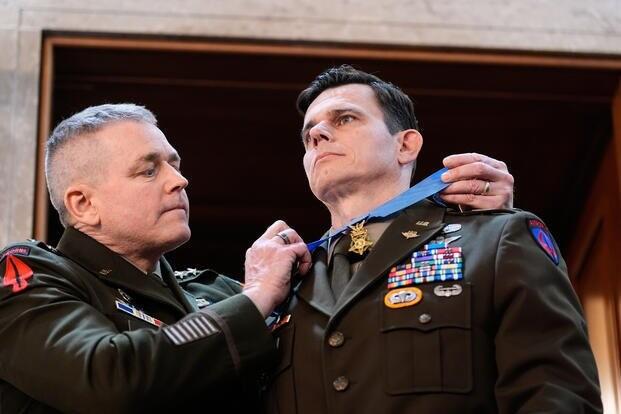
The presentation of two Congressional Medals of Honor during the 2026 State of the Union address, recognizing valor separated by over seventy years, signals a critical inflection point in how the U.S. manages military recognition and historical disclosure protocols.
Strategic Juxtaposition of Classification Timelines
The award to Retired Navy Capt. Royce Williams for his 1952 aerial engagement involving four Soviet MiGs, immediately preceded by the recognition of Army Chief Warrant Officer 5 Eric Slover’s actions during the recent capture of Nicolás Maduro, mandates a comparative analysis of historical classification frameworks versus modern operational security imperatives.
Williams’ award, delayed by decades of mandated secrecy rooted in Cold War escalation management concerning direct kinetic engagement with the Soviet Union, highlights significant administrative friction in declassifying high-stakes military achievements.
The timing, externally catalyzed by a 2017 American Legion Magazine report, suggests that sustained journalistic pressure can successfully override entrenched security directives, establishing a functional precedent for the future review of long-suppressed combat records.
Executive Leverage: Unifying Historical and Contemporary Valor
President Trump’s linkage of these distinct acts—the centenarian Williams next to the First Lady—serves a dual strategic purpose: validating the historical commitment of the Armed Forces while lending immediate gravity to recent, politically charged operational successes.
This theatrical linkage utilizes unimpeachable historical heroism to frame current kinetic actions, such as the Maduro capture raid, within a perceived continuum of American martial excellence, reinforcing executive policy legitimacy.
The operational scope of Williams’ 1952 feat—a 35-minute dogfight against superior Soviet air assets—exemplifies sustained individual aerial dominance unmatched since, proving the symbolic value of singular performance transcends immediate military utility, serving instead as a cultural anchor for martial standards.
Operational Exposure vs. Historical Insulation
CW5 Slover’s recognition, tied directly to a highly sensitive, recent foreign intervention, immediately subjects the raid’s operational details to public scrutiny far exceeding controlled information release.
The descriptive detail provided during the address—including sustained heavy machine gun fire and critical wounds—offers tactical granularity potentially useful to adversaries, despite the mission’s acknowledged outcome.
This immediate public attribution places substantial institutional pressure on the DoD to manage intelligence fallout, contrasting sharply with the decades-long informational insulation afforded to Williams’ classified action.
The Shifting Calculus of Information Control
The institutional divergence between Williams’ delayed recognition and Slover’s immediate elevation reflects a fundamental shift in military information management driven by the digital environment.
Williams’ initial secrecy was driven by Cold War imperatives to contain the very existence of unacknowledged aerial combat with Soviet assets to prevent escalation.
Slover’s award occurs where operational details disseminate globally instantly; the strategic calculus now favors immediate public validation for political gain over long-term information suppression, provided the former outweighs intelligence exposure risks.
Stakeholder Impact and Precedent Setting
For active personnel, the dual ceremony establishes divergent benchmarks: sustained adherence to secrecy for Cold War operators versus expectation of immediate public recognition for contemporary high-risk missions.
This contrast implicitly re-calibrates the institutional reward structure for classified, long-term service versus high-visibility contemporary action, influencing career risk assessment.
The legislative chamber’s transformation into a review platform validates command decisions authorizing both the 1952 engagement and the recent Venezuela operation through executive endorsement.
Veterans Advocacy and Recognition Pipeline Inertia
Williams’ status as the oldest recipient underscores systemic administrative bottlenecks requiring external stimuli (investigative journalism) to overcome classification barriers spanning seventy years.
This creates a critical precedent for accelerating the review of other meritorious service records currently locked behind classification, testing the capacity of military archives to process retroactive commendations efficiently.
Narrative Convergence and Political Staging
The framing of Williams as a pilot spanning WWII, Korea, and Vietnam (though the award concerned 1952) consolidates a narrative of continuous martial competence under current executive oversight.
This strategy links past operational excellence directly to the current administration’s defense posture, asserting consistent leadership capability.
The emphasis on Williams’ near-mythic performance (“almost destroyed the others” after four MiGs) maximizes symbolic impact beyond confirmed kill counts.
Executive Control Over Military Culture
Utilizing the high-visibility State of the Union for these awards nationalizes the recognition, bypassing traditional, decentralized military ceremonies.
This politicization of the highest honor introduces complexity regarding process neutrality, especially when recipients are tied to recent, sensitive geopolitical actions.
The executive branch demonstrates its capacity to momentarily reset national focus by integrating symbols of sacrifice directly into the State of the Union’s political messaging framework, marking a centralization of honor presentation protocol.
Contextualizing the 1952 Engagement and Disclosure
The 1952 dogfight occurred during unacknowledged, intense aerial surveillance near contested airspace; official acknowledgment of four confirmed Soviet downings significantly revises public military history.
Achieving this feat while “massively outnumbered and outgunned” confirms superior technological and tactical leverage, which was deemed an intelligence asset worth protecting through decades of silence to manage strategic risk throughout the Cold War.
The 2017 Catalyst: Erosion of Information Control
The 2017 American Legion Magazine report indicates the erosion of institutional narrative control began when information migrated outside strictly governmental channels.
This transition from classified status via a veteran-focused publication signals a slow, deliberate declassification driven by historical accuracy demands rather than immediate operational necessity.
The 2026 Presidential award confirms final institutional acceptance, completing the cycle from operational secret to national symbol under a new administration.
Analysis of the Maduro Capture Mission Context
CW5 Slover’s actions were explicitly tied to the capture of Nicolás Maduro, an event carrying significant international political ramifications.
The detailed account of Slover sustaining multiple machine gun hits while maintaining operational function underscores the critical reliance on air support resilience in complex, high-stakes extraction scenarios.
Immediate public recognition validates the operational risk taken, securing domestic political capital derived from that specific foreign policy action.
Incentives Driving Operational Disclosure
In contrast to the deterrence incentive for Williams’ secrecy, Slover’s recognition aims for immediate domestic support and signals unwavering commitment to personnel in controversial foreign interventions.
This public display functions as a retention/recruitment tool, assuring candidates that extreme risk will yield the highest national honor, irrespective of mission political sensitivity.
The operational leverage is psychological: bolstering troop morale and projecting decisive military capability regarding high-value target commitment to both domestic audiences and international observers.
Institutional Momentum and Future Benchmarks
The combined impact creates a potent new benchmark for the recognition pipeline, forcing reconciliation between historical classification standards and contemporary transparency expectations.
Future declassification requests for historically significant classified actions will cite the Williams case as a successful precedent against administrative resistance.
The handling of the Slover award standardizes how successes tied to contentious foreign policy objectives are immediately integrated into the national narrative via executive recognition.
The President’s direct presentation to Williams, unusual for a previously recognized service member, emphasizes executive control over the narrative framing of honor, indicating centralized strategic decision-making regarding award timing and platform.
This centralization contrasts with traditional, decentralized presentation by the Secretary of Defense, signifying a deliberate integration of military honor into the State of the Union’s political messaging structure.
The convergence of Cold War proxy conflict and contemporary direct action under one ceremonial umbrella unifies the perception of American military commitment across disparate geopolitical landscapes.
Defense departments face friction managing historical security mandates against contemporary demands for immediate public validation.
This dual recognition compresses the timeline for historical validation, lowering the threshold for public acknowledgment when narrative utility aligns with the current political environment.
Williams’ age (100) introduces logistical/administrative requirements for proactive archival review to prevent meritorious service loss due to witness mortality or documentation degradation.
The reliance on external media for initial disclosure highlights a systemic lag in the military’s internal historical recognition mechanisms, which this high-profile event may rectify via executive fiat.
For the defense industry, high-profile validation of legacy aerial platforms (1952 context) and advanced rotary-wing insertion capabilities (Slover account) reinforces investment in both established and cutting-edge military technology.
The narrative indirectly validates platform effectiveness, influencing DoD procurement and modernization strategies.
The ceremony compels contemporary leadership to reconcile early jet age doctrine with modern precision raid realities, using these anchors for institutional continuity.
The strategic communication value of showcasing a pilot achieving an unmatched aerial feat elevates the perceived standard of individual combat effectiveness in the Navy fighter community, potentially affecting training criteria.
Ultimately, the State of the Union tribute recalibrates public understanding of military secrecy, operational risk tolerance, and the enduring value assigned to individual heroism across the full spectrum of American conflict.

Photo by michalnavrat on Pixabay.