
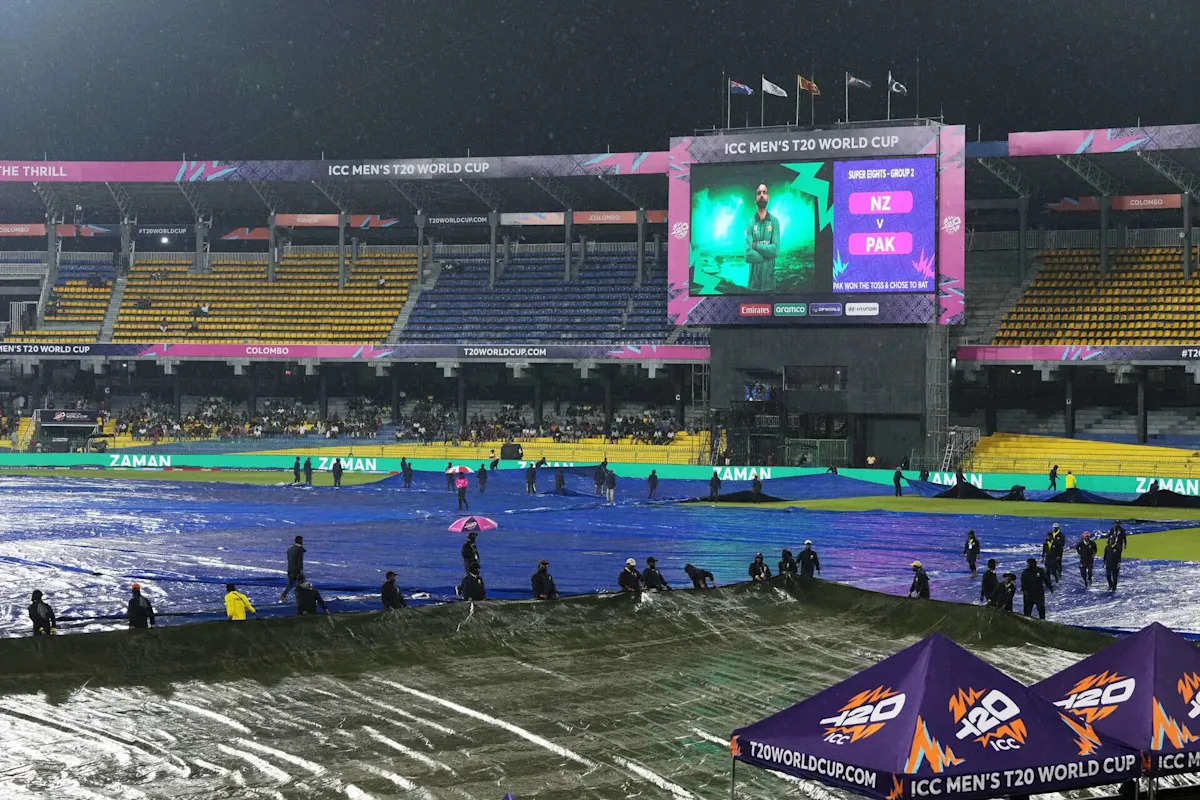
The T20 World Cup Super 8 stage intensifies at the R Premadasa Stadium as Sri Lanka and New Zealand engage in a fixture defined by high-stakes mathematical necessity. Following an inability to chase a marginal 147-run target in their previous outing, Sri Lanka enters a mandatory-victory phase. This institutional pressure is mirrored by New Zealand, whose campaign momentum was stalled by a meteorological washout against Pakistan, making this encounter a de facto eliminator within the Super 8 points hierarchy.
Atmospheric Variables and DLS Contingencies
While the primary forecast for Wednesday night suggests a stable 25°C environment, a 25% precipitation probability introduces a critical layer of tactical hedging. The most significant physical variable is the projected 30 km/h northerly gusts. These wind speeds directly impact ballistics, affecting both the drift available to spinners and the clearing of boundary dimensions. Captains must calibrate their bowling rotations to leverage these gusts, particularly in a stadium known for its expansive outfield where wind direction can dictate the viability of the long-ball strategy.
The 1% thunderstorm probability offers some relief regarding total abandonment, yet the threat of intermittent showers necessitates a constant alignment with Duckworth-Lewis-Stern (DLS) par scores. In the event of a compressed contest, the strategic emphasis shifts from traditional innings construction to optimized power-hitting and immediate resource deployment. For New Zealand, another weather-impacted result would create a points bottleneck, likely decoupling their progression from purely on-field performance.
Surface Topography and Spin-Centric Tactics
The R Premadasa surface remains a bastion for technical precision over raw aggression. Historical data and current dry pitch forecasts suggest a low-rebound, spin-conducive environment. This topology challenges the high-strike-rate paradigms of modern T20, favoring a risk-averse batting philosophy during the middle overs. Coach Vikram Rathour has identified the failure to adapt to these decelerated tempos as a primary tactical deficit for Sri Lanka; consequently, the operational mandate for this fixture is the maximization of strike rotation and the elimination of dot-ball accumulation.
New Zealand’s bowling unit, characterized by disciplined multi-phase variations, is structurally well-suited to exploit these conditions. The absence of significant cloud cover (27%) will likely mitigate early-innings swing, forcing seamers to rely on cutters and pace-off deliveries to stifle scoring rates. The match will likely be decided by the ‘slow-ball economy’ during the 7-15 over window, where the team that better manages the surface friction will dictate the competitive flow.
Institutional Stakes and Qualification Metrics
Beyond the immediate result, Net Run Rate (NRR) management looms as a secondary but vital objective. For Sri Lanka, a victory must also serve as a corrective measure for previous NRR degradation to ensure a viable path to the semifinals. For New Zealand, the urgency to compensate for the lost point against Pakistan may drive a more aggressive selection policy, potentially prioritizing a second specialist spinner over a traditional third seamer.
The International Cricket Council (ICC) and commercial stakeholders view this match as a pivotal moment for the tournament’s narrative momentum. A definitive outcome in Colombo ensures that the semifinal qualification process remains meritocratic. As the players finalize their preparations, the convergence of meteorological volatility, wind ballistics, and slow-pitch dynamics creates a high-friction environment where the margin for tactical error is virtually non-existent.

Photo by grafmex on Pixabay.