
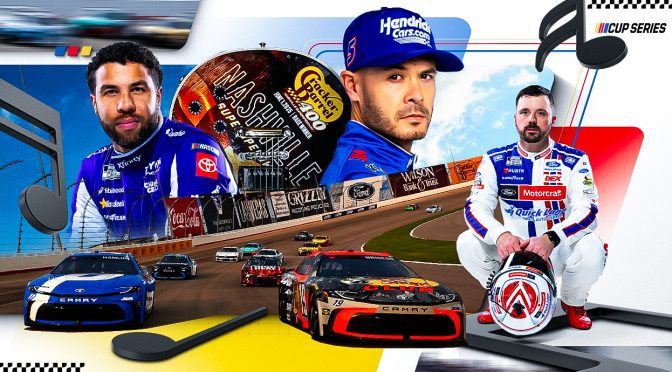
Metric-Based Grid Positioning: The Value of Institutional Consistency
The cancellation of the Busch Light Pole Qualifying at Nashville Superspeedway due to inclement weather has pivoted the competitive focus from raw single-lap speed to institutional consistency. Under NASCAR’s performance metric, Denny Hamlin (No. 11 Joe Gibbs Racing) secures the pole, a placement that validates JGR’s high-floor operational success throughout the season’s first half. This starting position is critical on Nashville’s 1.33-mile concrete surface, granting Hamlin the primary pit stall—a tactical advantage that facilitates cleaner exits and superior track position during high-pressure green-flag cycles.
The front-row lockout by Toyota-affiliated teams—with Tyler Reddick starting second—establishes an immediate aerodynamic hierarchy. This alignment allows for early-race drafting cooperation, potentially enabling the lead duo to establish a gap before the first 90-lap stage break. For Toyota, the objective is singular: capturing its first-ever Cup Series victory at this venue to close a historic performance gap on intermediate concrete ovals.
The Concrete Variable: Thermal Sensitivity and Mechanical Grip
Nashville Superspeedway presents a unique technical friction point within the Cup Series. Unlike asphalt, which degrades to create a high-grip ‘rubbered-in’ line, concrete maintains a consistent friction coefficient but remains highly sensitive to ambient temperature fluctuations and tire heat cycles. The transition from daytime practice to a 7 p.m. ET start introduces a track-cooling variable that complicates chassis tuning.
With the track surface washed ‘green’ by rain, initial tire graining and unpredictable handling will favor veteran drivers like Hamlin and Kyle Larson, who possess the throttle modulation skills necessary to preserve the right-rear tire over long runs. Christopher Bell’s practice-leading speed suggests that the Toyota technical alliance has identified a viable setup window, balancing mechanical grip with the side-force stability required for Nashville’s specific geometry.
Economic Implications: Purse Distribution and the R&D Lifecycle
The $11,233,037 total purse for the Cracker Barrel 400 underscores the high-capital nature of modern stock car racing. Beyond the trophy, this distribution provides essential liquidity for mid-tier organizations like Spire Motorsports. Daniel Suarez, starting third, represents a significant ROI opportunity for Spire; a high-value finish provides the capital necessary to fund late-season R&D cycles as the field prepares for the playoff gauntlet.
For teams like Chase Briscoe’s, currently 15th in the standings and hovering on the playoff bubble, the race is a high-stakes calculation of risk versus reward. The margin for error is non-existent, as a DNF (Did Not Finish) could jeopardize millions in post-season sponsorship bonuses. This economic pressure dictates pit road strategy, specifically the decision to ‘short-pit’ for stage points versus staying out to maintain track position against defending race winner Ryan Blaney.
Media Evolution and the Digital Pivot
The integration of digital platforms into NASCAR’s broadcasting model reflects a broader shift in sports media rights valuation. As the series moves toward more diversified distribution, performance from high-visibility drivers like Suarez and Reddick serves as a primary driver for viewer engagement. This multi-channel approach is vital for maintaining sponsorship valuations, offering brands granular data on audience retention during the peak viewership windows of the season’s second half.
Photo by PublicDomainPictures on Pixabay.