Commercial Deployment and Hardware Transition Strategy
Nintendo is scheduling a ground-up remake of The Legend of Zelda: Ocarina of Time for its upcoming Nintendo Switch 2 platform, targeting an official release date of Nov. 5. Rather than relying on legacy digital distribution or subscription-tier emulation, this production represents a high-capital redevelopment aimed at accelerating platform adoption across mature and incoming demographics. Zelda series producer Eiji Aonuma characterizes the 2026 title not as a 1:1 mechanical carbon copy of the 1998 Nintendo 64 original, but as a faithful interpretation engineered to meet contemporary interaction benchmarks while maintaining thematic continuity.
The strategic deployment directly addresses hardware transition dynamics. Moving users from the established Nintendo Switch base to the Switch 2 requires software capable of establishing immediate hardware attachment. Historically, the title was limited on recent platforms to emulated N64 software via subscription services and the 2011 stereoscopic 3DS edition. By funding a full console remake, Nintendo minimizes technical debt, establishes early commercial momentum, and derisks the launch cycle by anchoring it to foundational intellectual property.
Spatial Logic: Structural Density Over Geographic Expansion
The transition to modern hardware architecture systematically refactors Hyrule’s geography around structural density rather than macro-scale landmass expansion. Unlike the open-air design paradigm of The Legend of Zelda: Breath of the Wild, production capital is concentrated on interior room fidelity, sightline calibration, and obstacle physics. Preview documentation confirms that while rooms retain their familiar spatial footprints, they incorporate completely redesigned puzzle mechanics and navigational impediments that disrupt legacy walkthrough strategies and muscle memory.
This architectural refactoring improves physical continuity across dungeon systems and environmental thresholds. Seamless environmental transitions replace legacy hard-loading zones, establishing structural coherence between the rustic enclosure of Kokiri Forest and the kingdom’s outlying regions. The priority remains focused on spatial depth, raising interaction density within village hubs and corridors without compromising original narrative pacing.
Theatrical Staging, Visual Assets, and Voice Integration
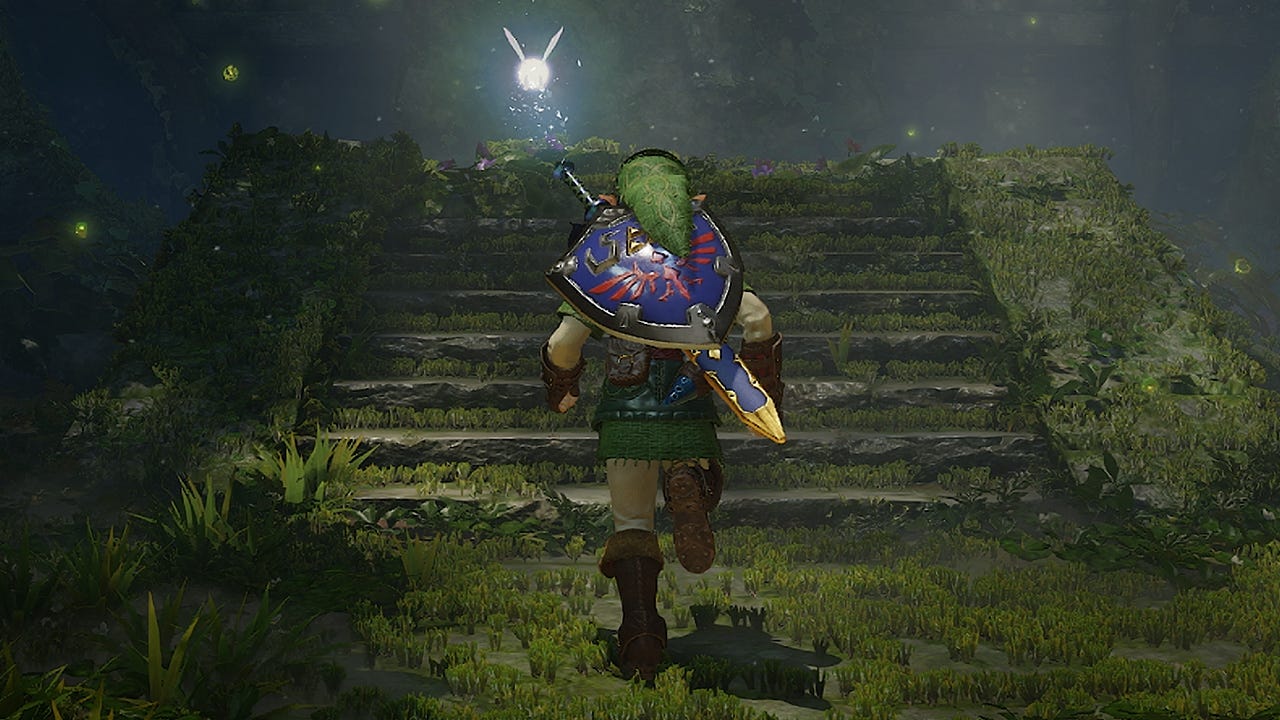
Aesthetic direction leans heavily into the theatrical staging that originally inspired the 1998 production. Hyrule functions as a choreographed narrative space, utilizing dynamic lighting pipelines, deliberate camera composition, and character blocking to project mythic drama. The visual framework leverages high-fidelity assets tailored to the Switch 2 processing architecture, modernizing character silhouettes and ecological detail across environments like Link’s treehouse and Kokiri Forest.
Complementing this visual re-engineering is the franchise’s shift to fully voice-acted cutscenes, moving away from the text-exclusive delivery of the cartridge era. Scripted dramatic set pieces—including Link’s departure from Kokiri Forest—utilize full voice performances to heighten dramatic tension, standardize pacing, and update the cinematic presentation to contemporary industry expectations.
Script Revisions and Narrative Pacing
Narrative integration expands through augmented dialogue trees for foundational non-player characters. Key narrative figures such as Saria and the fairy guide Navi feature rewritten interactions that supply expanded contextual background. Early sequence alterations, such as Saria directly approaching Link’s treehouse immediately after his awakening, establish proactive character relationships prior to acquiring essential equipment like the Deku Shield.
These script augmentations preserve the primary narrative trajectory concerning the quest for the Triforce while deepening non-player character characterization. Hyrule’s inhabitants shift from static quest-dispensers into dynamic community members. Crucially, the bilateral temporal framework remains intact: players alternate between Young Link and Adult Link, with the expanded dialogue dynamically reflecting the societal and environmental deterioration of the kingdom across timelines.
Control Ergonomics and Real-World Acoustic Mechanics
Player control mechanics have been refactored to align with modern third-person ergonomics, reducing input latency, camera friction, and targeting resistance. Sword-and-shield combat retains its deliberate, tactical focus, requiring players to observe enemy attack patterns and exploit vulnerability windows rather than relying on rapid input execution. Combat encounters integrate redesigned puzzle mechanics, while modern inventory management eliminates interface friction during equipment switches.
Mechanical innovation extends beyond standard button inputs through a physical acoustic interface. Official documentation confirms that players can interact with Link’s musical execution by humming learned melodies or playing along using real-world instruments. This mechanic integrates ambient acoustic performance into the software execution layer, transforming the ocarina into an active, multi-modal input system.
Lifecycle Context and Industry Implications
The Nov. 5 launch of The Legend of Zelda: Ocarina of Time represents a definitive case study in legacy software conservation. By prioritizing internal density, modern acoustic mechanics, re-engineered spatial puzzles, and high-fidelity theatrical presentation, the project establishes a framework for updating seminal historical designs without diluting their original authorial intent. The release solidifies Nintendo’s strategy of utilizing fully modernized flagship intellectual properties to validate next-generation console hardware.