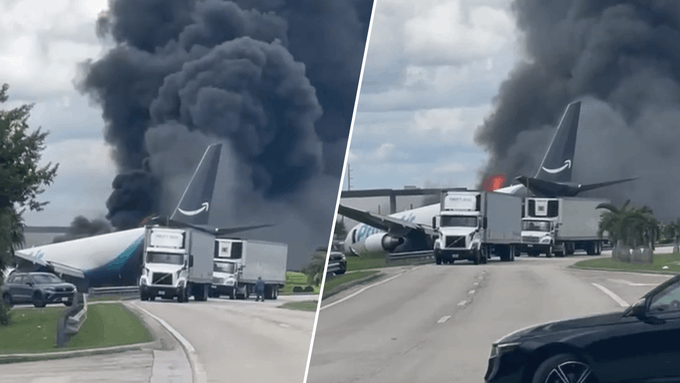
A runway excursion involving a Boeing 767-300 cargo aircraft, operated for Amazon Prime Air, at Miami International Airport (MIA) has disrupted one of the Western Hemisphere’s most critical logistics nodes. The incident occurred during a rejected takeoff (RTO) or acceleration phase, resulting in the airframe breaching the Runway Safety Area (RSA) and coming to rest across a perimeter roadway.
Node Congestion and Systemic Vulnerability
The immediate ground stop at MIA highlights the systemic vulnerability of high-utilization aviation hubs to single-point airfield failures. As a primary gateway for North-South trade, the cessation of departures at MIA creates a cascading backlog, affecting not only e-commerce fulfillment but also international belly-cargo and wide-body freighter schedules. For Amazon, the loss of this airframe necessitates an immediate shift in middle-mile sorting, redirecting high-volume throughput to secondary regional facilities to mitigate delivery delays.
Infrastructure Integrity and RSA Performance
The aircraft’s penetration of the airport perimeter onto a public roadway raises significant questions regarding the adequacy of current Runway End Safety Areas (RESA). While these buffers are engineered to decelerate aircraft, the kinetic energy of a fully-laden cargo 767 can exceed design parameters. This breach demands a structural assessment of MIA’s perimeter security and the potential implementation of Engineered Material Arresting Systems (EMAS) to prevent future incursions into civilian infrastructure.
Regulatory Scrutiny and Technical Variables
The National Transportation Safety Board (NTSB) and Federal Aviation Administration (FAA) have initiated a technical inquiry focused on flight data recorder (FDR) and cockpit voice recorder (CVR) telemetry. Key investigative vectors include:
- Performance Calculations: Verification of V-speed determinations and thrust settings relative to aircraft weight and balance.
- Environmental Factors: Assessment of runway friction coefficients and prevailing wind shear at the time of the excursion.
- Mechanical Integrity: Examination of braking systems, thrust reversers, and tire conditions during the RTO sequence.
Strategic and Financial Implications
Beyond the immediate hull-loss or repair costs, the financial exposure for Amazon and its contract carriers includes environmental remediation and insurance premium adjustments. This incident may prompt an internal audit of operational standards across the Prime Air network, which relies on a decentralized fleet of third-party operators. Maintaining the ‘Prime’ delivery promise under such operational strain tests the resilience of Amazon’s proprietary logistics stack and its ability to absorb major asset disruptions without eroding consumer confidence.
Institutional Shift in Safety Mandates
Historically, such excursions lead to industry-wide revisions in pilot training, specifically regarding high-speed RTO decision-making. Stakeholders will analyze the final NTSB findings to determine if new safety mandates are required for wide-body cargo operations in geographically constrained environments. The restoration of MIA’s full operational capacity remains the immediate priority, but the long-term impact on safety protocols for e-commerce aviation will be significant.