Tesla Shares Slip as Cybercab Unveiling Fails to Convince Investors
Tesla’s stock dipped 6% following the reveal of its Cybercab, a launch that did not significantly boost investor confidence in the company’s ambitious robotaxi strategy. The muted market reception underscores persistent skepticism regarding Tesla’s ability to disrupt the established autonomous vehicle sector, where rivals like Alphabet’s Waymo hold considerable ground.
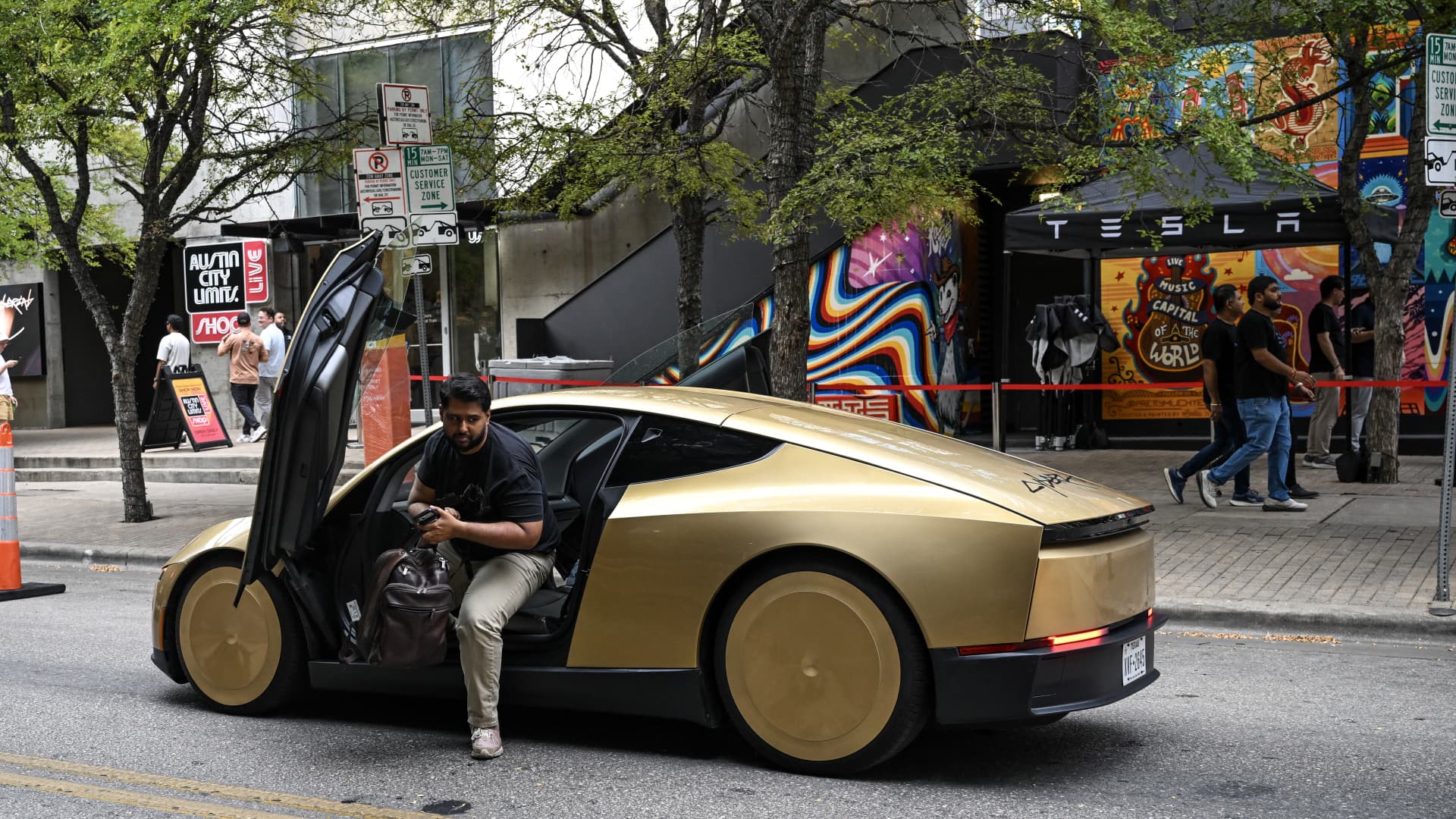
The Cybercab, first previewed almost two years ago, has been in limited production since April. Its design features a distinct bronze finish, a two-seat configuration, butterfly doors, and notably, the absence of a steering wheel or pedals, positioning it as a purpose-built autonomous vehicle, distinct from modified consumer models.
Exclusive Event Fuels Concerns Over Transparency, Production, and Regulation
Tesla’s event in Austin, Texas, was an invite-only affair, forgoing the public livestream typical of the company’s major product announcements. This lack of transparency, compounded by CEO Elon Musk’s absence, amplified investor apprehension. The company did announce that users of its Tesla Robotaxi app could now access driverless rides within a defined geofenced area around Austin.
Analysts at RBC Capital Markets observed that the event offered “limited new incremental disclosure relative to prior announcements.” Key outstanding questions regarding pricing strategy, production volume targets, and essential regulatory approvals remain unaddressed, creating a significant information gap for investors assessing Tesla’s entry into the robotaxi market.
Federal Probe Launched into Steering-Wheel-Free Taxi Operations
Concurrently with the Cybercab’s operational debut, federal authorities have initiated an investigation into Tesla’s steering-wheel-free taxis. The probe, commencing the day after driverless rides began, introduces substantial regulatory risk and heightened scrutiny to Tesla’s autonomous vehicle strategy, signaling a proactive stance by regulators concerned with novel transportation technologies.
The timing of the federal inquiry, immediately following the commencement of rides, suggests regulators are prioritizing the assessment of safety protocols and operational integrity for Tesla’s unique vehicle design. This governmental oversight could potentially lead to deployment delays, mandate design modifications, or influence the scope of future autonomous vehicle rollouts, impacting Tesla’s market entry timeline and financial projections.
Competitive Landscape and Ecosystem Integration Challenges
The Cybercab’s introduction places Tesla in direct competition with established players like Alphabet’s Waymo, which has been operating autonomous ride-hailing services in multiple cities for years. Waymo benefits from extensive operational data, a proven safety record, and established regulatory frameworks. Tesla’s approach, characterized by rapid deployment but less transparency, contrasts sharply with its rivals’ methodical, data-driven expansion.
Tesla’s strategy appears to leverage its established manufacturing scale and brand recognition for accelerated market penetration. However, the current ambiguity surrounding production capacity and regulatory approvals indicates that achieving significant market share in the robotaxi segment will necessitate overcoming substantial operational and compliance hurdles. Navigating these complexities is critical for Tesla’s long-term success in this capital-intensive and highly regulated industry.
Investor Sentiment Shifts, Demanding Tangible Progress
The market’s tepid response to the Cybercab update reflects a broader investor sentiment questioning Tesla’s current valuation in light of its ambitious autonomous driving goals. Historically, Tesla has commanded a premium based on future potential, but tangible progress and a clear path to profitability for its robotaxi service are now under intense scrutiny. The perceived underwhelm of the launch suggests investors require more concrete evidence of operational readiness and a viable business model.
This situation compels a strategic re-evaluation by Tesla’s management. The company must address investor concerns through clearer disclosures on production ramp-up, safety validation, and the economic feasibility of its robotaxi service. Failure to provide such clarity risks continued stock price volatility and potential erosion of investor confidence, impacting its ability to secure future capital for expansion.
Operational Realities and Market Entry Constraints
The limited geofenced operational area in Austin highlights current technological and regulatory constraints for autonomous vehicles. Deploying fully driverless vehicles requires comprehensive mapping, advanced sensor technology, and sophisticated decision-making algorithms for diverse urban environments. Tesla’s restricted deployment zone suggests significant technological and infrastructural challenges remain before widespread adoption is feasible.
Furthermore, the absence of manual driving controls in the Cybercab introduces specific safety and operational considerations. While signifying full autonomy, it poses challenges for emergency human intervention and integration into mixed-traffic scenarios. The evolving regulatory framework for vehicles entirely lacking manual controls adds another layer of complexity to Tesla’s market entry strategy.
Capital Allocation and Competitive Dynamics in Mobility Services
Tesla’s substantial investment in autonomous vehicle technology, including the Cybercab, represents a significant capital allocation decision. This focus diverts resources potentially usable for expanding EV production or battery technology development. Competitive pressures and the high cost of developing and deploying autonomous systems necessitate a clear return on investment strategy.
Cybercab’s success is tied to Tesla’s ability to generate revenue from ride-hailing and scale operations efficiently. Profitability issues or significant regulatory hurdles could strain financial resources and impact its market position. Rivals are also investing heavily in autonomous technology, making Tesla’s execution of its robotaxi strategy crucial for maintaining leadership in the automotive and technology sectors.
Media Narrative and Public Perception Management
The narrative surrounding the Cybercab launch is shaped by Tesla’s communication strategy and external factors like media coverage and regulatory actions. The decision for an exclusive event without a livestream, alongside the federal investigation, has fostered a perception of opacity. This contrasts with past highly publicized and accessible product reveals designed to generate significant public buzz.
Media focus on transparency issues and the federal probe risks overshadowing technological advancements. This can influence public perception, potentially impacting consumer adoption and complicating regulatory approval. Tesla’s ability to manage this narrative and build public trust will be as vital as its technological development for widespread robotaxi success.
Long-Term Strategic Implications for Tesla and the AV Industry
The Cybercab initiative is a high-stakes endeavor for Tesla, aiming to capture a substantial share of the burgeoning robotaxi market. Its outcome will profoundly impact Tesla’s valuation and future growth, as well as the broader trajectory of the autonomous vehicle industry. Successful navigation of regulatory, operational, and competitive challenges could set a new benchmark for autonomous ride-hailing.
Conversely, significant setbacks could embolden competitors, slow global AV deployment, and foster a more cautious approach from regulators and investors. Current developments highlight the complex interplay of technological innovation, regulatory oversight, market acceptance, and financial viability defining the future of autonomous transportation.
Institutional Responses and Market Adjustments to AVs
The market’s immediate reaction, evidenced by the stock price drop, signals a recalibration of investor expectations. This reflects a demand for greater clarity and tangible progress from Tesla, moving beyond aspirational statements to demonstrable operational and financial results. Federal involvement introduces an institutional dimension, underscoring that advanced technology deployment is subject to significant governmental oversight.
This institutional response from regulatory bodies is critical in shaping the competitive landscape. It implies that the path to market for autonomous vehicles depends not only on technological prowess but also on adherence to safety standards and regulatory compliance. Companies adept at navigating this complex framework are likely to gain a significant advantage, influencing capital flows and strategic partnerships.
Capital Movement and Strategic Investment Horizons in Autonomy
Capital markets are closely monitoring Tesla’s robotaxi venture, with investor sentiment directly influencing its ability to fund ambitious projects. Current skepticism suggests perceived risks—production scalability, regulatory approval, competitive pressures—may outweigh projected returns in the short to medium term, potentially leading to cautious institutional investment in Tesla’s AV division.
The long-term strategic horizon for robotaxi services is substantial, involving significant upfront investment and gradual infrastructure/operational build-out. Tesla’s ability to attract and retain capital hinges on demonstrating a clear, achievable roadmap to profitability, balancing innovation with financial prudence. Competitive dynamics suggest capital will flow towards companies offering a compelling blend of technological advancement and a sustainable business model.
Performance Leverage and Operational Execution in Autonomous Mobility
Tesla’s history is marked by aggressive innovation and challenging industry norms. However, Cybercab’s success relies on meticulous operational execution, ensuring safety and reliability in real-world autonomous driving. The limited geofenced area in Austin underscores ongoing challenges in achieving Level 5 autonomy and the need for robust testing and validation.
Tesla’s manufacturing expertise in scaling Cybercab production efficiently will be key to its market impact. Operational performance—ride availability, customer satisfaction, cost-effectiveness—will be critical for market traction. Execution missteps could negatively affect investor confidence and regulatory perception, hindering strategic objectives.
Ecosystem Integration and Future Trajectories in Mobility as a Service
The Cybercab initiative represents Tesla’s broader strategy to integrate its technology into the mobility-as-a-service ecosystem. Success in robotaxis could unlock new revenue streams and solidify Tesla’s leadership in autonomous transportation, potentially influencing smart city infrastructure and urban planning. Fostering partnerships and integrating services with existing transportation networks will be crucial.
Current challenges highlight the complex ecosystem. Federal regulators, competitor pressures, and evolving public perception create a dynamic environment. Tesla’s upcoming decisions on transparency, safety validation, and production scaling will significantly shape its future and the broader evolution of the autonomous vehicle industry.