The 2026 WNBA season represents a critical inflection point where structural growth matures into operational optimization. This era is defined by the intersection of a modernized collective bargaining agreement, the league’s first significant expansion in the current economic cycle, and a fundamental transition in media distribution. By entering the San Francisco market with the Golden State Valkyries, the WNBA is leveraging established NBA-adjacent infrastructure to accelerate revenue scaling and market penetration.
The Streaming Pivot: Amazon Prime as a Data-Driven Multiplier
The migration of primary broadcasting rights to Amazon Prime Video signals a departure from legacy linear models toward a global, streaming-first ecosystem. This move prioritizes granular viewership analytics over broad, often imprecise, cable ratings. For stakeholders, the shift to Prime Video offers a direct conduit to a digitally native demographic, enhancing the valuation of intangible assets like jersey patches and courtside virtual signage. The streaming-centric model also facilitates international accessibility, vital for a league seeking to convert global talent into global market share.
Institutional Maturity: The Golden State Valkyries’ Entry
The debut of the Golden State Valkyries at the Chase Center serves as a litmus test for the WNBA’s expansion viability. Operating under the Golden State Warriors’ organizational umbrella, the Valkyries benefit from immediate access to high-performance facilities and sophisticated ticket-yield management. Strategically, their entry triggers a league-wide recalibration of talent distribution via the expansion draft, while simultaneously establishing a West Coast anchor that complicates logistical scheduling. This expansion indicates an intentional move toward high-value metropolitan hubs capable of sustaining premium corporate partnerships.
Competitive Dynamics: Dynastic Continuity vs. Asset Accumulation
The Las Vegas Aces enter 2026 pursuing a fourth title in five seasons, attempting to cement a historical dynasty. Under Becky Hammon, the Aces’ system emphasizes high-efficiency offensive sets and defensive versatility, anchored by A’ja Wilson. Their operational continuity remains the league’s gold standard; however, recent defensive lapses suggest that peak-performance sustainability requires increasingly precise load management of their core rotation, including Wilson and Kelsey Plum.
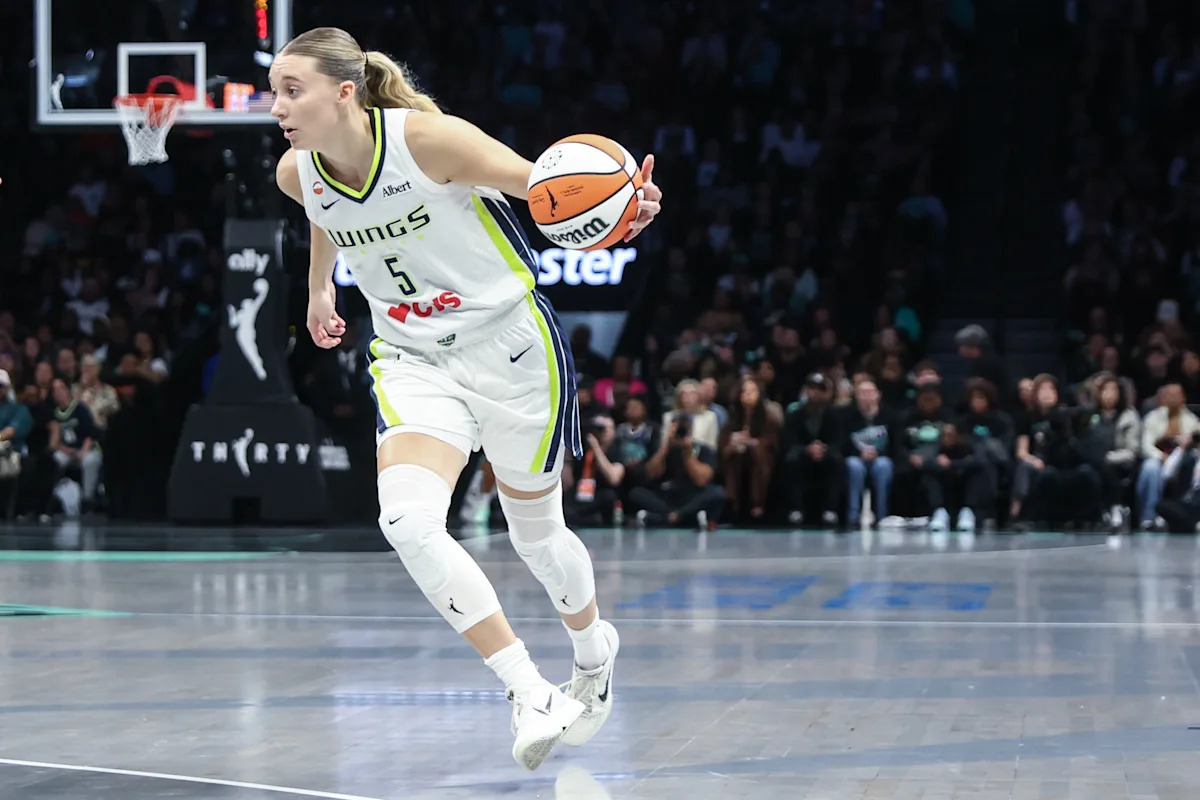
Conversely, the Dallas Wings represent a model of strategic player development. By pairing Paige Bueckers with Azzi Fudd, the Wings have constructed a backcourt defined by tactical synergy and significant marketing leverage. While Chennedy Carter’s hyper-efficient 66.2% field goal percentage provides an elite offensive floor, the team’s ability to transition into a championship contender depends on improving their defensive rating to match their high-volume scoring output.
Analytic Trends and Betting Market Integration
The May 28 matchup between the Aces and Wings—with Las Vegas as a 5.5-point favorite—reflects the market’s recognition of the gap between established elite contenders and rising challengers. Statistical outliers, such as Carter’s 58.3% accuracy from distance, underscore a shift toward individual efficiency that challenges traditional scouting reports. As advanced analytics increasingly dictate shot selection, the value of players who can break defensive systems through outlier efficiency has reached a premium, signaling a more sophisticated era of professional play.