
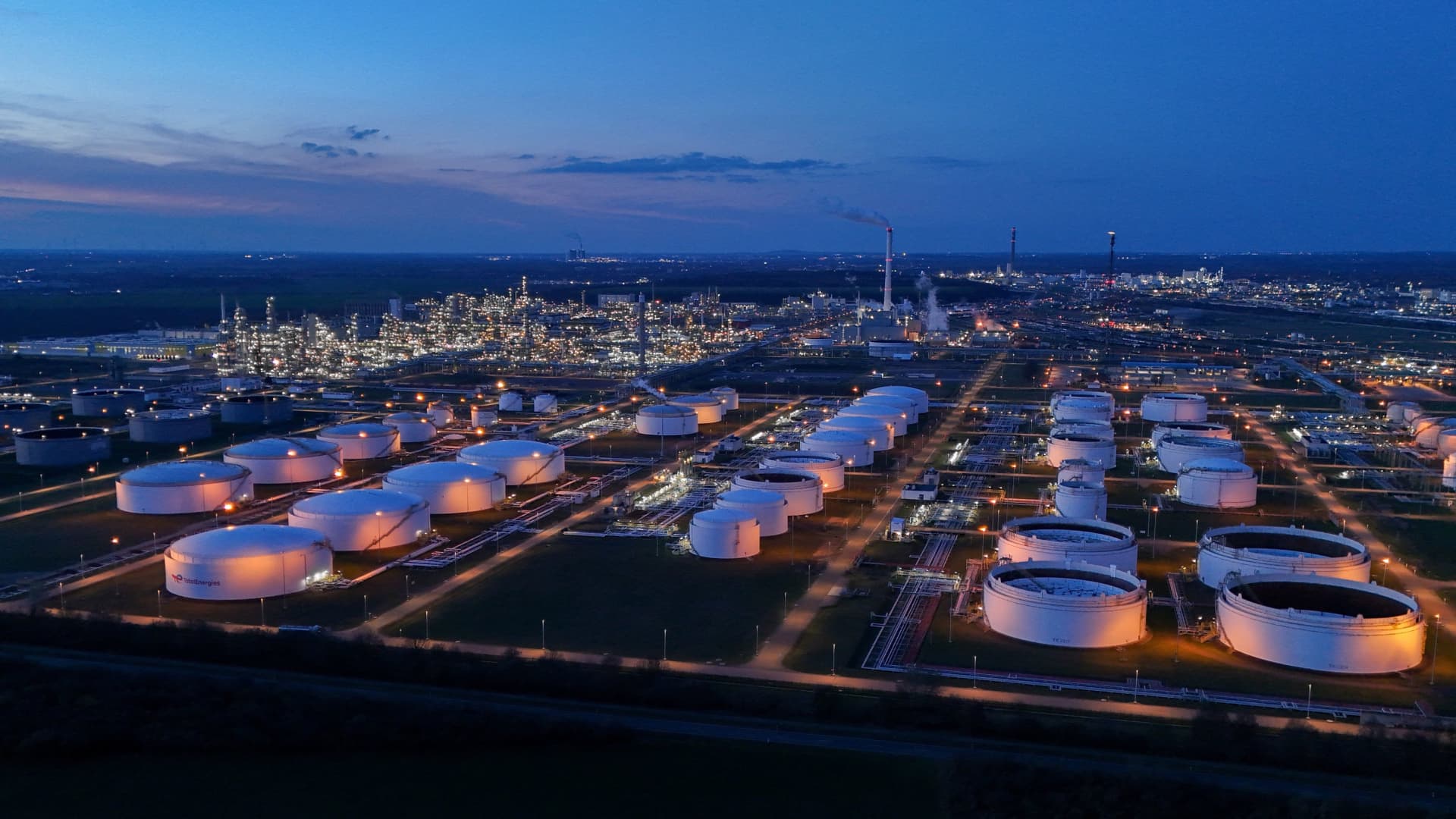
Market Volatility and the Tuesday Ultimatum
Global energy markets are currently integrating a substantial geopolitical risk premium as U.S. President Donald Trump establishes a definitive 8 p.m. ET Tuesday deadline for Iran to restore maritime access through the Strait of Hormuz. The administration’s explicit threat to target civil infrastructure—specifically power grids and bridges—marks a shift toward a doctrine of asymmetric escalation, designed to exert maximum economic leverage over the Islamic Republic.
U.S. West Texas Intermediate (WTI) crude futures for May delivery surged over 2%, reaching $112.41 per barrel. This price action signals a market hedging against two extremes: a rapid military resolution or a protracted supply deficit should the deadline expire without a diplomatic breakthrough. Brent crude for June delivery followed suit, rising 1.3% to $109.77 per barrel, reflecting the international benchmark’s sensitivity to the heightened probability of kinetic engagement in the Persian Gulf.
The Doctrine of Asymmetric Infrastructure Targeting
The pivot toward targeting power plants and transport nodes indicates a departure from traditional military-only engagement. By threatening to neutralize the nation’s foundational assets “in one night,” the U.S. administration is utilizing coercive diplomacy to force a capitulation on maritime transit. The destruction of power grids would cause immediate industrial paralysis, while the targeting of bridges—critical logistical nodes—would impede both domestic commerce and military mobility.
This strategy leverages the vulnerability of fixed infrastructure to bypass the tactical complexities of a prolonged naval blockade. Iranian leadership must now calculate whether the strategic leverage gained from closing the Strait outweighs the potential for permanent degradation of their domestic industrial base.
Systemic Supply Shocks and Refined Product Scarcity
The closure of the Strait of Hormuz since February 28 has triggered a systemic shock that extends beyond raw crude. Scarcity in refined products, notably diesel and jet fuel, is driving global inflationary pressure. These middle distillates are the backbone of global freight and aviation; their depletion removes a critical percentage of daily oil transit that alternative suppliers and strategic reserves have yet to successfully mitigate.
Current price levels reflect more than immediate scarcity; they represent a forward-looking assessment of the costs associated with the potential loss of Iranian export capacity. Market participants are increasingly forced to price in a scenario where the infrastructure required for future production and distribution is structurally compromised by military action.
Diplomatic Brinkmanship and Multilateral Pressures
Despite the aggressive posture, the White House has characterized current negotiations as being conducted “in earnest.” This suggests a dual-track strategy where the threat of total infrastructure destruction serves as the primary incentive for a negotiated reopening. The mention of involvement from “incredible countries” points to a multilateral effort, likely led by nations whose energy security is most vulnerable to Persian Gulf disruptions.
The 8 p.m. Tuesday deadline serves as a forcing function, intended to prevent diplomatic stalling. By dictating the tempo of the process, the U.S. is attempting to regain the initiative, leaving Iranian leadership with a narrow window to respond before the operational shift from diplomacy to kinetic action occurs.
Economic Recalibration and Downstream Impact
The surge in crude futures is manifesting in downstream costs, impacting manufacturing margins and consumer retail prices. Institutional investors are shifting capital toward energy assets and safe-haven currencies, fearing that a failure in negotiations could lead to a structural transformation of the global energy market defined by higher baseline costs and increased supply chain fragility.
As the deadline approaches, the global economy sits at a critical juncture. The outcome will either validate the efficacy of high-stakes coercive diplomacy or trigger a conflict that redefines regional stability and energy security for the foreseeable future.
Photo by markusspiske on Pixabay.