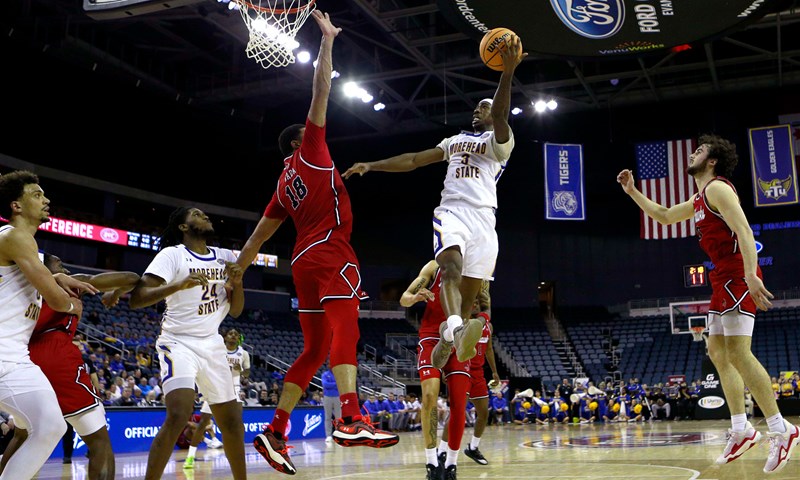
The Ohio Valley Conference (OVC) automatic qualifier for the 2026 NCAA Tournament has been determined following the conference championship concluded at the Ford Center in Evansville, Indiana. The final pitted No. 1 seed Tennessee State against No. 2 seed Morehead State, a decisive contest for the league’s singular bid to March Madness.
Leverage of Semifinal Execution
Tennessee State’s path to the final was solidified by a decisive 68-55 semifinal defeat of No. 4 seed UT Martin. This victory was rooted in operational efficiency, specifically leveraging high-volume three-point shooting and superior rebounding metrics against a motivated underdog.
The offensive output against UT Martin highlighted a strategic reliance on perimeter efficiency, marked by nine made three-pointers on 22 attempts. Travis Harper II’s four successful treys anchored this attack, indicating a tactical focus on floor spacing to exploit defensive rotations. This contrasts sharply with traditional tournament grind-it-out styles, signaling a deliberate offensive philosophy prioritizing high-leverage scoring opportunities.
Individual statistical contributions underscore this depth. Aaron Nkrumah delivered a potent two-way impact with 19 points, four assists, and three steals, suggesting effective transition creation and defensive disruption. Lorick III’s crucial double-double provided necessary interior stability, ensuring TSU controlled the possession differential required to dictate tempo.
Strategic Momentum and Seeding Validation
The semifinal win immediately clinched the 2026 NCAA Tournament berth, validating TSU’s regular-season performance and fulfilling a critical institutional objective: returning to the NCAA Tournament after a 14-year absence. This success alleviates significant internal pressure concerning program trajectory and resource allocation.
The aggressive start against UT Martin—leading 23-10 early via a 10-of-13 three-point clip in the initial phase—demonstrates a strategic priority: establishing immediate scoreboard separation. This pace, orchestrated by Coach Nolan Smith’s team, aimed to neutralize underdog energy and force UT Martin into a reactive offensive structure.
The anomaly of ten first-half threes suggests meticulous scouting identified exploitable weaknesses in UT Martin’s defensive scheme. This high-stakes shooting efficiency reflects superior preparation and execution under duress, a key metric for assessing tournament readiness.
Championship Context: Regular Season Parity and Market Expectations
The final against Morehead State was framed by near-perfect regular-season parity, both teams finishing 15-5 in OVC play. This shared top billing transformed the final into the definitive tiebreaker for the league’s hierarchy heading into the national selection process.
Predictive analysis heavily favored an offensive shootout, based on historical data showing the two teams averaging 192.5 combined points in their prior meetings, significantly eclipsing the established championship line of 145.5. This suggests market skepticism regarding the sustainability of high offensive output under elimination pressure.
Morehead State entered the final with an eight-game winning streak and a 75.8 PPG average, implying strong late-season cohesion capable of matching TSU’s up-tempo approach.
Incentives: Title Drought and Stakeholder Exposure
For Tennessee State, securing the bid ends the 14-year drought, directly improving alumni engagement, recruiting leverage, and administrative capital. Marketing the program as an NCAA participant immediately elevates its competitive standing within the OVC.
Conversely, Morehead State faced the structural disadvantage of needing an at-large bid had they lost, placing them subject to national committee evaluations that frequently undervalue OVC results compared to Power Six conferences. Their final performance served as the crucial, final data point for external evaluators.
The betting market projecting Over 145.5 indicated stakeholder anticipation that both teams would adhere to their offensive identities. TSU, possessing a Top 75 scoring offense (80.5 ppg), ensures the championship narrative centers on offensive execution versus defensive attrition.
Cascading Effects on OVC Institutional Positioning
The OVC structure, defined by two dominant teams, suggests a bifurcation of competitive strength. The automatic qualifier status provides a critical operational advantage, shielding the winning program from the subjective scrutiny inherent in mid-major at-large considerations.
The shared 15-5 conference record establishes a concentrated competitive ceiling, influencing future scheduling and resource allocation for remaining OVC members who must now recalibrate against this high-performing baseline.
Leverage of Selection Sunday Narrative Control
Tennessee State’s successful navigation grants them total control over their postseason narrative, bypassing the contentious Selection Sunday debates that affect non-Power Six teams. This direct path is a strategic asset, allowing resource focus entirely on NCAA preparation rather than perception management.
The historical 14-year absence amplifies the institutional significance. This success translates directly into increased visibility, correlating with higher merchandise sales, donor engagement, and stronger leverage in future facility and coaching contract negotiations.
The contrast between TSU’s efficient three-point focus and MSU’s high-scoring pace sets the stage for a tactical clash where execution under duress is paramount. TSU’s demonstrated ability to shoot 45%+ from deep against MSU in regular-season matchups suggests a successful tactical countermeasure deployed.
Ultimately, the documented events confirm the successful execution of a multi-stage competitive strategy by Tennessee State, culminating in capturing the OVC’s singular national qualification slot. Downstream implications involve immediate resource reallocation towards NCAA preparation and long-term leverage in institutional fundraising based on ending the multi-decade drought.