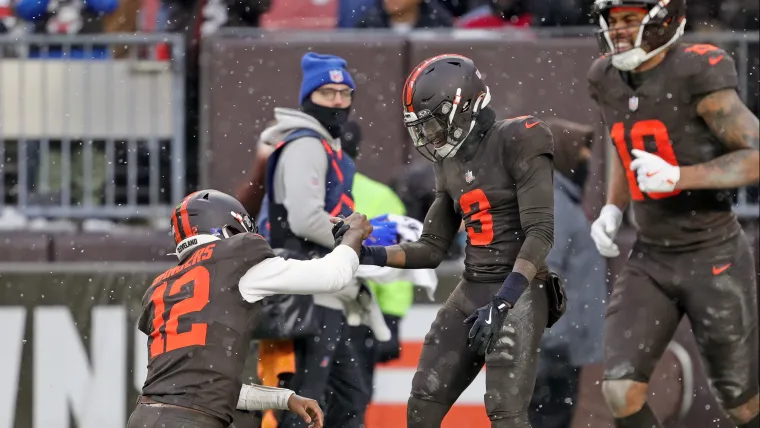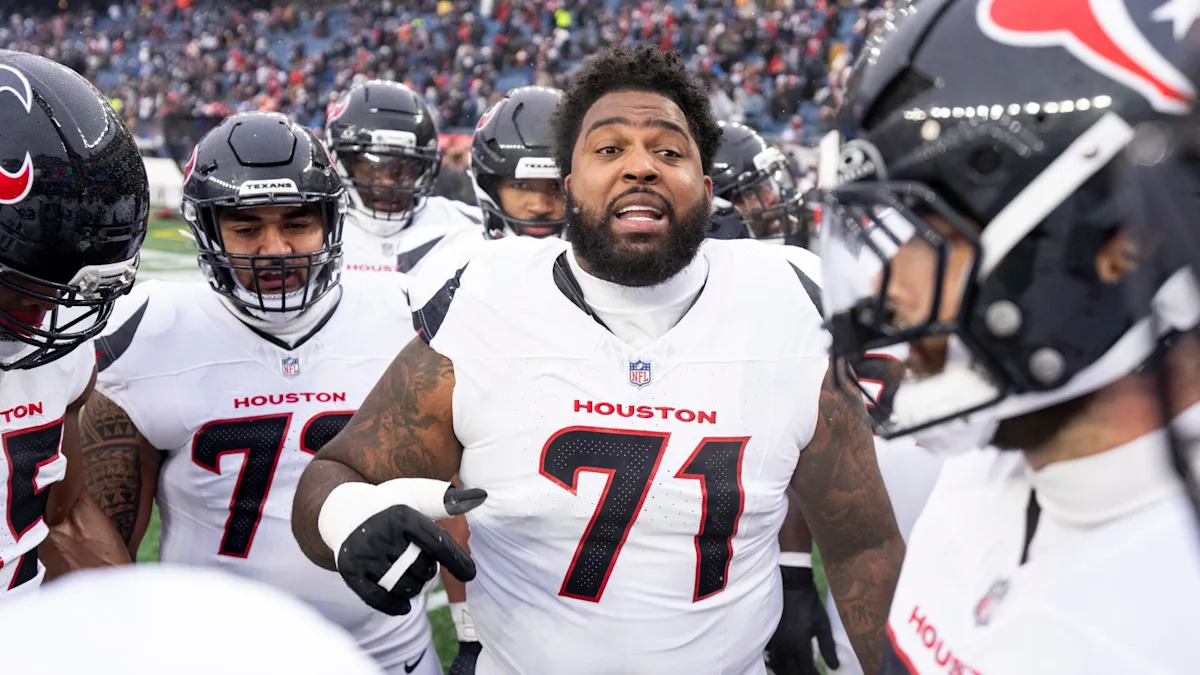
The trade of offensive lineman Tytus Howard from the Houston Texans to the Cleveland Browns signifies a pivotal realignment of strategic imperatives for both franchises entering the 2026 league year. For Houston, this transaction represents a calculated deleveraging of immediate cap obligations, preparing for a substantial capital reallocation towards their ascending cornerstone players. Conversely, Cleveland is aggressively deploying resources to fortify an offensive front that proved a critical strategic vulnerability in the preceding season.
Strategic Cap Deleveraging in Houston
For the Houston Texans, the decision to divest from a veteran starter in exchange for a fifth-round draft selection is fundamentally an exercise in long-term financial foresight, not a commentary on Howard’s on-field utility. Howard carried a prohibitive cap hit of nearly $28 million in the final year of his previous contract, a figure that would have severely constrained the front office’s capacity to maneuver during future free agency periods. By eliminating this commitment, Houston immediately gains significant fiscal liquidity, crucial for managing the escalating market value of their elite rookie-contract talent.
The impending contract extensions for franchise quarterback C.J. Stroud and dominant edge rusher Will Anderson Jr. are the primary catalysts for this divestment. Savvy front offices, operating with high-performing quarterbacks on rookie deals, must meticulously optimize financial flexibility before these players transition to market-setting contracts that typically consume a substantial percentage of the total salary cap. Moving Howard now proactively sidesteps the “sunk cost” trap, avoiding a high-priced veteran who might not align with the team’s championship window five years hence.
Moreover, the Texans’ willingness to accept a modest fifth-round pick unequivocally signals that the paramount value derived from the trade was the immediate $18 million in salary and bonuses Howard was owed. This strategic move communicates to the league Houston’s prioritization of roster agility over veteran depth, implicitly trusting their robust scouting department to identify cheaper, younger alternatives through the draft. It represents a calculated risk, predicated on the assumption that the offensive line can sustain its integrity and performance without Howard’s proven versatility at both guard and tackle.
Cleveland’s Aggressive Offensive Line Fortification
The Cleveland Browns initiated the 2026 offseason confronting a systemic structural deficiency across their offensive front, exacerbated by six key players heading toward free agency and a pervasive track record of inconsistent performance. The acquisition of Howard marks the foundational step in a comprehensive overhaul designed to safeguard their significant investment in the backfield and re-establish the team’s identity as a physically dominant, line-driven offense. General Manager Andrew Berry’s immediate action to sign Howard to a three-year, $63 million extension forcefully underscores the urgency of this critical restructuring.
By securing Howard through the 2028 season, Cleveland endeavors to install a veteran anchor within a unit that may feature multiple new starters by the regular season opener. The $21 million average annual value of the extension firmly positions Howard among the league’s higher-paid tackles, a valuation reflecting the premium teams must now pay for proven starting-caliber players in a market where demand consistently outstrips supply. This substantial financial commitment unambiguously indicates the Browns’ perception of Howard as a foundational piece, rather than merely a transient stopgap solution.
The operational impact of this trade will be immediately palpable in Cleveland’s pass protection schemes, which demonstrably struggled with both health and fundamental consistency throughout the 2025 campaign. Howard’s documented ability to competently play multiple positions affords the coaching staff valuable tactical flexibility, though his primary deployment is anticipated to be at right tackle. Furthermore, this preemptive acquisition functions as a crucial defensive measure against the inherent volatility of the free-agent market, ensuring the Browns avoid a reactive bidding war for potentially lower-tier talent later in the offseason.
Contractual Dynamics and Market Repercussions
The specific financial architecture of Howard’s new deal offers granular insight into Cleveland’s cap management strategy over the forthcoming three seasons. A $63 million extension for a player characterized by a history of intermittent injuries and performance inconsistencies suggests the Browns are strategically prioritizing a high performance “floor” over a speculative “ceiling” in their roster construction. The organization is banking on a healthy, well-integrated Howard to consistently deliver league-average or superior performance, thereby rectifying the pervasive instability that plagued their offensive line during the previous year’s collapse.
From a broader market perspective, this contract establishes a salient new benchmark for veteran offensive tackles who, while not necessarily considered elite, are deemed indispensable for maintaining offensive stability. Player agents across the league will undoubtedly leverage Howard’s $21 million average annual value as a foundational negotiating point for similar players. This inflationary pressure on the offensive line market retrospectively validates Houston’s decision to exit the Howard business, reinforcing their prudent cost-control strategy.
For Cleveland, this deal encapsulates a continuation of their aggressive, inherently high-risk approach to roster building, a defining characteristic of the Andrew Berry era. While the monumental trade for Deshaun Watson remains a cautionary tale within the organization’s recent history, the front office appears undeterred in its willingness to both expend significant draft capital and commit to substantial extensions to address critical positional deficiencies. The ultimate efficacy of the Howard trade will be unequivocally measured by his consistent availability and his ability to provide the blind-side and interior security that the Browns’ offense has conspicuously lacked.
Risk Assessment and Positional Flexibility
Notwithstanding the considerable financial outlay, Howard’s professional profile is not devoid of substantial risks that both franchises rigorously evaluated prior to finalizing the agreement. His tenure in Houston was marked by periods of exceptionally high-level play, frequently interspersed with injury-related absences and strategic shifts in positional responsibilities that occasionally impeded his consistent development. Cleveland is, in essence, making a premium investment in the version of Howard who excelled as a dominant right tackle early in his career, rather than the player who struggled with positional consistency and effectiveness at left guard during the previous season.
The Browns’ comprehensive medical and scouting departments must have meticulously concluded that Howard’s previous injuries are non-degenerative and that any performance fluctuations were predominantly a byproduct of Houston’s evolving offensive schemes. Should Howard successfully reclaim his form as a commanding edge protector, the $63 million investment will be unequivocally perceived as a necessary, albeit significant, cost of doing business within the hyper-competitive AFC North. Conversely, should performance inconsistencies or health issues persist, Cleveland will find itself burdened by another expensive, long-term contract, severely limiting their future roster maneuverability.
Houston’s strategic pivot away from the Howard era simultaneously reflects an evolving offensive philosophy under their current coaching staff. By trading a player renowned for his positional versatility, the Texans may be signaling a preference for more specialized, technically refined blockers who are intrinsically better suited for a specific zone-blocking or power-gap scheme. This transaction empowers them to reset their offensive line identity, tailoring it precisely to maximize the strengths of C.J. Stroud and prioritizing agile, quick-footed protectors capable of neutralizing the AFC South’s elite pass rushers.
Institutional Memory and the Watson Transaction Parallel
It is jurisprudentially impossible to analyze a major trade between the Texans and the Browns without acknowledging the indelible historical context of the Deshaun Watson transaction. That preceding deal fundamentally recalibrated the strategic trajectory of both franchises, saddling Cleveland with a massive, unprecedented financial burden while equipping Houston with an unprecedented cache of draft picks that singularly fueled their rapid, successful rebuild. The Howard trade, though smaller in financial magnitude, undeniably follows a similar pattern: Cleveland dispatching assets to Houston in exchange for a high-priced veteran with a complex professional track record.
This palpable sense of “déjà vu” introduces an additional layer of intense scrutiny to the current move, as both fans and analysts will inevitably juxtapose Howard’s impact against the conspicuously underwhelming returns of the Watson trade. For Houston, this transaction represents yet another masterclass in extracting significant value from Cleveland while simultaneously optimizing their own balance sheet. The Texans have effectively leveraged the Browns as a strategic partner, consistently facilitating their seamless transition from a foundational rebuilding team to a burgeoning contender with an impeccably clear financial runway.
For the Browns, the institutional pressure to validate this trade is immense; another high-profile failure involving a former Texans player would profoundly erode the credibility of the current front office administration. The offensive line remains the singular positional group where the Browns cannot afford even marginal mediocrity if they harbor aspirations of competing in a division defined by elite defensive fronts. By doubling down on Howard, the Browns are unequivocally signaling their conviction that their current championship window remains open, notwithstanding accumulating evidence of roster stagnation.
Macro-Market Implications for Offensive Tackle Valuation
The Tytus Howard trade will assuredly generate discernible ripple effects across the National Football League as teams meticulously prepare for the commencement of the new league year. With a proven starting-caliber tackle definitively off the market and a newly established salary benchmark, other franchises in desperate need of offensive line reinforcement will be compelled to recalibrate their player valuations. This transaction will almost certainly amplify the negotiating leverage of impending free agents and high-end draft prospects, as the inherent scarcity of premium tackle talent becomes even more acutely pronounced.
Conversely, teams like the Texans, now possessing an additional fifth-round pick and substantial newfound cap space, are strategically positioned to be exceptionally aggressive players in the secondary market. They can judiciously afford to overpay for short-term veteran depth or strategically take calculated swings on high-upside players who have fallen out of favor elsewhere. This enhanced financial and draft flexibility is a direct, quantifiable outcome of the Howard trade, providing Houston with multiple synergistic pathways to reinforce their roster around the generational talents of Stroud and Anderson.
Conversely, Cleveland’s proactive move may paradoxically signal a cooling of the market for other similarly tiered veteran tackles, as one of the most demonstrably desperate buyers has now addressed its primary need. Other teams contemplating moving expensive offensive linemen may consequently encounter fewer willing suitors prepared to absorb large contracts and concurrently surrender valuable draft capital. The Browns have effectively delineated the upper ceiling for what a team is willing to pay for a non-elite, yet reliable, starter, which could precipitate a more stagnant market for veteran blockers as the offseason unfolds.
Conclusion: Divergent Strategic Trajectories and Outcomes
The Tytus Howard trade serves as a compelling microcosm of the fundamentally divergent stages of the franchise lifecycle currently occupied by Houston and Cleveland. Houston is operating with the rigorous financial discipline characteristic of a team that has decisively identified its core and is now meticulously managing its fiscal resources to ensure enduring long-term sustainability. Their strategic focus is acutely targeted towards the 2027 and 2028 seasons, when their emergent stars will command record-breaking, market-resetting salaries, rendering every dollar judiciously saved today a critical investment in that expansive future.
Cleveland, in stark contrast, is operating with the pronounced urgency of a franchise whose perceived championship window may be rapidly constricting, or at minimum, one that acutely recognizes its current trajectory is fundamentally unsustainable without immediate, decisive intervention. The offensive line represented a glaring, existential weakness that threatened to systematically undermine the entire organizational framework, and the high-stakes acquisition of Howard constitutes a profound attempt to comprehensively patch that critical vulnerability. Whether this strategic maneuver ultimately provides the requisite stability or metamorphoses into another debilitating financial anchor remains the pivotal, overarching question for the Browns’ front office.
Ultimately, the long-term success of this intricate trade will be unequivocally predicated on the sustained health and on-field performance of the players involved, coupled with the accuracy of the underlying financial projections meticulously crafted by both teams. Should Howard robustly anchor the Browns’ offensive line for the duration of his three-year contract, the surrendered fifth-round pick and the $63 million investment will be retrospectively perceived as a justified, necessary expenditure for achieving foundational stability. Concomitantly, if Houston expertly leverages the resulting cap space to seamlessly navigate the monumental extensions of Stroud and Anderson, the trade will be indelibly remembered as a masterclass in proactive, visionary roster management.