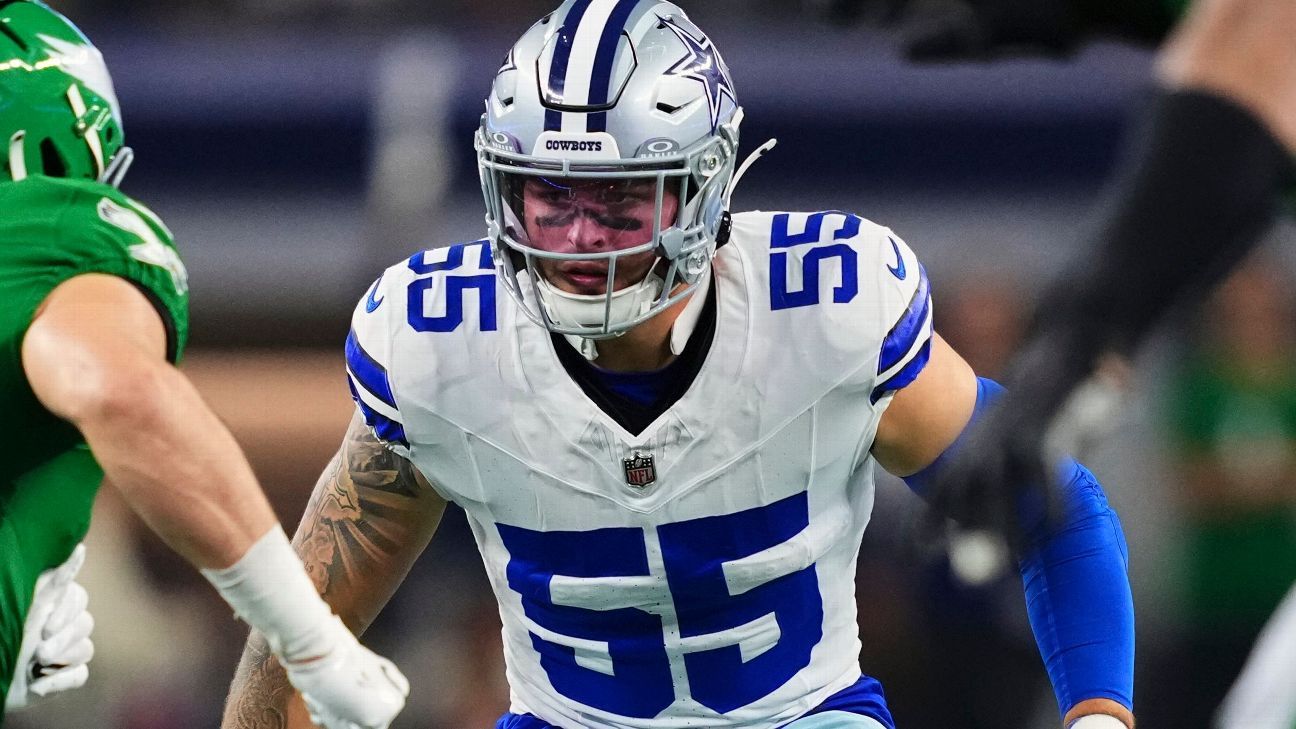
The Dallas Cowboys’ immediate decision to waive veteran linebacker Logan Wilson extracts a crucial $6.5 million in salary cap space, specifically freeing up funds in the 2026 fiscal year. This action effectively nullifies the capital outlay—a 2026 seventh-round pick—spent acquiring Wilson from the Cincinnati Bengals at the 2025 trade deadline.
Rapid Philosophical Alignment Under Christian Parker
Wilson’s release is the first major personnel declaration under new Defensive Coordinator Christian Parker, illustrating a non-negotiable commitment to aligning the roster with his specific defensive architecture. Parker’s stated focus centers on winning first and second downs to force manageable third-down scenarios, a requirement where Wilson’s usage (one start in seven appearances) suggests incompatibility.
The positional bottleneck that prompted the mid-season trade for Wilson appears resolved internally or deemed secondary to the immediate necessity for financial leverage. Wilson’s limited operational rhythm, reportedly hampered by inconsistent snap counts even before the coaching change, confirmed the acquisition was a short-term tactical failure.
The $6.5M Liquidity Advantage
The $6.5 million saved represents essential operational headroom. Since Wilson’s contract carried no guaranteed money into 2026, his release provided a ‘clean exit,’ maximizing liquidity without incurring dead cap penalties. This capital is now earmarked to address systemic deficiencies exposed during the previous season’s defensive regression, potentially through restructuring existing contracts or aggressive free-agency pursuits.
Performance Disparity vs. Pedigree
Despite Wilson’s established pedigree—including a Pro Bowl selection and significant starting experience in Cincinnati—his on-field impact in Dallas was muted (24 tackles, one forced fumble). The data suggests the performance decline or schematic mismatch was apparent quickly. Evidence of this incompatibility existed even prior to the trade, as Wilson had reportedly been supplanted by rookie Barrett Carter in Cincinnati.
Furthermore, an incident where Wilson did not play a snap in the Christmas Day win against Washington, later attributed to a ‘coaches’ error,’ underscores fractured communication and inconsistent deployment strategies that precluded any meaningful integration.
Roster Hierarchy and Future Outlook
The organization’s retention of Kenneth Murray Jr. as the primary starter signals a clear positional preference aligning with Parker’s vision, regardless of the overall unit’s struggles. This sets the competitive baseline for the linebacker corps moving forward.
For the Bengals, the transaction was an effective asset management play: divesting a depreciating, high-snap-count veteran for future developmental capital. Conversely, the Cowboys incurred the sunk cost of the 2026 pick for zero sustained on-field return, resulting in a net loss of asset value used solely to correct a tactical misstep.
Structural Lesson: The Pitfalls of Mid-Season Correction
The rapid acquisition and subsequent release of Wilson highlight the structural risk associated with attempting to fix core systemic deficiencies via mid-season trades rather than comprehensive offseason planning. Such reactive moves force immediate, often costly, roster compression when integration fails.
Parker’s introductory focus on fundamental execution—blocking, tackling, attacking the ball—suggests a philosophical reset that structurally marginalized Wilson’s specific veteran skill set. The focus must now shift to allocating the $6.5 million strategically, proving that the cap relief translates into superior talent acquisition rather than merely balancing pre-existing budgetary pressures.