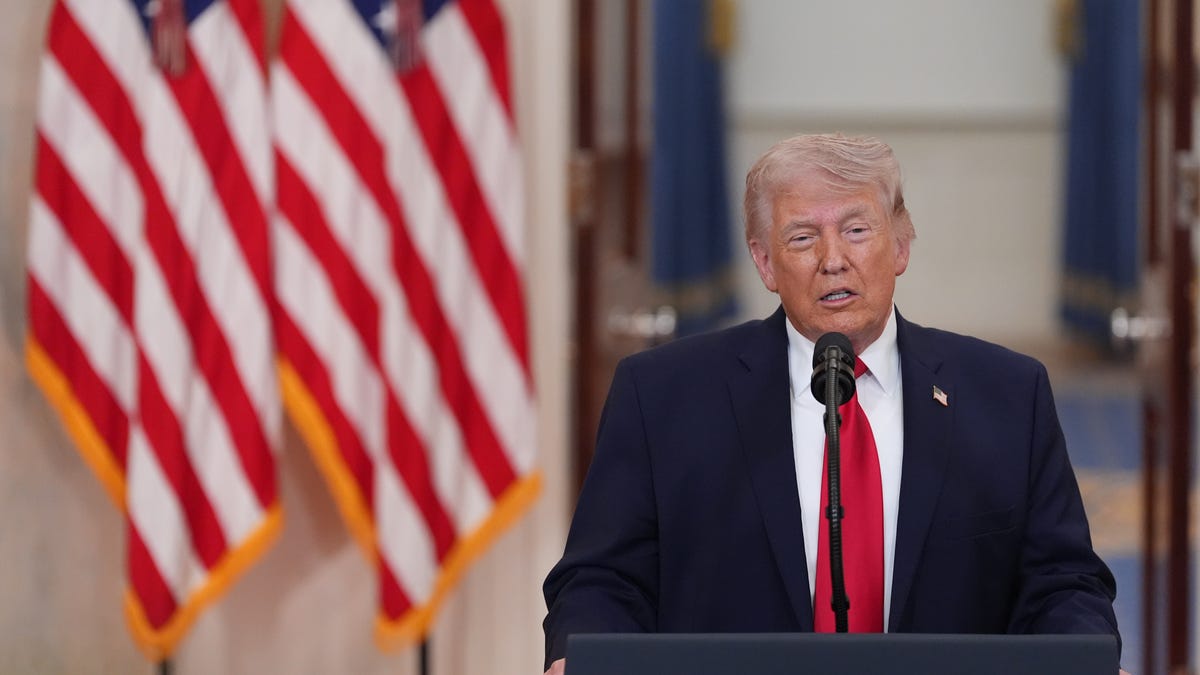
President Donald Trump has signaled a fundamental shift in executive fiscal strategy, proposing a divestment of federal childcare funding in favor of augmented military expenditures. During a strategic briefing at the White House, the President issued a directive to Office of Management and Budget (OMB) Director Russell Vought to reallocate capital away from domestic social infrastructure, framing the move as a return to core sovereign functions.
This policy pivot reinterprets federal mandates, suggesting that the provision of childcare constitutes an overextension of the national government’s authority. By prioritizing defense readiness over domestic social subsidies, the administration aims to consolidate federal resources toward global conflict management and national security, asserting that local jurisdictions are the appropriate venues for social service administration.
The Mechanics of Fiscal Devolution
The proposal represents a strategic devolution of social services, rooted in a federalist restructuring that seeks to decentralize operational management. The administration argues that the diversity of the fifty states necessitates localized solutions rather than a centralized federal model. However, this strategy effectively shifts the fiscal burden to state legislatures, many of which operate under balanced-budget requirements that limit their capacity to absorb sudden revenue shortfalls.
By withdrawing federal grants-in-aid, the administration challenges the institutional framework that has historically stabilized the childcare sector. This realignment assumes that state governments can identify new revenue streams—potentially through localized tax increases—to replace lost federal subsidies, a move likely to face significant political and economic friction.
Operational Risks and Labor Market Impacts
The childcare industry, characterized by high labor costs and narrow margins, is acutely sensitive to shifts in subsidy structures. The withdrawal of federal support risks immediate capital shortfalls for providers, which could lead to increased costs for consumers or the total collapse of subsidized care options in states with smaller tax bases.
Furthermore, the loss of affordable care creates a secondary threat to labor market stability. A contraction in the availability of childcare could force an exodus of low-to-middle income parents from the workforce, creating volatility for employers who rely on a consistent labor supply. This geographical fragmentation of social services could lead to long-term economic imbalances between wealthier states and those unable to sustain their own subsidy programs.
Institutional Friction and the Zero-Sum Budget
The directive to the OMB utilizes administrative leverage to bypass legislative consensus, using the budget process as a primary tool for policy transformation. The administration’s rhetoric—characterizing childcare funding as a “lead balloon” and prioritizing “fighting wars”—underscores a zero-sum view of federal resources. In this hierarchy, military readiness is positioned as a non-negotiable priority, while domestic programs are categorized as non-essential to federal stability.
Ultimately, the move to treat childcare as a state-level responsibility rather than a federal necessity marks a pivotal moment in the debate over the role of the national government. The operational consequences of this shift will likely trigger a period of intense fiscal adjustment at the state level, testing the resilience of the American federalist model under modern economic pressures.