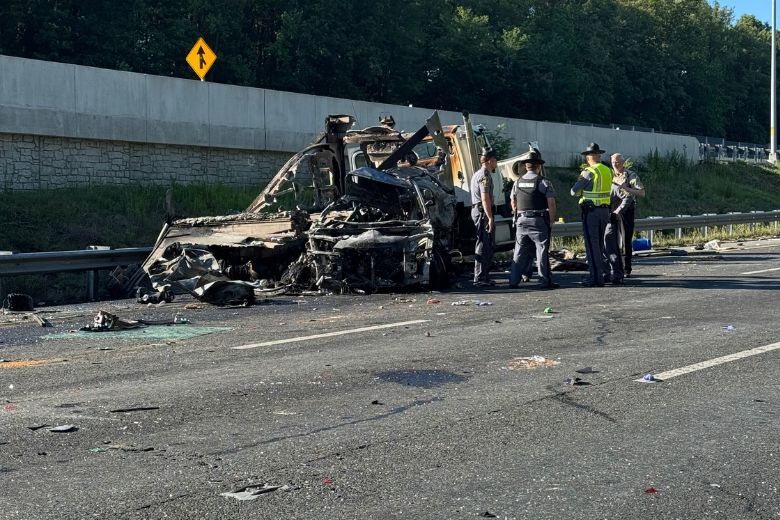
The multi-vehicle collision on Interstate 95 in Stafford County, Virginia, serves as a critical case study in the failure of long-haul transit safety within high-velocity corridors. The incident, involving an E&P Travel motor coach, highlights the catastrophic consequences when commercial kinetic energy intersects with nocturnal infrastructure maintenance zones.
Kinetic Chain Reaction and Work Zone Dynamics
Preliminary investigations indicate the E&P Travel bus failed to decelerate upon entering a marked work zone near mile marker 146. The resulting impact with a Chevrolet Suburban initiated a high-energy chain reaction, demonstrating the physics of ‘secondary projectiles’ in highway environments. The mass differential between a commercial motor coach and passenger SUVs effectively nullifies standard vehicle safety features, converting a localized traffic slowdown into a mass-casualty event.
This failure points to a breakdown in situational awareness, likely exacerbated by the ‘circadian low’—the early morning window (approx. 2:35 a.m.) where driver fatigue and reduced visibility converge. For carriers on the New York–Charlotte corridor, the operational pressure to maintain schedules through active construction zones creates a high-risk environment that necessitates advanced driver-assist technologies and automated braking systems.
Institutional Risk and Regulatory Scrutiny
E&P Travel faces significant institutional exposure regarding its adherence to Federal Motor Carrier Safety Administration (FMCSA) standards. The investigation by the Virginia State Police will focus on three key pillars: hours-of-service compliance, mechanical integrity, and driver training protocols. For mid-sized carriers, the financial liability stemming from five fatalities and 44 injuries often exceeds standard insurance caps, leading to protracted litigation and potential corporate dissolution.
Furthermore, the incident emphasizes the need for ‘smart’ work zones. While the area was reportedly signaled, the lack of real-time speed-governing feedback or physical intervention barriers remains a systemic vulnerability in U.S. highway infrastructure policy.
Socio-Economic Erosion and Healthcare Surge
The loss of the Doncev family represents more than a personal tragedy; it is an erosion of human capital in Greenfield, Massachusetts. As a night-shift nurse at Holyoke Medical Center, Dmitri Doncev embodied the essential labor force. The sudden removal of such professional expertise, alongside the loss of two generations of a family, creates a vacuum within regional immigrant networks and local healthcare institutions.
The emergency response in Stafford County also provides a data point for hospital surge capacity. Transporting 44 patients simultaneously tested regional triage protocols and mutual aid agreements. The logistical strain of a mass-casualty event on this scale disrupts standard care delivery and highlights the necessity for robust trauma-center coordination along major commerce arteries.
Strategic Conclusion: Policy Trajectories
The Stafford County disaster necessitates a shift from passive safety signage to active technological enforcement. Policy recommendations should include mandatory collision-avoidance systems for all intercity buses and more aggressive speed-tapering protocols in nocturnal work zones. Until carrier accountability and infrastructure design are integrated, the I-95 corridor will remain a site of recurring strategic risk for the traveling public.