Meteorological Drivers of Continental Smoke Transport
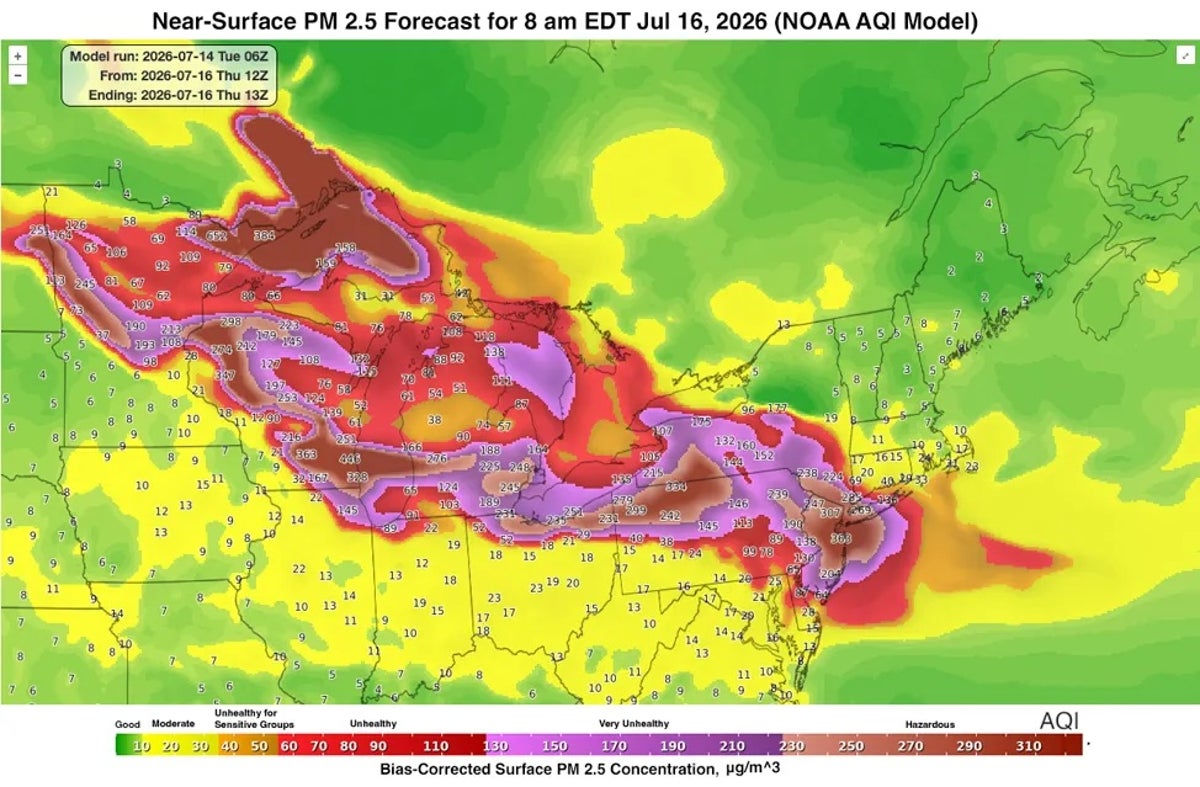
A significant atmospheric transport event is underway as wildfire intensification in northern Minnesota and Ontario interfaces with a high-pressure heat dome over the central United States. This anticyclonic system generates a clockwise circulation, facilitating the horizontal advection of wood smoke plumes across the North American interior. The resulting meteorological corridor acts as a high-speed conduit, bypassing local containment and introducing foreign particulate matter into the New England and Mid-Atlantic air sheds.
Atmospheric Subsidence and Ground-Level PM2.5 Infiltration
The primary risk to municipal health lies in vertical mixing and atmospheric subsidence. While smoke often remains aloft in the upper troposphere, the downward pressure from the central heat dome forces these plumes toward the planetary boundary layer. This process threatens to saturate the breathing zone with high concentrations of PM2.5—microscopic particles capable of penetrating the pulmonary and cardiovascular systems. Forecasts from the National Oceanic and Atmospheric Administration (NOAA) indicate that cities such as Detroit, Cleveland, and New York face a transition from hazy skies to tangible ground-level pollution events.
The Air Quality Index (AQI) as a Tactical Framework
As the smoke descends, the Air Quality Index (AQI) serves as the critical metric for public health interventions. Projections suggest a shift into ‘Unhealthy’ (Red) and ‘Hazardous’ (Purple) categories, necessitating immediate operational adjustments. Beyond respiratory risks, these elevations in particulate density trigger economic disruptions, including reduced labor productivity in outdoor sectors—construction, logistics, and tourism—and increased pressure on regional healthcare infrastructure due to acute asthma and cardiovascular distress.
Regional Vulnerability and Strategic Resilience
The exposure of the Northeast corridor highlights the geographic vulnerability of coastal urban centers to Midwestern and Canadian environmental volatility. Even when smoke is trapped miles above the ground—as currently observed in parts of New England—it alters local microclimates by reflecting solar radiation, complicating short-term temperature forecasting. Building urban resilience now requires a recalibration of municipal management, treating air quality as a recurring variable in regional economic and social planning rather than an isolated anomaly.
Conclusion: Navigating Transboundary Pollution Events
The movement of smoke from Minnesota and Ontario into the Northeast demonstrates the interconnectedness of continental weather patterns. The stability of ground-level air is increasingly dependent on distant climatic events and the behavior of high-pressure systems. Effective response strategies must rely on institutional data and transboundary coordination to mitigate the systemic effects of persistent wildfire activity on public health and economic continuity.