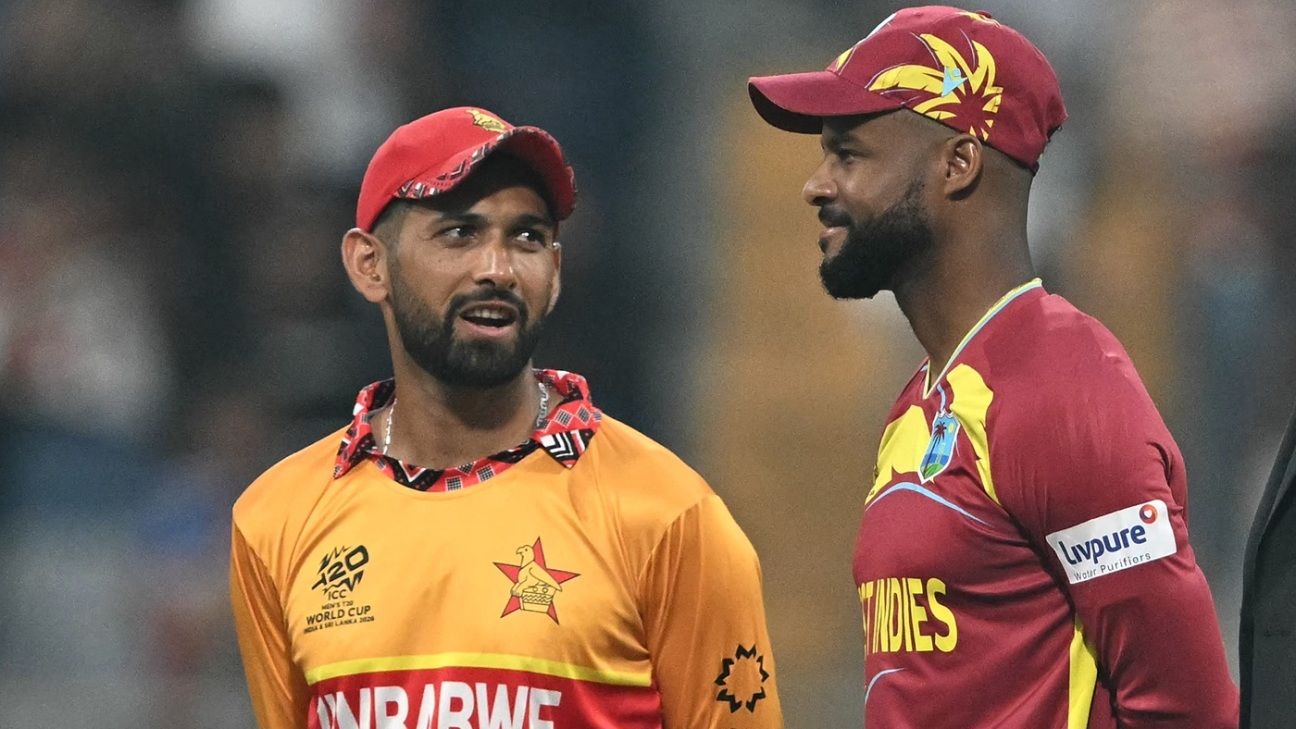
The Super Eight encounter between Zimbabwe and the West Indies at Mumbai’s Wankhede Stadium serves as a significant case study in data-driven tactical recalibration within the 2026 T20 World Cup. Zimbabwe captain Sikandar Raza’s decision to bowl first reflects an institutional reliance on venue-specific historical data, specifically leveraging the evening dew factor and the high boundary-clearance rates associated with the Wankhede surface. The strategic alignment between Raza and West Indies captain Shai Hope—who admitted a preference for the same trajectory—highlights a shared objective: minimizing the variables associated with defending a total in high-humidity conditions.
Zimbabwe’s Powerplay Mechanics: The Ngarava Factor
The reintegration of Richard Ngarava into the Zimbabwe XI marks a fundamental shift from defensive containment to aggressive verticality. By replacing left-arm spinner Wellington Masakadza with a high-release-point left-arm quick, Zimbabwe is prioritizing the exploitation of Wankhede’s inherent bounce. This adjustment is designed to disrupt the West Indies’ top-order rhythm, specifically targeting Brandon King and Shai Hope with angles that challenge the outside edge. The omission of Masakadza signals a strategic retreat from spin-heavy powerplay strategies, placing a higher premium on the middle-over execution of Sikandar Raza and Graeme Cremer.
Ngarava’s presence fundamentally alters the defensive geometry of the field. His ability to extract steep carry forces batters into vertical shot selections, which are high-risk maneuvers in the early overs. This operational pivot suggests Zimbabwe has identified a susceptibility in the West Indies’ batting core to high-velocity, angled deliveries, shifting their defensive posture to a proactive, wicket-seeking philosophy that seeks to neutralize power-hitters before the death-over phase.
West Indian Structural Redundancy and Seam Depth
The West Indies have mirrored this shift toward pace by reintroducing Romario Shepherd at the expense of Roston Chase. This move prioritizes seam-bowling redundancy over the middle-over stabilization typically provided by Chase’s off-spin. Shepherd’s return from injury provides Shai Hope with a high-impact asset capable of operating across all three phases of the innings. By maintaining Matthew Forde in the lineup alongside Shepherd and Jason Holder, the West Indies have constructed a pace-dominant triumvirate designed to exploit any latent assistance in the pitch, mitigating the risk of being targeted by Zimbabwe’s middle-order hitters on a traditionally flat surface.
This configuration leaves Akeal Hosein and Gudakesh Motie as the primary tactical differentiators. Hosein’s role as a powerplay specialist remains intact, but the overall burden of spin containment now falls on Motie. This structural adjustment suggests a bet on the pitch offering more to fast bowlers than slow bowlers under lights, while Shepherd’s lower-order batting capability ensures that the West Indies do not sacrifice depth for defensive utility.
Institutional Context and Global Positioning
Statistically, this match represents a rarity, being only the fifth T20I meeting between these two nations. This lack of head-to-head data forces both coaching staffs to rely on individual scouting and broader performance trends rather than historical matchup metrics. For Zimbabwe, the Super Eight stage is a vital institutional platform to demonstrate parity with traditional powerhouses, influencing future bilateral scheduling and ICC commercial valuations. For the West Indies, a win here is essential for maintaining their trajectory as a premier T20 power, reinforcing their development model focused on multi-disciplinary seam-bowling all-rounders.
Leadership Calculus and Match Trajectory
The tactical burden rests heavily on Sikandar Raza, whose multi-faceted role as captain, primary spinner, and middle-order anchor defines Zimbabwe’s operational ceiling. His ability to rotate Ngarava and Blessing Muzarabani effectively will determine if Zimbabwe can restrict the West Indies to a sub-par total. Conversely, Shai Hope must manage a lineup that lacks the stabilizing presence of Roston Chase, requiring the top order to balance aggression with calculated risk to set a target that can withstand the Wankhede chase bias. The result will likely hinge on which side better manages the final five overs of the first innings, where the West Indies’ power-hitting depth meets Zimbabwe’s revamped pace attack.