
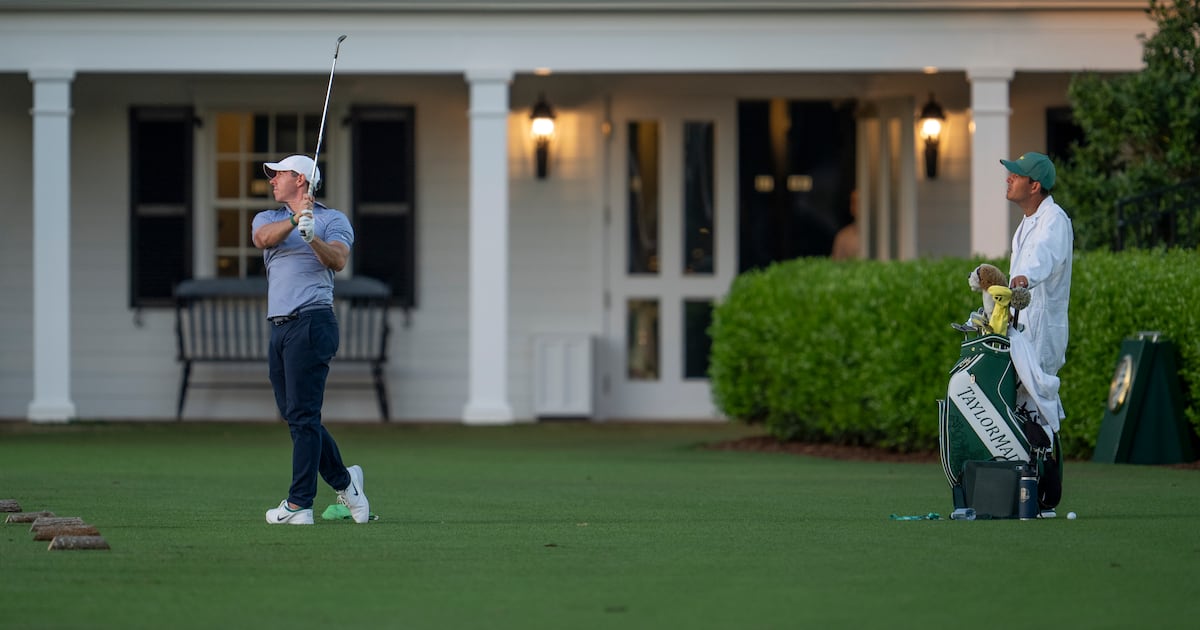
The modern golf economy has become increasingly indexed to the performance variance of Rory McIlroy. Brandel Chamblee’s characterization of McIlroy’s career as the ‘greatest rollercoaster in sport’ describes more than an athletic trajectory; it identifies a structural phenomenon that dictates media valuation, betting liquidity, and the field’s tactical responses. In the context of a major championship, McIlroy functions as a primary volatility driver, where his scorecard fluctuations influence the commercial solvency of the broadcast and the psychological equilibrium of the tournament field.
The Economics of Asymmetric Performance
Broadcasters like Sky Sports operate within a tension between predictable excellence and high-stakes collapse. While a dominant, wire-to-wire victory offers historical prestige, it often yields a ‘flat’ Sunday, depressing viewership in the high-value afternoon windows. Conversely, McIlroy’s propensity for extreme scoring swings—the ‘Rory Ride’—maximizes audience retention by maintaining uncertainty across the full 72-hole cycle. This creates a paradox where the athlete’s competitive instability is more commercially lucrative for the media ecosystem than a stable, dominant performance, placing unique psychological strain on the player to fulfill a narrative role as much as a competitive one.
Strategic Entropy and the Six-Shot Lead
Paul McGinley’s analysis of McIlroy’s early-round dominance highlights a critical shift in the field’s risk-reward calculus. A significant lead at Augusta National fundamentally alters the tournament’s strategic geometry. For the leader, the challenge transitions from aggressive birdying to defensive ‘par-centric’ management, often leading to a loss of the very momentum that established the lead. For the chasing pack, a large McIlroy advantage creates a ‘strategic vacuum’; mid-tier players often pivot to playing for podium finishes, assuming the lead is insurmountable, only to be caught off-guard when McIlroy’s inherent volatility reopens the door for the field.
Architectural Compatibility and Psychological Friction
Augusta National is frequently cited as McIlroy’s ‘spiritual home,’ a term reflecting the alignment between his high-launch ball flight and the course’s specific carry requirements. However, this architectural compatibility is offset by the psychological burden of the career Grand Slam. Sir Nick Faldo’s comparison of McIlroy to the England national football team suggests a systemic pattern of high-leverage underperformance. This suggests that the ‘spiritual home’ narrative may actually exacerbate mental fatigue, as the technical ease with which McIlroy can navigate the course is countered by the historical gravity of the elusive Green Jacket.
The Hunger Narrative and Brand Solvency
Pre-tournament discourse regarding McIlroy’s ‘hunger’ often serves as a proxy for concerns regarding his motivation in an era of guaranteed financial security. While his early-round performances typically rebut these claims, the persistence of the narrative reflects the PGA Tour’s reliance on McIlroy as a de facto spokesperson. His success is not merely a personal milestone but a strategic necessity for the Tour’s brand health. The ‘hunger’ debate underscores the institutional pressure to maintain a meritocracy where the game’s biggest stars remain its most desperate competitors.
Tactical Shadows: The Rise of the ‘Sneaky Winner’
Rich Beem’s identification of the ‘sneaky winner’ points to the tactical advantage of low-profile consistency. When media focus is hyper-saturated on a single star’s rollercoaster performance, it creates a ‘narrative shadow’ that allows steady-variance players to advance without the weight of public scrutiny. In the volatile environment of Augusta’s back nine, the ability to maintain emotional and tactical neutrality is a massive asset. McIlroy’s struggle to find this equilibrium often creates the opening for a lower-profile contender to capitalize on the chaos, turning the tournament into a clash between McIlroy’s high-ceiling talent and the field’s collective floor.
Conclusion: Managing the Variance
Ultimately, McIlroy’s journey at Augusta is a case study in the difficulty of managing high-variance outcomes under maximum pressure. The lessons of his performance patterns inform how future stars are developed and how media organizations frame the sport’s competitive stakes. Until McIlroy can synchronize his technical mastery of Augusta with a low-variance psychological approach, the ‘Rory Ride’ will remain the defining, albeit turbulent, feature of the modern Major era.
Photo by alboomen on Pixabay.