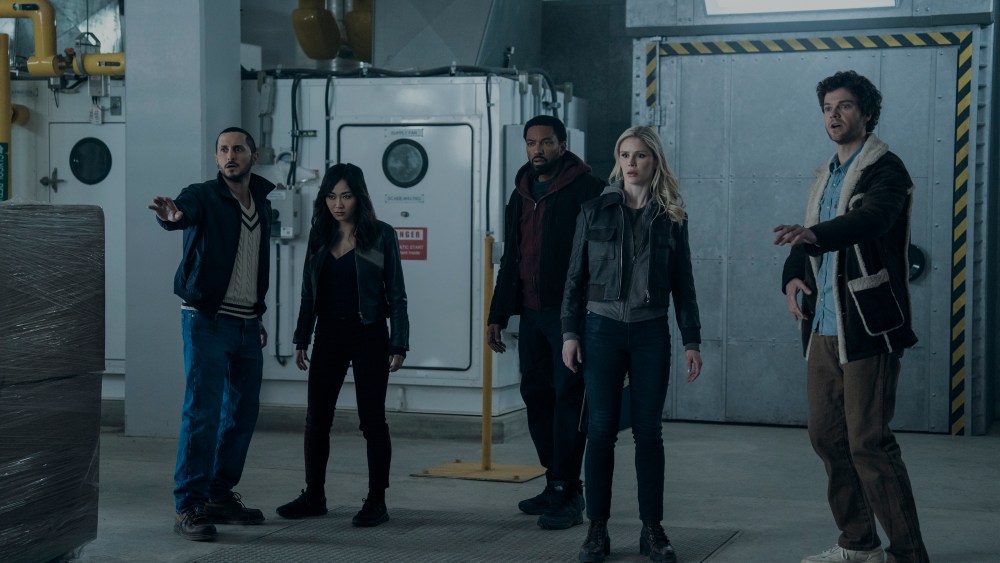
The fifth and final season of The Boys executes a paradigm shift, moving from the satire of late-stage capitalism toward an examination of institutional collapse and the consolidation of absolute power. By centering the narrative on the capture of the federal executive branch and the deployment of internment camps, the series explores the mechanics of a burgeoning supe-state.
Liquidation of Internal Dissent: The A-Train Pivot
The execution of A-Train by Homelander serves as a critical strategic pivot. Beyond the shock value, his death signifies the termination of moral ambiguity within the Seven. Previously, supes functioned as brand assets managed through PR discipline; under the new regime, they are rebranded as paramilitary tools subject to summary execution for perceived disloyalty.
Structurally, A-Train’s death provides narrative closure to the series’ inciting incident. By neutralizing the character responsible for the death of Robin Ward, the show signals that the stakes have escalated from Hughie Campbell’s personal vendetta to a systemic struggle for national survival. The era of individual agency has been replaced by a culture of absolute loyalty or total liquidation.
Institutional Capture and the ‘Freedom Camp’ Infrastructure
Vought’s evolution into a state-level apparatus is codified through the establishment of ‘Freedom Camps.’ These facilities represent more than detention centers; they are logistical hubs for the suspension of constitutional protections. Vought has effectively bypassed market pressures and judicial oversight, moving from a defense contractor to a sovereign power with a monopoly on state-sanctioned violence.
The imprisonment of the Butcher crew highlights this erosion of law. With Homelander as the de facto overlord and Sage providing strategic intellectual defense, the regime has achieved total capture of the federal executive. The brand’s value is no longer dictated by consumer sentiment, but by the enforcement of public submission through terror.
Post-Truth Warfare: The Flight 37 Liability
The release of the Flight 37 footage demonstrates the limitations of legacy scandals in a radicalized political landscape. Where this revelation once threatened Vought’s market valuation, it is now mediated by a base that prioritizes ideological victory over moral accountability. Homelander’s lingering psychological vulnerability to social media perception persists, yet his ability to reframe damaging narratives in real-time illustrates the regime’s control over the information ecosystem.
Operational Constraints of the Resistance
The Butcher crew faces unprecedented operational paralysis. Transitioning from a clandestine hit squad to high-profile political targets, the loss of their primary speedster asset and the incarceration of key members severely limits their offensive capabilities. As traditional avenues of resistance—legal, media, and corporate—are co-opted, the remaining insurgents must pivot from targeted hits to dismantling the foundational infrastructure of the supe-state.
Franchise Continuity and the Creator’s Vision
The announcement of the Vought Rising prequel provides a historical lens for the current crisis, detailing the decades of moral compromise that allowed a corporation to supersede the state. Showrunner Eric Kripke’s commitment to a definitive ending ensures narrative integrity, positioning the final conflict as a zero-sum struggle between accountability and unchecked power.