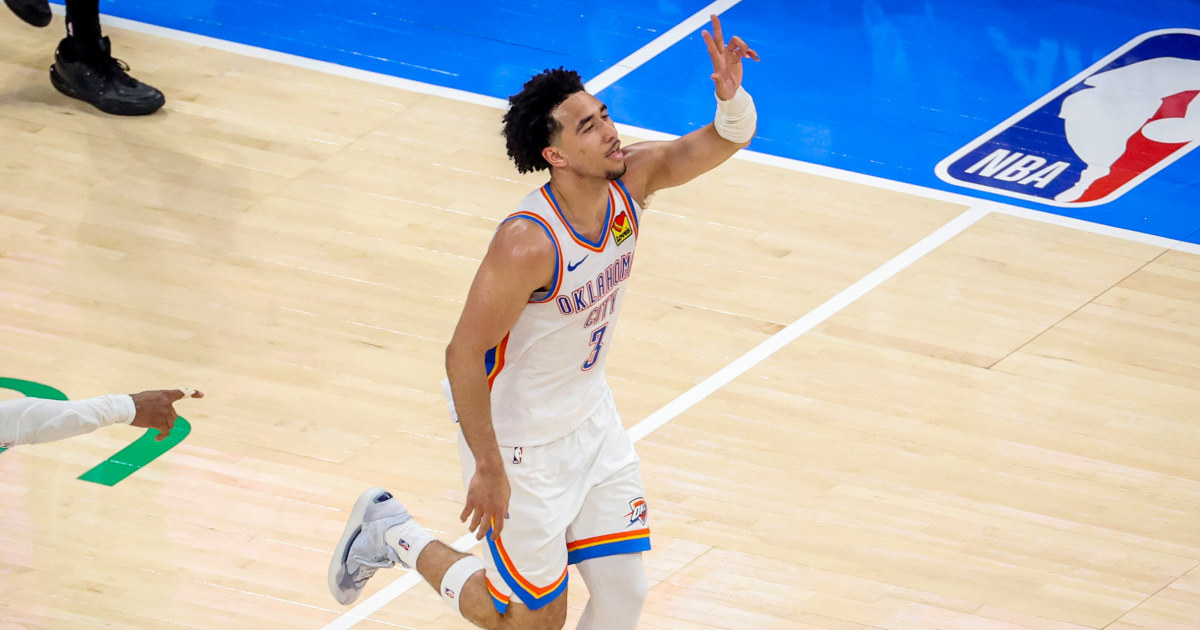
The Western Conference finals reached a critical tactical inflection point following the Oklahoma City Thunder’s 127-114 victory over the San Antonio Spurs in Game 5. By establishing a 3-2 series lead, the Thunder stand one win away from securing their second consecutive NBA Finals appearance. This pivotal matchup demonstrated how strategic roster construction and dynamic in-series adjustments can offset acute personnel deficits under high-stakes postseason conditions.
Mitigating Attrition Through Positional Redundancy
Postseason success is fundamentally tethered to physical durability, often forcing coaching staffs to redesign tactical frameworks on short notice. Entering Game 5, Oklahoma City faced significant operational challenges due to the consecutive absences of injured All-Star forward Jalen Williams and reserve guard Ajay Mitchell. Losing an All-Star forward typically disrupts offensive flow and defensive rotations by forcing a massive redistribution of usage rate and defensive matchups across the remaining rotation.
Rather than succumbing to these structural vulnerabilities, the Thunder leveraged their organizational philosophy of positional versatility. By utilizing a system built on redundant skill sets, OKC maintained its competitive baseline. Their secondary rotations seamlessly absorbed the missing minutes, mitigating the efficiency drops usually observed when a short-handed roster faces elite competition late in a playoff series.
Jared McCain’s Tactical Integration and Spatial Spacing
Inserting rookie guard Jared McCain into the starting lineup for his first career playoff start was a calculated risk that fundamentally altered the series’ physical geography. McCain contributed 20 points, offering high-level perimeter gravity that prevented San Antonio’s defense from packing the paint. His performance illustrates the value of developmental programs that prepare reserve players to execute complex tactical schemes under intense playoff pressure.
McCain’s insertion forced the Spurs’ coaching staff to abandon their preferred help-side defensive assignments. By demanding constant defensive attention, the rookie alleviated playmaking pressure on the primary ball-handlers. This shift highlights how coaching staffs can deploy unheralded roster assets to disrupt an opponent’s scouted defensive game plan.
Bench Unit Efficiency as a Performance Lever
While starting lineups dictate the initial tactical matchups, bench units frequently decide high-possession postseason games. In Game 5, the reserve trio of Alex Caruso, Kenrich Williams, and Cason Wallace combined for 37 points, sustaining OKC’s offensive pace and defensive intensity. This collective impact allowed the Thunder to rest their primary stars without suffering the typical regression in net rating.
A productive bench does more than score; it accelerates the physical fatigue of the opponent’s primary defenders. By maintaining transition pressure across multiple waves, OKC forced San Antonio to defend a wider variety of pick-and-roll configurations. This depth-driven strategy functions as a wear-down mechanic, shifting the physical burden of the series onto a top-heavy Spurs rotation as games enter the fourth quarter.
Superstar Gravity and Spatial Economics
Even with substantial secondary contributions, the Thunder’s offensive engine remains anchored by the elite playmaking of Shai Gilgeous-Alexander. His 32-point performance in Game 5 acted as the primary catalyst, consistently breaking down San Antonio’s point-of-attack defense. Gilgeous-Alexander’s ability to generate efficient looks from the midrange and paint creates immense defensive gravity, forcing defenders to sag off perimeter targets.
This defensive gravity directly optimized the scoring efficiency of the supporting cast. When opposing defenses collapse to contain an MVP finalist, passing lanes open up, yielding higher-quality, uncontested catch-and-shoot looks. This synergy between superstar gravity and role-player execution represents the peak operational efficiency of modern five-out basketball, especially when neutralizing elite rim protectors like San Antonio’s Victor Wembanyama.
Game 6 Strategic Outlook in San Antonio
With a 3-2 lead, the series shifts back to San Antonio, where the Thunder face the difficult task of closing out a series on the road. Securing a deciding game in a hostile arena demands strict execution and emotional composure. The Spurs, anchored by the unique defensive wingspan and offensive versatility of Victor Wembanyama, will likely adjust their drop coverage and rim-protection schemes to counter OKC’s spacing.
For the Thunder, the core challenge in Game 6 lies in replicating their high-efficiency offensive output on the road, where role players historically experience a drop in shooting percentages. The coaching staff must decide whether to retain the small-ball configurations that unlocked Game 5 or pivot back to traditional rotations depending on the health of their injured starters. This ongoing tactical chess match defines the margin of error in deep postseason runs.
Institutional and Media Perspectives
The broader narrative surrounding the Western Conference finals has captured national attention, with sports desks like NBC News highlighting the shift toward organizational depth over pure superstar reliance. This analytical pivot emphasizes that modern NBA success relies on complete roster construction rather than top-heavy star pairings. The success of small-market franchises like OKC and San Antonio demonstrates that disciplined drafting and patient player development remain viable pathways to championship contention, shifting how league front offices approach asset management and team building.