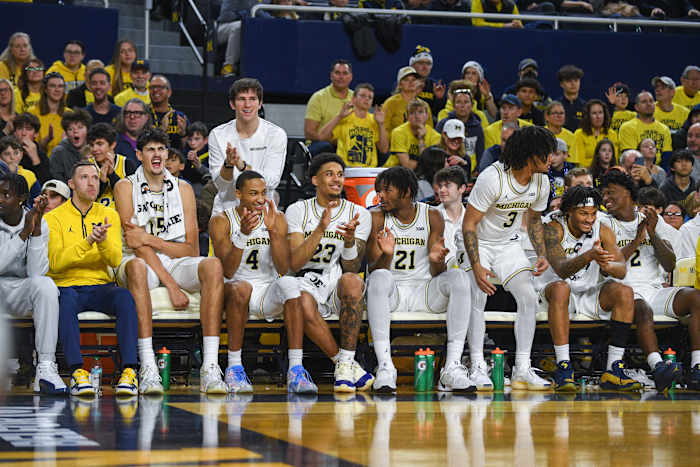
The third-ranked Michigan Wolverines (25-2, 15-1 Big Ten) enter Tuesday’s matchup against the Minnesota Golden Gophers at a critical intersection of historical milestone and championship finality. Beyond the immediate objective of clinching a share of the program’s 16th Big Ten regular-season title, the Wolverines are positioned to secure their 100th all-time victory against Minnesota—a centennial feat previously achieved against only Iowa, Michigan State, and Northwestern. This matchup serves as a high-leverage opportunity to transform statistical dominance into tangible conference hardware.
Statistical Volatility and Defensive Thresholds
Despite Michigan’s 59-22 historical advantage in Ann Arbor, recent series trends introduce a layer of competitive volatility. Minnesota has secured victories in two of the last three meetings at the Crisler Center, including an 84-81 overtime upset in January 2025. This pattern highlights Michigan’s intermittent vulnerability to Minnesota’s late-game execution. However, the current season presents a staggering 21.9-point scoring disparity: Michigan averages 89.6 points per game against a Minnesota defense that typically permits 67.7. For the Golden Gophers (13-14, 6-10), the challenge is not merely tactical but operational, requiring them to suppress an offense operating at elite efficiency.
Rebounding Efficiency and Interior Gravity
Michigan’s structural superiority is anchored by its defensive rebounding rate, currently ranked fifth nationally at 27.8 boards per game. This metric functions as a transition catalyst, limiting second-chance opportunities while fueling the Wolverines’ high-octane offense. Yaxel Lendeborg remains the primary engine of this system, averaging 14.6 points and 7.5 rebounds. Complementing Lendeborg is Morez Johnson Jr., whose 63.9% field-goal efficiency over the last ten games creates an interior gravity that forces opposing defenses to over-rotate, leaving perimeter lanes vulnerable.
Strategic Branding and Postseason Trajectory
The institutional decision to brand this sell-out as the “Pool(e) Party” reflects a sophisticated commercial strategy to maximize home-court leverage for a Tuesday night national broadcast. While the thematic atmosphere engages the student body, the analytical focus remains on postseason positioning. A victory provides Michigan a strategic buffer to manage roster health ahead of the Big Ten Tournament. Conversely, Minnesota seeks a high-profile upset to recalibrate their standing, relying on Cade Tyson’s high-volume scoring to disrupt Michigan’s restrictive defensive schemes, which currently hold opponents to a 37.4% shooting average.