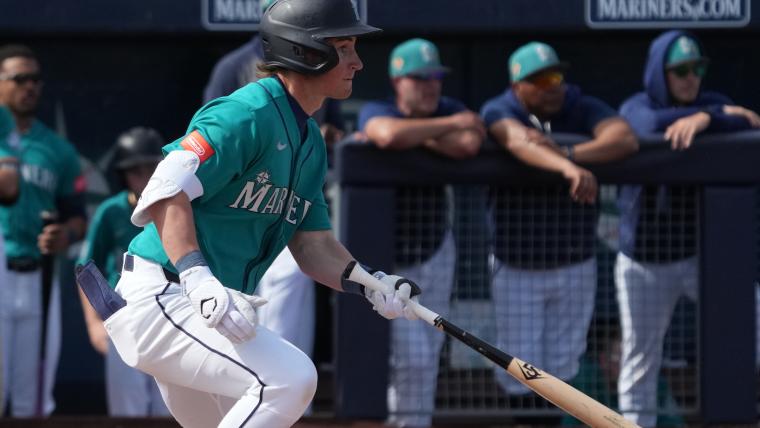
The Seattle Mariners have finalized an unprecedented eight-year contract extension with consensus top shortstop prospect Colt Emerson, guaranteeing $95 million, according to reports from Robert Murray.
This agreement decisively establishes a new industry benchmark for guaranteed money awarded to a player lacking any Major League service time, surpassing the previous record, set by Jackson Chourio, by a substantial $13 million margin.
The structure incorporates a club option for a ninth season, which, contingent upon performance incentives, could escalate the total commitment beyond $130 million. This represents a calculated organizational maneuver to secure Emerson’s cost-controlled years preemptively.
Strategic Pivot: Pre-Debut Control Acquisition
Committing nearly nine figures to an unproven prospect signals a fundamental strategic shift for the Mariners. This pivot prioritizes long-term roster certainty and control over conventional service time accumulation models, which expose teams to arbitration inflation.
By securing a consensus top-10 prospect immediately, Seattle mitigates the inherent volatility of development timelines, effectively purchasing the most cost-effective years of his prime at a premium, predetermined valuation. This contrasts sharply with waiting for service-time triggers or initial MLB success to negotiate extensions.
Incentive Alignment and Leverage Exchange
Represented by ACES, Emerson gains significant immediate financial security, notably including a full no-trade clause—a rare protection for a player yet to debut. The inclusion of a no-trade clause strongly signals the Mariners’ intent to view Emerson as a foundational, non-moveable asset, regardless of short-term performance fluctuations.
The incentive structure, offering $35 million in potential escalators, aligns Emerson’s compensation with elite performance realization, ensuring scalability beyond the $95 million floor.
Operational Context and Immediate Roster Integration
Emerson’s accelerated minor league trajectory—evidenced by a strong 13.1% walk rate in High-A (2025) and a subsequent .293/.383/.470 slash line across Double-A and Triple-A in 2026—validated the organization’s high internal valuation, necessitating immediate long-term planning.
The timing of the extension aligns critically with current roster dynamics, specifically the injury absence of starting shortstop J.P. Crawford. This vacuum positions Emerson for immediate integration, supported by the financial stability of the new long-term deal.
Leverage Shift: Security Over Arbitration
Coupled with existing long-term commitments to core players like Julio Rodriguez and Cal Raleigh, this extension underscores Seattle’s aggressive philosophy toward talent retention. The preemptive measure secures necessary infield depth before external market forces inflate his value past manageable thresholds.
The readiness to promote a 20-year-old to the Major League shortstop role, underpinned by this long-term financial commitment, suggests organizational readiness to absorb developmental growing pains associated with the position.
Industry Repercussions on Prospect Valuation
This record pre-debut contract immediately recalibrates industry expectations for elite, near-MLB-ready prospects. Organizations holding players with similar advanced plate discipline and power metrics in the upper minors will face increased pressure to offer comparable financial security.
The $13 million gap over the former record holder reflects a substantial upward revision in the perceived present value of projected future MLB performance for players deemed near-certainties for stardom.
Capital Allocation Re-evaluation
For front offices, this transaction forces a re-evaluation of capital allocation, weighing guaranteed, long-term control against the escalating cost curve of standard arbitration. The calculation favors upfront expenditure when a prospect’s peak projected value is exceptionally high.
The Mariners are front-loading earnings, trading short-term cash flow flexibility for long-term salary predictability, a structure beneficial for managing payroll volatility years in advance.
Institutional Confidence and Cultural Signaling
The magnitude of this commitment sends a powerful cultural message regarding the Mariners’ belief in their scouting and development infrastructure. Securing a top prospect on such favorable long-term terms reinforces the organizational narrative of identifying and retaining foundational talent.
Competitive Landscape Exposure
This extension strategically removes a high-value asset from the trade market for the foreseeable future, forcing competitors to pivot their acquisition strategies for elite young middle-of-the-field talent. Furthermore, the significant guarantee sets a high internal valuation marker for the shortstop position within Seattle’s organizational salary structure.
Analysis of Control Mechanisms
The eight-year term plus the ninth-year option secures a potential 10-year window of organizational control, capturing Emerson’s presumed peak earning years that typically commence post-arbitration and extend through early free agency.
Agent Sophistication and Precedent Setting
The negotiation, brokered by ACES, successfully leveraged Emerson’s high consensus ranking and immediate readiness to extract veteran-level protections (no-trade clause) prior to debut. This outcome will be a primary citation point for agents representing similarly profiled prospects across MLB.
Long-Term Certainty vs. Immediate Expenditure
While the $95 million guaranteed is a significant liability for an unproven MLB asset, it acts as a hedge against the exponential costs associated with a player of Emerson’s projected talent navigating the standard arbitration process.
Context of Existing Core Commitments
Placing Emerson within the existing structure of long-term contracts (Raleigh, Rodriguez) suggests management views the current competitive window as open enough to justify immediate, aggressive investment in foundational talent, rather than awaiting contract maturation.
Operational Urgency and Performance Justification
The injury contingency involving J.P. Crawford likely accelerated the finalization timeline, providing the perfect inflection point to integrate Emerson immediately, using the contract as a stabilizing factor. The decision to potentially deploy him at shortstop underscores organizational confidence in his defensive acumen and offensive profile translating directly to the Majors.
Statistical Validation
Emerson’s elite walk rate and power production across advanced minor league levels serve as the quantitative justification for this financial outlay. His early success in Triple-A confirmed the performance translation required to trigger this maximum organizational commitment.
Concluding Strategic Evaluation
The Mariners’ record-setting, long-term commitment to Colt Emerson is a high-stakes strategic maneuver predicated on deep organizational conviction regarding his elite projection. It fundamentally redefines the financial risk profile for managing top-tier prospects by moving toward immediate control acquisition. The success of this structure is contingent on Emerson validating the aggressive pre-emptive valuation through sustained Major League dominance.