
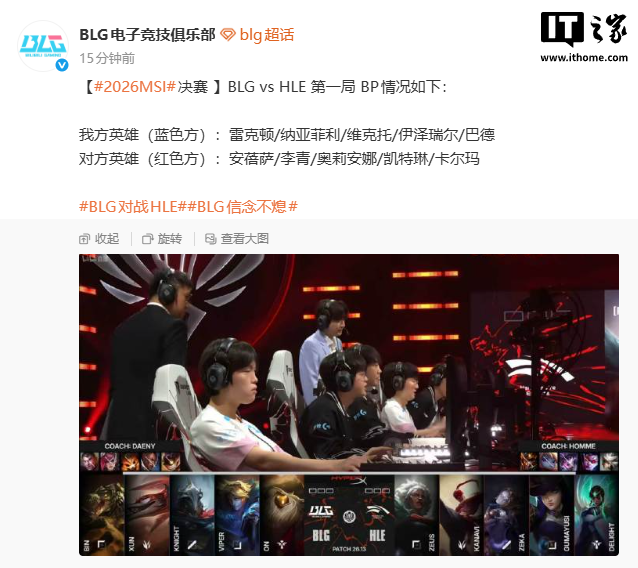
The Grand Final of the 2026 League of Legends Mid-Season Invitational (MSI) in Daejeon, South Korea, represents a critical strategic juncture in the LPL-LCK regional rivalry. Bilibili Gaming (BLG) enters the ultimate match against Hanwha Life Esports (HLE) with substantial analytical momentum, having executed a decisive 3-1 upper-bracket victory over them on July 9. This highly anticipated rematch not only decides the mid-season champion but also tests the operational limits of both organizations under the tournament’s revamped structural regulations.
The Strategic Demands of the Fearless Draft Format
The mandatory integration of the Fearless Draft format across the best-of-five (BO5) knockout stage has fundamentally re-engineered professional pick-and-ban theory. By banning previously played champions within a series, the format penalizes shallow champion pools and rewards systemic roster versatility. Traditional reliance on static, meta-dominant compositions has been replaced by dynamic, real-time tactical adaptation, shifting the competitive advantage to organizations with deep analytical preparation.
For BLG and HLE, navigating these constraints requires meticulous resource management and forward-looking pick-and-ban pathing. Coaching staffs must balance immediate game-state optimization against the risk of depleting key champion pools for subsequent matches. This operational pressure exposes depth vulnerabilities, forcing players to adapt without the safety net of comfort picks during the late stages of a series.
Furthermore, the Fearless Draft format elevates the utility of versatile flex picks, allowing teams to obscure their strategic intent. The analytical burden on support staff has multiplied, requiring real-time statistical modeling of remaining champion pools. Consequently, the organization demonstrating superior draft-pathing and tactical asset preservation will hold a decisive advantage in the Grand Final.
Regional Seed Allocation and Franchise Capitalization
Beyond the immediate prestige of international silverware, the tournament outcomes carry profound structural consequences for regional league ecosystems. Under the 2026 MSI rules, the top two performing regions earn an additional qualification slot for the upcoming World Championship. By securing their Grand Final berth, BLG has locked in a critical fourth World Championship seed for the LPL, fundamentally shifting the competitive stakes of the upcoming domestic Summer Split.
This additional seed provides a vital safety net for high-budget LPL franchises, reducing the financial and competitive volatility of domestic qualification. Securing a fourth slot stabilizes sponsor valuations and investor confidence, ensuring more top-tier organizations retain a viable path to the global stage. Conversely, the high-stakes MSI environment acts as a structural filter, directly influencing capital allocation and roster construction strategies for the subsequent competitive cycle.
For the LCK, the pressure to secure the remaining premium seed has intensified the domestic competition between elite franchises like HLE and T1. The financial implications of missing out on an extra global slot are substantial, affecting merchandise sales, media rights distribution, and brand equity. Thus, the competitive results in Daejeon establish a direct economic feedback loop shaping the financial health of the participating regional ecosystems.
Bracket Asymmetry and Rematch Dynamics
BLG’s path to the Grand Final highlights the structural benefits of the double-elimination system, which rewards upper-bracket resilience. Having defeated T1 in a grueling five-game series on July 4, swept LYON, and subsequently dispatched HLE 3-1 on July 9, BLG earned direct passage to the final. This trajectory granted the LPL champions valuable recovery time and an opportunity to analyze HLE’s lower-bracket recovery matches without exposing further strategic assets.
In contrast, HLE was forced to navigate the volatile lower bracket to earn their rematch, exposing their tactical adjustments and champion preferences to BLG’s analytical staff. While this additional stage time allowed HLE to refine their execution under pressure, it also provided BLG with a comprehensive blueprint of their opponent’s adaptive capabilities. The psychological leverage of the prior 3-1 victory further bolsters BLG’s positioning, establishing a clear baseline of tactical superiority that HLE must actively disrupt.
The rematch dynamic under the Fearless Draft format introduces unique complexity, as both teams must account for the strategic data gathered during their July 9 encounter. HLE must identify and correct the specific draft vulnerabilities that led to their upper-bracket defeat, while BLG must anticipate these adjustments. This tactical chess match elevates the importance of the opening game, where the initial draft choices will signal each team’s overarching strategic adjustments.
Individual Milestones and Organizational Longevity
The tournament has also highlighted individual competitive longevity, exemplified by BLG top laner Bin becoming the first player in LPL history to reach four MSI finals. This milestone underscores the critical role of experienced leadership in navigating high-pressure international environments. Bin’s ability to maintain peak performance across different meta-game shifts and roster iterations provides BLG with a stable competitive anchor.
From an organizational perspective, BLG’s third consecutive appearance in an MSI final validates their long-term scouting, player development, and coaching infrastructure. Sustaining this level of international success requires a highly functional support system capable of managing player burnout and maintaining analytical rigor over extended competitive seasons. This structural stability contrasts with organizations that experience rapid performance decay following roster changes or coaching staff turnover.
The performance of key players under the Fearless Draft format also serves as a benchmark for future talent acquisition. Teams are increasingly prioritizing players with diverse champion profiles and high tactical IQ over mechanical specialists. Bin’s historic run demonstrates that adaptability and mental resilience are the primary drivers of sustained competitive relevance in the modern era.
The Daejeon Context and Regional Supremacy
Hosting the 2026 MSI in Daejeon, South Korea, has intensified the geopolitical and cultural rivalry between the LPL and LCK. Playing on opponent territory, BLG has systematically dismantled the LCK’s top representatives, achieving a “double kill” by defeating both T1 and HLE in successive bracket matches. The prospect of securing a “triple kill” in the Grand Final on South Korean soil adds a layer of regional prestige that transcends the immediate tournament stakes.
For the LCK, defending their home turf is of paramount importance to maintain their status as the premier competitive region. The pressure on HLE to reverse the previous result and prevent an LPL coronation in Daejeon is immense, affecting both player psychology and fan sentiment. This intense regional rivalry drives high viewership and engagement metrics, reinforcing the commercial viability of the global esports ecosystem.
Ultimately, the 2026 MSI Grand Final serves as a definitive test of regional supremacy and strategic innovation. The structural changes introduced this season, from the Fearless Draft to the revised seed allocation rules, have elevated the stakes of every match. As the first game commences in Daejeon, the immediate tactical execution will reveal which organization has truly mastered the complexities of the modern competitive landscape.

Photo by Pexels on Pixabay.