The Institutional Breach of the Iranian Executive
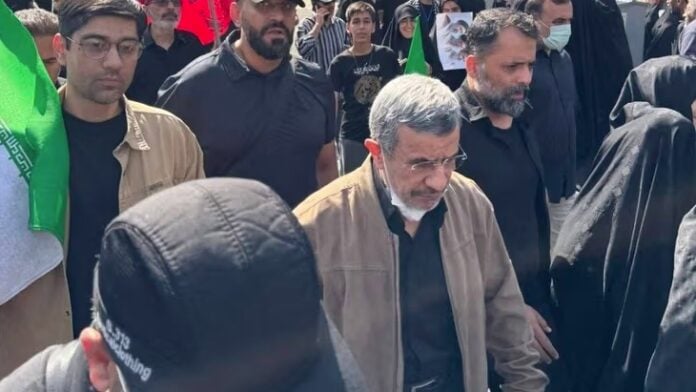
The reported house arrest of former Iranian President Mahmoud Ahmadinejad by the Islamic Revolutionary Guard Corps (IRGC) intelligence branch signifies a critical rupture in the Islamic Republic’s internal security architecture. This development suggests a profound vulnerability within the counter-intelligence apparatus, indicating that external influence has penetrated the highest echelons of the former executive branch. The targeting of a former head of state signals a transition in IRGC domestic strategy: moving beyond the suppression of grassroots dissent toward the systematic containment of high-profile political figures deemed a risk to regime stability.
The Budapest Interface and Academic Subterfuge
Central to the alleged Israeli operation was the ‘Budapest Protocol,’ utilizing academic and diplomatic covers to bypass traditional surveillance. Ahmadinejad’s invitation to a climate summit at Ludovika University of Public Service serves as a case study in the weaponization of third-party venues for clandestine statecraft. The involvement of senior Hungarian officials in facilitating this invitation highlights the use of semi-aligned states as operational hubs. For Ludovika’s rector, Gergely Deli, the event represented a high-stakes calculation where academic legitimacy was leveraged to provide cover for strategic intelligence exchanges between historical adversaries.
Doctrine of Internal Subversion: Asset Cultivation
The Mossad’s alleged objective—cultivating Ahmadinejad as a strategic asset for a post-regime change transition—points to a refined doctrine of internal subversion. Rather than imposing external governance models, this strategy prioritizes the co-opting of existing populist infrastructure. By targeting a figure with an established power base, intelligence agencies seek to minimize the friction of leadership transitions. However, the IRGC’s interception of these contacts demonstrates a sophisticated monitoring capability that remains focused on marginalized members of the political elite who might leverage foreign support to regain domestic influence.
Counter-Intelligence Recalibration and Proxy Dynamics
This internal purge occurs against a backdrop of regional volatility. In Yemen, the strategic restraint shown by Rashad al-Alimi’s government—refusing to escalate against Houthi forces following the Sanaa airport incident—illustrates a conscious effort to avoid Iranian-led escalatory traps. Simultaneously, the IRGC uses the Ahmadinejad case to consolidate its role as the ultimate arbiter of national loyalty, reinforcing its mandate to override the traditional immunity of former officials. This dual-track approach—securing the domestic core while managing regional proxies—defines Iran’s current defensive posture in the ongoing shadow war.
Conclusion: The Evolution of the Shadow War
The exposure of the Budapest meeting and the subsequent crackdown mark a new chapter in Iran-Israel relations, where the battlefield has shifted from nuclear facilities to the integrity of the political leadership. The incident serves as a definitive warning to neutral states and academic institutions: the intersection of statecraft and scholarly exchange is increasingly fraught. As the IRGC moves to create a more monolithic, insular power structure, the risk of alienating populist segments remains, even as they successfully neutralize immediate external subversion threats.