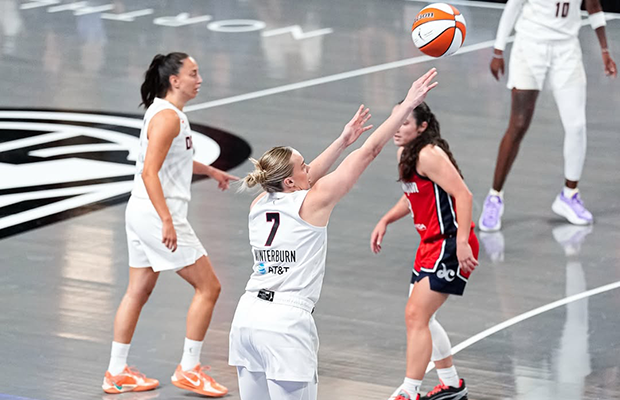
The WNBA landscape in 2026 represents a fiscal inflection point: the record-breaking Collective Bargaining Agreement (CBA) has significantly elevated athlete compensation, yet it has simultaneously triggered a period of unprecedented roster compression. The Atlanta Dream’s eleventh-hour waiver of British guard Holly Winterburn—occurring just as the team prepared for its inaugural road trip—serves as a high-stakes case study in the league’s evolving operational ruthlessness.
While the CBA was designed to enhance franchise valuation and player wealth, it has narrowed the margin for error for front offices. The mandate to optimize salary cap efficiency for immediate championship contention now frequently outweighs the long-term value of developmental talent. Winterburn’s dismissal suggests a shift in strategic calculus where positional depth and financial flexibility take precedence over pre-season statistical dominance.
Market Liquidity and the High-Stakes Training Camp Contract
Training camp contracts function as low-risk, high-reward instruments for franchises to vet international prospects without incurring long-term dead-cap hits. For Winterburn, a standout from Greece’s Athinaikos, the transition to the WNBA necessitated an immediate translation of European tactical efficiency into the league’s high-velocity environment. Despite leading the Dream with 12 points against the Washington Mystics, she fell victim to the structural constraints of a 12-woman roster.
Her release underscores a systemic reality: in a league where roster spots are the scarcest resource in professional sports, individual scoring metrics are secondary to a player’s fit within a rigid salary structure. The timing of the move—the infamous ‘bus waiver’—highlights a lack of roster liquidity, where late-breaking veteran availability or marginal cap adjustments can instantly render a top performer redundant.
The CBA Paradox: Heightened Compensation vs. Diminished Job Security
The 2026 CBA has birthed a professional paradox. As minimum salaries and veteran caps rise, the ‘opportunity cost’ of holding a non-guaranteed developmental player increases exponentially. Teams are increasingly adopting a transactional ‘Plug-and-Play’ model, prioritizing immediate Return on Investment (ROI) over the patience required for international or rookie acclimation.
This trend is exemplified by the Golden State Valkyries cutting fan-favorite Kate Martin. For an expansion franchise to release a high-profile asset suggests that the pressure to establish a winning culture from ‘Day Zero’ is overriding the traditional grace period granted to new organizations. This bottleneck is an institutional failure of the market to expand at the same rate as the talent pool, forcing elite athletes into early displacement.
International Pipeline Attrition and Global Market Friction
The waiver of Winterburn has ripple effects across the international talent pipeline. For British basketball, her inclusion was a symbol of regional growth; her sudden exclusion highlights the friction between FIBA-style ecosystems and the WNBA’s restrictive contract framework. The risk is that international prospects may begin to view the WNBA as an unreliable career path, opting for multi-year stability in the EuroLeague over the volatility of North American training camps.
Franchises must now manage a delicate reputational balance. The human cost of ‘business decisions’ is increasingly scrutinized on social media, where players like Winterburn and Martin are leveraging their personal brands to control the narrative. By framing their departures as results of systemic scarcity rather than personal failure, they maintain their professional currency for future free agency.
Institutional Conclusion: The Expansion Imperative
The WNBA’s current volatility is a symptom of a league that has outgrown its own infrastructure. Until roster expansion or the addition of more franchises occurs, the benefits of the CBA will remain concentrated among a small elite, while ‘middle-class’ and developmental players face an increasingly precarious employment landscape. The ‘bus waiver’ is no longer an anomaly; it is an inherent feature of a hyper-competitive, high-valuation sports economy that waits for no one.